
Samkhya In Abhidharmakosa Bhasya
Added to library: September 2, 2025
Summary
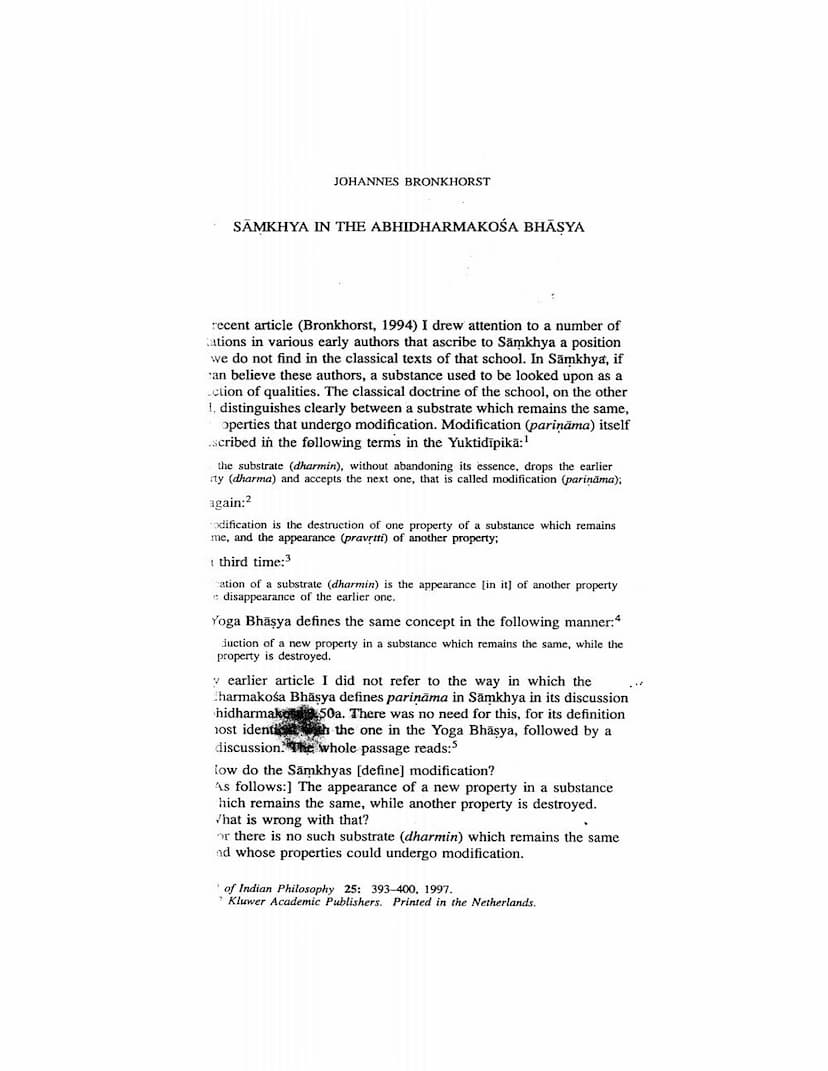
This article, "Samkhya in the Abhidharmakośa Bhāṣya" by Johannes Bronkhorst, examines how the influential Buddhist text Abhidharmakośa Bhāṣya, authored by Vasubandhu, presents and critiques the Samkhya school of Indian philosophy, particularly regarding the concept of parināma (modification).
Bronkhorst begins by highlighting earlier research that identified non-classical interpretations of Samkhya in certain texts. He then focuses on the Abhidharmakośa Bhāṣya's discussion of parināma. According to the classical Samkhya texts like Yuktidīpikā and Yoga Bhāṣya, parināma is defined as a substrate (dharmin) that remains the same while shedding one quality (dharma) and adopting another.
The Abhidharmakośa Bhāṣya passage in question presents a dialogue between a Buddhist and a Samkhya. The Samkhya explains parināma as the appearance of a new property in a substance that remains the same, while another property is destroyed. The Samkhya further clarifies that the substrate is not distinct from its properties; rather, modification is simply the "becoming otherwise of that very substance." The Buddhist criticizes this by arguing that no such unchanging substrate exists.
Bronkhorst then contrasts the Sanskrit original with Louis de la Vallée Poussin's French translation. While the Sanskrit text appears to present classical Samkhya, Poussin's translation suggests a pre-classical Samkhya view where a substance is nothing more than a collection of properties. Bronkhorst investigates the commentary by Yaśomitra (Sphuṭārtha Abhidharmakośa Vyākhyā) to understand this discrepancy.
Yaśomitra's commentary on the Abhidharmakośa Bhāṣya reveals a crucial point regarding the interpretation of "a substance which remains the same." Yaśomitra explains this as "constituted of color, taste, and so on." This suggests that, even within the context of Vasubandhu's critique, there was an understanding of Samkhya where substance was primarily defined by its qualities, rather than a distinct underlying substrate.
Bronkhorst notes that a different reading of the Abhidharmakośa Bhāṣya exists, adopted by editors like Dwarikadas Shastri. This alternative reading attributes sentence (b) to the Buddhist critic, Vasubandhu, rather than the Samkhya. If this reading is correct, it means Vasubandhu himself is arguing against the existence of an unchanging substrate, aligning with a Buddhist perspective.
The article concludes that La Vallée Poussin's translation might have been influenced by an interpretation that linked Vasubandhu's critique of Samkhya to a pre-classical Samkhya position, possibly due to his lack of access to the Sanskrit original. However, an examination of Yaśomitra's commentary suggests that Vasubandhu's critique was directed at a Samkhya view where substance is constituted by its qualities. Bronkhorst also touches upon Leo M. Pruden's English translation, which followed Poussin's but also had access to the Sanskrit, and observes that the tendency to present this pre-classical view persists.
In essence, the article explores the nuances of how Buddhist philosophers like Vasubandhu understood and criticized the Samkhya concept of modification, highlighting the importance of accurate textual interpretation and commentary in understanding these complex philosophical debates. The core of the discussion revolves around whether Abhidharmakośa Bhāṣya presents classical Samkhya's dualistic concept of substrate and qualities or an earlier, more monistic view where substance is inseparable from its qualities.