
Sambandha And Abhisambandha
Added to library: September 2, 2025
Summary
Here's a comprehensive summary of Ashok Aklujkar's "Sambandha And Abhisambandha" in English:
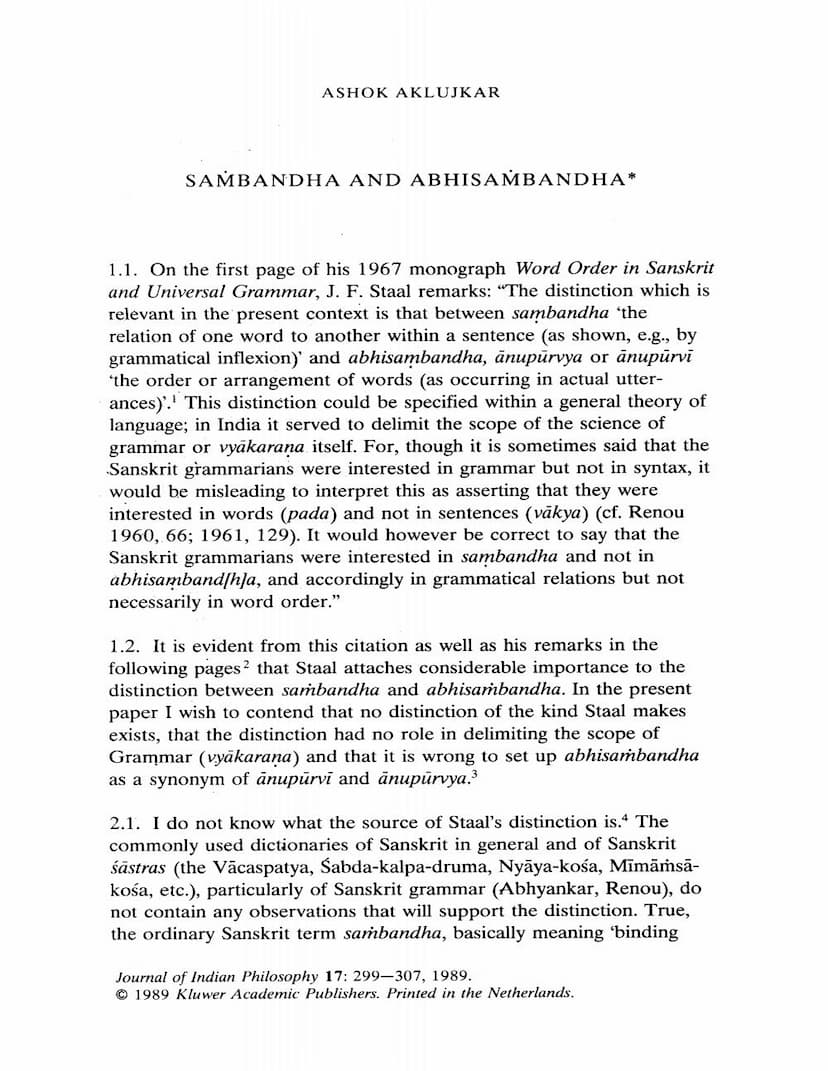
Ashok Aklujkar's article "Sambandha And Abhisambandha" directly challenges the distinction proposed by J.F. Staal in his 1967 monograph, "Word Order in Sanskrit and Universal Grammar." Staal argued that Sanskrit grammarians distinguished between sambANDHA, the relation of one word to another within a sentence (often shown by grammatical inflection), and ABHISAMBANDHA (also referred to as anupūrvya or anupūrvi), the actual order or arrangement of words in an utterance. According to Staal, this distinction delimited the scope of Sanskrit grammar (vyākaraṇa), with grammarians focusing on sambANDHA (grammatical relations) rather than ABHISAMBANDHA (word order).
Aklujkar argues forcefully against this interpretation, asserting that:
-
No Such Distinction Exists: Aklujkar contends that no such distinction between sambANDHA and ABHISAMBANDHA exists in the commonly used Sanskrit dictionaries or in the works of prominent Sanskrit grammarians and philosophers of language like Bhartrhari and Nagesa. He finds no explicit statements or juxtapositions of these terms that indicate a difference in their meanings.
-
Dictionaries Do Not Support the Distinction: He notes that standard Sanskrit dictionaries, including those specifically for Sanskrit śāstras (like Vācaspatya, Śabda-kalpa-druma, Nyāya-kośa, Mīmāṁsākośa, and works on grammar like Abhyankar and Renou), do not record any sense of ABHISAMBANDHA distinct from the primary meaning of SAMBANDHA, which is 'binding together, tying, connecting, relation.' While SAMBANDHA can contextually mean 'grammatical relation' or 'syntactic connection,' no separate meaning for ABHISAMBANDHA is noted.
-
Lack of Evidence in Sanskrit Texts: Aklujkar points out that Staal fails to provide any passages where SAMBANDHA and ABHISAMBANDHA are contrasted to clarify their distinct senses. He argues that if such an important distinction existed, it would likely be documented in the rich Indian tradition of linguistic theorizing.
-
Bhartrhari and Nagesa Use Them Interchangeably: He highlights that Bhartrhari, in explaining his Trikāṇḍi, uses abhisam + bandh and sam + bandh in ways that suggest no significant difference. Similarly, Nagesa casually shortens Patañjali's phrase containing abhisambandhah to one with sambandhah.
-
Meaning of ABHISAMBANDHA is Primarily 'Connection': Aklujkar examines various contexts where ABHISAMBANDHA and its derivatives appear, both in non-technical and technical grammatical literature. He concludes that the term consistently means 'connection,' occasionally taking on specific shades like 'grammatical connection' or 'semantic connection' based on the context. He provides an example where the St. Petersburg Wörterbuch quotes "vyavāya-śabdasya pratyekaṁ abhisambandhaḥ," arguing that in this context, ABHISAMBANDHA cannot mean 'word order' but rather the recognition of intended relationships between words.
-
Reinterpreting Patañjali's Passages: Aklujkar analyzes the Patañjali passages cited by Staal to support his distinction.
- First Passage (P. 28): Staal interprets Patañjali's statement "saṁskrtya saṁskrtya padāny utsrjyante. teṣāṁ yathestam abhisambandho bhavati" ("Words are generated in accordance with grammatical rules, but their order [abhisambandha] is free, as in āhara pātraṁ, pātraṁ āhareti") as evidence for free word order in Sanskrit. Aklujkar argues that this passage is not about general free word order but a specific point within Patañjali's commentary on Pāṇini's rule vṛddhir ādaic. The point is that the specific order in this rule is not meant to restrict usage (prayoga-niyama), because Pāṇini presupposes that word order is free and words can be connected as desired. Therefore, the unusual order in vṛddhir ādaic cannot be used to infer a specific intention for that particular sequence. The primary meaning of abhisambandha as 'connection' fits perfectly here.
- Second Passage (P. 32): Staal uses Katyāyana's vārttika concerning ānupūrvya and yathestam abhisambandhaḥ to equate abhisambandha with 'word order'. Aklujkar argues that if abhisambandha is to be distinct from ānupūrvya (which clearly means 'order' or 'sequence'), then abhisambandha cannot mean 'order'. He suggests that Staal's later admission that anupūrvya refers to a "given particular succession" and abhisambandha to "word order in general" is arbitrary and unsupported. He also points out that if abhisambandha meant 'word order in general,' it still doesn't fit the first Patañjali passage and lacks strong evidence.
-
The Role of the Prefix 'Abhi': Aklujkar proposes that the preference for abhisambandha over the simpler sambandha might stem from an early sensitivity to the semantic nuances of prefixes. The prefix abhi signifies 'facing' or 'looking in the direction of.' In situations of identification or when a word or signifier is understood as being directed towards a signified or another word for the purpose of connection, the use of abhi was felt to be appropriate. He supports this by citing numerous examples of abhisambandha from Patañjali and Bhartrhari where this sense of directed connection is evident.
In conclusion, Aklujkar asserts that there is no valid technical or grammatical distinction between sambandha and abhisambandha. The claim that a lack of interest in abhisambandha delimited the scope of Grammar is therefore incorrect. He suggests that the focus of Sanskrit grammarians was different, leading to an absence of detailed studies on word order itself, rather than a deliberate exclusion of the concept. The term abhisambandha simply refers to connection, with the prefix abhi adding a nuance of directedness.