
Role Of Parents Teachers And Society In Instilling Culture Values
Added to library: September 2, 2025
Summary
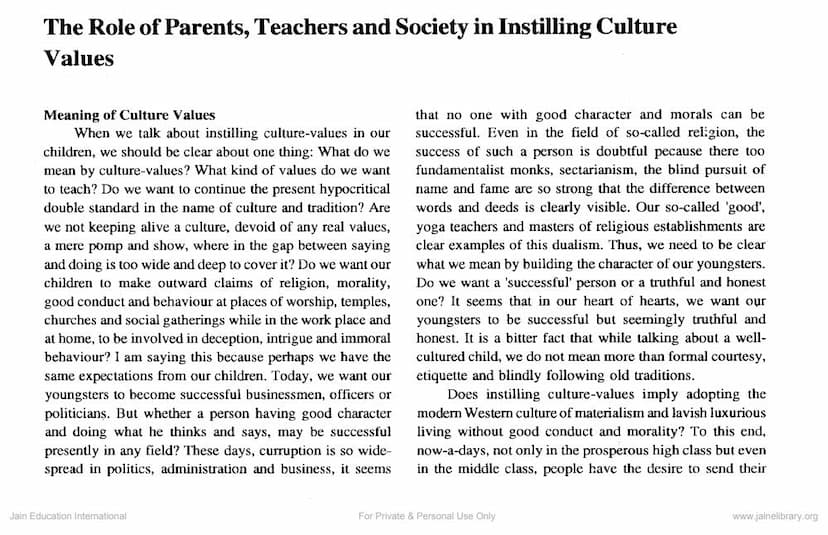
Here's a comprehensive summary of the provided Jain text, "The Role of Parents, Teachers and Society in Instilling Culture Values" by Sagarmal Jain, focusing on the key arguments and points:
The text critically examines the concept of "culture values" and challenges the current understanding and practice of instilling them in children. The author argues that a superficial, hypocritical, and materialistic approach to culture is prevalent, leading to a disconnect between outward claims of morality and actual behavior.
Key Issues and Criticisms:
- Ambiguity of "Culture Values": The author begins by questioning what is truly meant by culture values. He criticizes the tendency to perpetuate a "hypocritical double standard" where children are taught to display outward religious piety and good conduct in public but engage in deception and immoral behavior in private or professional life.
- The "Success vs. Truth" Dilemma: The text highlights a societal preference for material success (becoming businessmen, officers, politicians) over genuine character. It points out the pervasive corruption in various sectors, suggesting that honesty and good character might hinder success in the current environment. Even religious spheres are not immune, with instances of fundamentalism, sectarianism, and a focus on name and fame overshadowing true spirituality.
- Critique of Western Materialism: The author expresses concern about the adoption of Western materialism and a lavish lifestyle by middle and upper classes, often associating it with sending children to "convents." While acknowledging that convent education might impart outward formality, it's seen as lacking in moral and spiritual values.
- Rejection of Sectarianism and Ritualism: The text also condemns the instillation of "sectarianism, religious fanaticism, prejudice, and/or lifeless ritualism" under the guise of culture and tradition, labeling such objectives as "hollow." Blind faith in religious concepts without critical understanding is also discouraged.
- Defining a "Cultured Person": The author proposes a more profound definition of a cultured person, moving beyond mere success, Westernization, or ritualistic adherence. A truly cultured individual, in his view, possesses good intentions and immaculate conduct, characterized by good character. Culture is seen as moving away from animal instincts and embracing human values like self-control, a rational outlook, and cooperation.
Critique of the Education System:
- Misunderstanding of Education's Purpose: The text identifies a fundamental flaw in how education is perceived. Both guardians and educators often link education solely to livelihood and earning a living, neglecting its role in instilling culture and values. This materialistic focus reduces humans to their basic animal instincts of eating, sleeping, fear, and reproduction, ignoring the higher purpose of life.
- Blind Pursuit of Power and Wealth: Parents are driven by a desire for their children to achieve positions of authority and wealth, rather than becoming useful to society. This "blind pursuit of power and wealth" pollutes the outlook on education and breeds negative traits, creating "devils" rather than human beings.
- Ethics and Secularism: The author challenges the notion that teaching ethics is against secularism, arguing that secularism should not imply immorality or unethical conduct. The exclusion of ethics from education is seen as a detrimental consequence.
- Decline of the Guru-Shishya Relationship: The traditional revered relationship between a teacher (Guru) and student (Shishya) has degenerated into a transactional, business-like arrangement. Teachers are reduced to servants, and students and parents view them as such, making the instillation of culture values difficult.
- Education for Liberation vs. Livelihood: The text laments that the ancient ideal of education as a path to liberation ("sa vidya ya vimuktaye") has been forgotten, replaced by a focus on earning a livelihood. This results in producing skilled professionals but not necessarily good human beings. The quote by Firaq emphasizes this tragedy: "Everything is happening in this age of progress but the tragedy is that man is not becoming a human being."
The Role of Parents and Guardians:
- Family as the First School: The family is recognized as the primary institution for sowing the seeds of culture values, as children spend a significant amount of time with family members and are heavily influenced by their character.
- Parents' Responsibility: Parents are crucial but often fail in their role due to their own materialistic pursuits, busy schedules, and exposure to undesirable habits. Children are exposed to luxury, non-vegetarianism, intoxicating drinks, and unchecked desires, which negatively impact their character development.
- Impact of Absentee Parenting: When parents are absent (due to work, social engagements) and children are left with servants or baby-sitters, it leads to a loss of intimacy and the adoption of undesirable traits. The text uses a poignant couplet to illustrate how children reflect the environment they are raised in.
- Self-Imitation and Role Modeling: The author stresses that parents must lead immaculate, cultured, and ethical lives themselves to positively influence their children. They cannot rely on others (like boarding schools) to instill their values.
Recommendations for Parents and Guardians:
The text concludes with a set of practical recommendations for parents and guardians:
- Immaculate Conduct: Parents must exhibit cultured and ethical behavior as role models.
- Monitor Peer Influence: Be aware of the company their children keep, as peer pressure is significant.
- School Selection: Choose schools carefully and foster respect for teachers.
- Boarding School Caution: Select boarding schools and dormitories judiciously.
- Spend Time with Children: Prioritize spending quality time with children rather than leaving them with caretakers.
- Provide Good Literature: Offer morally uplifting reading material and shield children from "dirty" content.
- Use Moral Stories: Educate children about values through moral and biographical stories of great individuals.
- Exposure to Noble Personalities: Arrange for children to meet with admirable, educated, and cultured individuals.
In essence, Sagarmal Jain's text is a strong call for a redefinition and re-prioritization of culture and values in education and upbringing, urging a shift from superficiality and materialism towards genuine character development, ethical conduct, and spiritual consciousness.