
Role Of Meanings Uin Paninis Grammar
Added to library: September 2, 2025
Summary
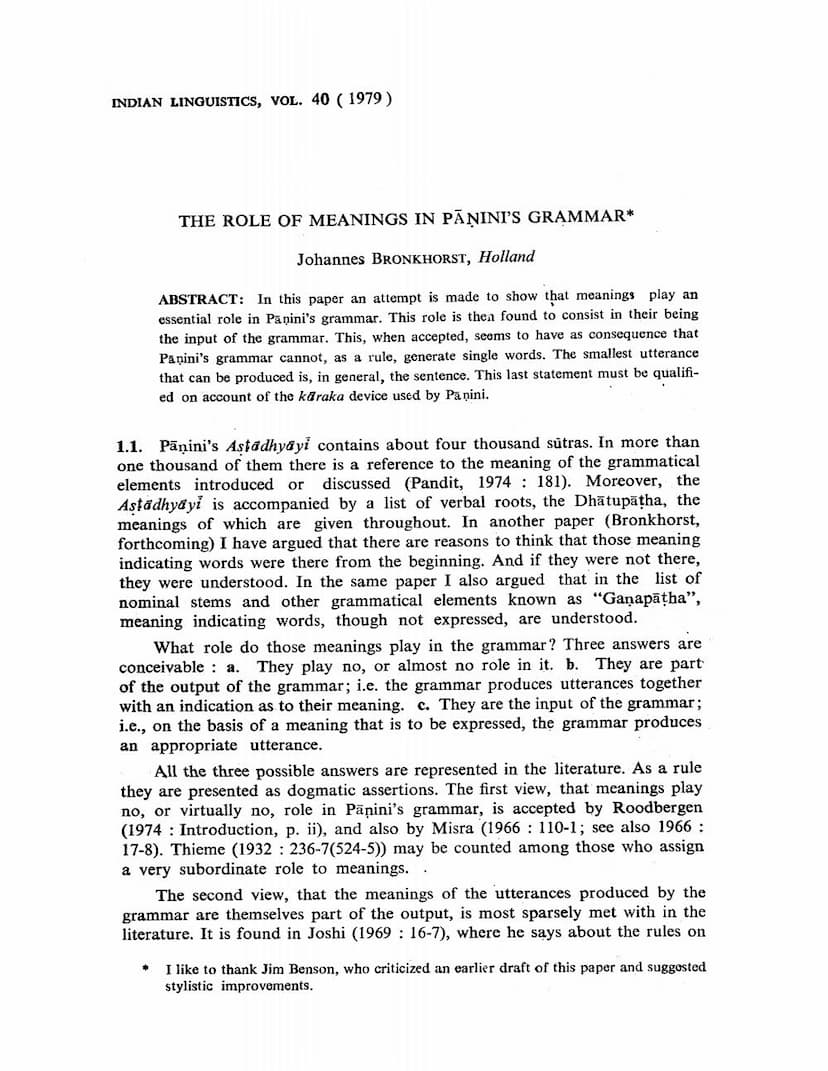
Here is a comprehensive summary of Johannes Bronkhorst's article "The Role of Meanings in Pāṇini's Grammar":
Core Argument:
Johannes Bronkhorst argues that meanings play an essential and fundamental role in Pāṇini's grammar, functioning as its input. This implies that Pāṇini's grammatical system, in general, is designed to generate complete utterances (sentences or clauses) from intended meanings, rather than producing individual words.
Key Points and Supporting Evidence:
-
Prevalence of Meaning in Pāṇini's Work:
- A significant portion (over a thousand) of the Aṣṭādhyāyī's sūtras (rules) directly refer to the meanings of grammatical elements.
- The Dhātupāṭha (list of verbal roots) explicitly provides meanings for these roots. Bronkhorst suggests these meaning entries were present from the beginning or were understood.
- Even the Gaṇapāṭha (list of nominal stems and other grammatical elements), while not explicitly stating meanings, implicitly suggests them.
-
Three Possible Roles for Meanings: Bronkhorst outlines three potential roles for meanings within Pāṇini's grammar:
- No Role: Meanings are irrelevant to the grammatical process. (Discarded by Bronkhorst).
- Output: The grammar generates utterances along with their meanings. (Considered but ultimately less favored).
- Input: The grammar takes intended meanings as its starting point and generates the appropriate linguistic expression. (The author's preferred view).
-
Discarding the "No Role" Hypothesis (Possibility a):
- Bronkhorst cites the work of Joshi and Roodbergen, who point out that certain rules (P.2.2.1-5) are necessary to preserve specific meanings, even if the grammatical forms could be generated without them. Cardona supports this view, arguing that without these rules, the forms would not convey the same meanings, thus highlighting the importance of meaning.
- Renou's observations on nipātana-sūtras (rules that introduce ready-made forms) are also used. Bronkhorst suggests that these ready-made forms are introduced precisely because analytically deriving them would require complex adjustments to meaning conditions. For example, asūryampasya is derived analytically, while ugrampasya is given as a nipātana to preserve its specific meaning of "fierce-looking" rather than an analytical "one who sees (something) fierce."
-
Favoring "Input" over "Output" (Possibilities c vs. b):
- Van Nooten's Argument: Van Nooten attempted to show that Pāṇini's rules are organized according to meaning, suggesting meanings are the organizing principle (input). Bronkhorst finds this attempt commendable but not entirely conclusive.
- The "One Name" Section and the Kāraka Device: Bronkhorst presents a stronger argument based on the "one name section" (rules 1.4.1 to 2.2.38), particularly P.1.4.2 (vipratiṣedhe param kāryam - "in case of conflict, the following rule takes effect").
- Example: dhanuṣā vidhyati: A bow can be seen as both an instrument (karaṇa) and a point from which something is shot (apādāna). Pāṇini has rules for both. The "one name" section and rule 1.4.2 ensure that only one designation (karaṇa in this case) is applied.
- Crucial Implication: This conflict resolution only makes sense if the grammar knows the intended meanings (bow as both instrument and point from which) before applying the rules. If meaning were merely output, there would be no conflict to resolve, and rule 1.4.2 would be irrelevant to the derivation of dhanuṣā vidhyati. This demonstrates that meanings must be the input to Pāṇini's grammar.
-
Consequence: Generation of Larger Utterances:
- Because meanings are the input, and Pāṇini's system aims to express these meanings, the grammar generally generates complete utterances (sentences or clauses). Single words are often not the direct output of a specific set of semantic inputs because many words require contextual information (other words) to be fully meaningful and derivable.
- Example: tvam bhavasi: The derivation of bhavasi (you become/are) requires yusmad (you) as an upapada (accompanying word) and an understanding that yusmad and the verb ending refer to the same entity. This is codified in P.1.4.105. Without the context provided by tvam, bhavasi cannot be generated in isolation. This illustrates that finite verbs (especially 2nd and 1st person) often cannot be produced independently.
- The Kāraka Device and "Pseudo-Meanings":
- The kāraka device (a system of syntactic relations like agent, patient, instrument, etc.) is introduced to bridge the gap between complex "real" meanings and the case endings.
- Pāṇini introduces "pseudo-meanings" (e.g., karman, karaṇa, sampradāna) to simplify the correspondence with case endings.
- Impact on Independence: When real meanings are replaced by these pseudo-elements (e.g.,
<<karaṇa>>instead of<karaṇa>), the resulting groups of semantic elements gain independence. They can then function as input for deriving parts of sentences, rather than requiring the entire sentence's meaning to be processed at once. - Example: puruṣāya krudhyāmy aham vs. puruṣaṁ abhikrudhyāmy aham: The choice between the dative (puruṣāya) and accusative (puruṣaṁ) depends on the presence of a preposition with the verb. The kāraka device, by assigning pseudo-elements like
<<sampradāna>>(for dative) or<<karman>>(for accusative), allows for the generation of these specific noun forms independently once the pseudo-meaning is established, even if the original meaning requiring the preposition was part of a larger semantic whole.
-
Summary of Conclusion:
- Pāṇini's grammar transforms meanings into utterances.
- As a consequence, the grammar primarily generates entire sentences or groups of sentences. While single words can be derived, it often requires specific conditions or the understanding of accompanying elements, reinforcing the idea that the fundamental process involves mapping larger semantic units to larger linguistic expressions.
In essence, Bronkhorst argues that Pāṇini's system is a meaning-driven generative grammar where the intent to convey a specific meaning is the primary driver for producing linguistic output, which is typically a complete thought or statement.