
Role Of Drstanta Indignagas Logic
Added to library: September 2, 2025
Summary
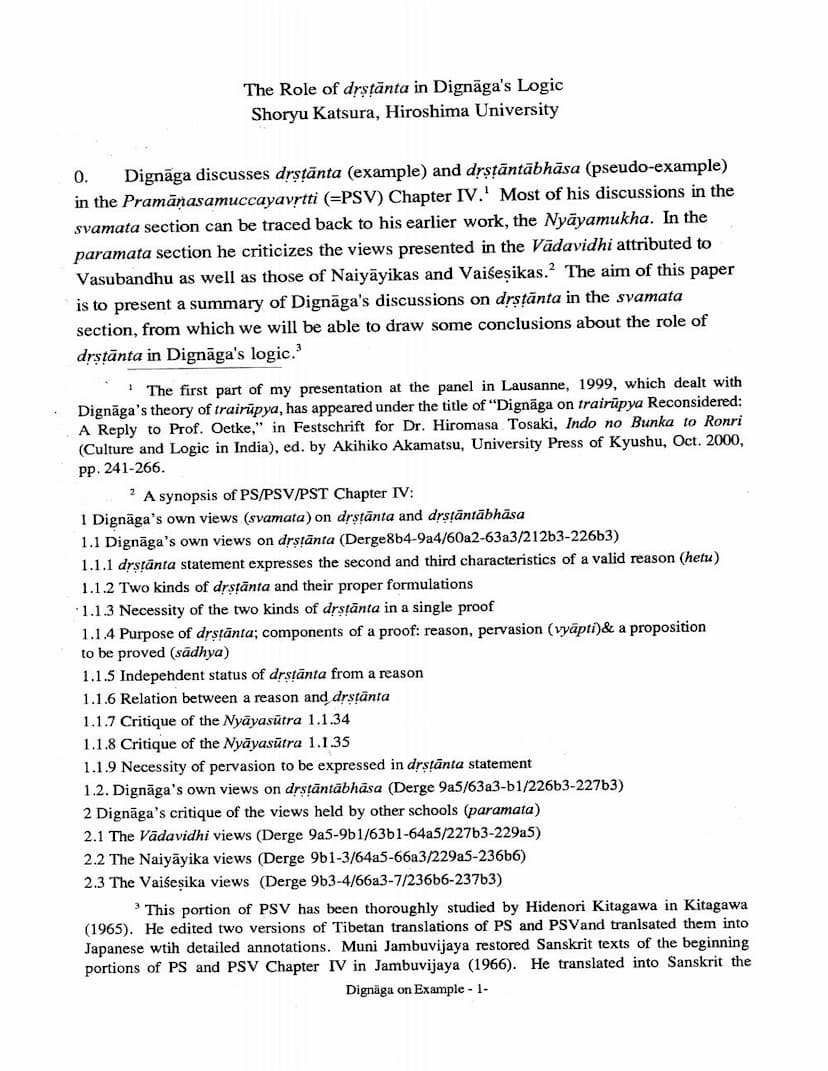
This document is a summary of Shoryu Katsura's analysis of the role of drṣṭānta (example) in the logic of Dignāga, a prominent Buddhist philosopher and logician. The summary focuses on Dignāga's views presented in Chapter IV of his Pramāṇasamuccayavṛtti (PSV), particularly his svamata (own views).
Here's a breakdown of the key points:
1. Dignāga's Theory of Inference and Proof:
- Inference for oneself (svārthānumāna): This involves establishing the presence of an inferential mark (like smoke) in the subject (like a mountain), recalling past experiences of its concomitance with the inferred property (fire) and its absence where the inferred property is absent, leading to certainty.
- Inference for others (parārthānumāna) / Proof: The aim is to produce the same certainty in others. Dignāga identifies three essential components (avayava) of a proof:
- Proposition/Thesis (pakṣa): States the matter to be inferred.
- Reason (hetu): Indicates the inferential mark, establishing the first characteristic of a valid reason (pakṣadharmatva - being a property of the topic).
- Example (drṣṭānta): Demonstrates the inseparable relation (avinābhāva) between the reason and the property to be proved, establishing the second (anvaya - positive concomitance) and third (vyatireka - negative concomitance) characteristics.
- Dignāga excludes other elements like "desire to know," "application," and "conclusion" from the essential members of a proof.
2. The Role and Formulation of Drṣṭānta (Example):
- Core Function: The primary role of the drṣṭānta statement is to express the avinābhāva (inseparable relation or pervasion, vyāpti) between the reason (hetu) and the property to be proved (sādhya). This relation signifies that the reason does not exist without the property to be proved.
- Two Types of Examples: Dignāga classified examples into two types, which were subsequently adopted by Indian logicians:
- Similar Example (sādharmya-drṣṭānta): Shows that where the reason is present, the property to be proved is also present. Dignāga formulates this as "Whatever possesses P possesses Q."
- Dissimilar Example (vaidharmya-drṣṭānta): Shows that where the property to be proved is absent, the reason is also absent. Dignāga formulates this as "Whatever does not possess Q does not possess P."
- Formulation of Pervasion (vyāpti): Dignāga uses relative pronouns like yad (whatever) and tad (that) to express universal relations. He also emphasizes the use of restrictive particles like eva (only) to formulate vyāpti more precisely. The formulations are often structured to express a general law derived from observation.
- Similar Example: "Whatever is produced by a human effort is non-eternal." (yat prayatnānantarīyakam tad anityam)
- Dissimilar Example: "Whatever is eternal is not produced by a human effort." (yan nityam tad aprayatnānantarīyakam)
- Connection to Trairūpya: The anvaya and vyatireka in the drṣṭānta statements correspond to the second and third characteristics of a valid reason in Dignāga's trairūpya theory.
- Inductive Nature: The formulation of examples, particularly the use of observed instances like "pot" (ghata) and "ether" (ākāśa), suggests an inductive basis for Dignāga's logic, where general laws are derived from empirical observations.
3. Critique of Other Schools and Dignāga's Innovations:
- Dignāga criticized the views of the Naiyayikas, Vaiseṣikas, and the author of the Vädavidhi (attributed to Vasubandhu) for their formulations of proofs.
- He clarified the distinct roles of the hetu and drṣṭānta statements, arguing that the hetu states the first characteristic (pakṣadharmatva) and the drṣṭānta states the other two (anvaya and vyatireka).
- Dignāga's insistence on the specific formulation of both similar and dissimilar examples to establish vyāpti was a significant contribution to Indian logic. He argued that using both is necessary to avoid logical fallacies and ensure the validity of the inference.
- He also introduced the distinction between paryudāsa (implicative negation) in similar examples and prasajya-pratiṣedha (simple negation) in dissimilar examples, highlighting the nuanced logical structure of his system.
4. Necessity of Both Examples:
- Dignāga argued that both similar and dissimilar examples are crucial. If only a dissimilar example were used, a unique and inconclusive reason (like "audibility" for the eternality of sound) could be mistakenly considered valid.
- He also maintained that even if vyāpti could be inferred (arthāpatti) from one type of example, explicitly stating both ensures clarity and avoids logical errors. The choice of restricting a property as a reason is dependent on the speaker's intention.
In essence, the paper highlights Dignāga's rigorous approach to logical argumentation, emphasizing the precise formulation of drṣṭānta statements as the cornerstone for establishing the pervasion between a reason and the conclusion, thereby ensuring the validity of inference.