
Rngog Lotsaba On Sahopalambhaniyama Proof In Dharmakirtis Pramanaviniscaya
Added to library: September 2, 2025
Summary
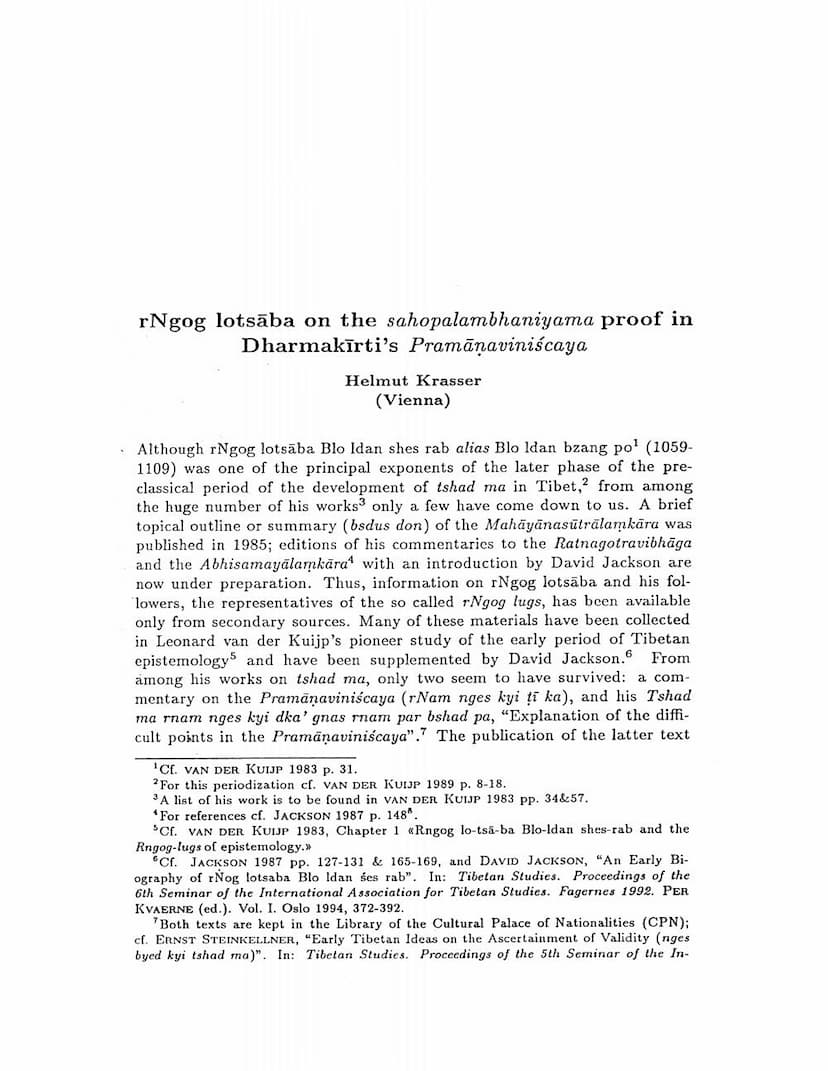
This document, "rNgog lotsāba on the sahopalambhaniyama proof in Dharmakīrti's Pramāṇaviniscaya" by Helmut Krasser, is a scholarly article focusing on a specific philosophical argument by the Indian Buddhist philosopher Dharmakīrti and its interpretation by the Tibetan scholar rNgog lotsāba.
Here's a comprehensive summary:
1. Introduction of rNgog lotsāba and his work:
- The article introduces rNgog lotsāba Blo ldan shes rab (1059-1109) as a significant figure in early Tibetan epistemology (tshad ma).
- It notes that many of rNgog lotsāba's works are lost, and information is primarily available through secondary sources.
- The author highlights that rNgog lotsāba's surviving works on tshad ma include a commentary on the Pramāņaviniscaya (PVIN) and an explanation of its difficult points. The article will focus on the latter, specifically rNgog lotsāba's interpretation of Dharmakīrti's sahopalambhaniyama proof.
2. Dharmakīrti's Sahopalambhaniyama Proof:
- The sahopalambhaniyama proof is presented as Dharmakīrti's argument that an object and its cognition are identical ("not different") because they are necessarily perceived together.
- This proof is found in Dharmakīrti's Pramāņaviniscaya (PVIN) and its parallels exist in the Pramāņavārttika.
- Dharmakīrti's argument is part of his broader discussion distinguishing between a means of cognition (pramāṇa) and its effect (pramāṇa-phala), aiming to show that any cognition has both a grasping (subjective) and a grasped (objective) aspect.
- The proof is presented within the context of vijñaptimātratā (consciousness-only) doctrine, where the existence of external objects is not necessarily assumed.
3. rNgog lotsāba's Analysis of the Proof:
- rNgog lotsāba's interpretation of the sahopalambhaniyama proof is broken down into two main points:
- The Subject of the Thesis (pratijñārtha):
- rNgog lotsāba distinguishes between the locus of properties (dharmin) and the property to be proved (sādhyadharma).
- He identifies the dharmin as consisting only of the objective aspect (grāhyākāra), specifically the "blue" aspect. He argues that the subjective aspect (cognition) should not be considered part of the dharmin because the subjective aspect is real (satya), while the objective aspect is unreal (alika) within the vijñaptimātratā framework.
- The Property to be Proved (sādhyadharma):
- rNgog lotsāba interprets abheda (non-difference) as a non-implicative negation (prasajyapratişedha), meaning it negates only "being different" and does not assert absolute identity.
- The Subject of the Thesis (pratijñārtha):
4. Comparison with Indian Commentators:
- The article examines how other Indian commentators interpreted Dharmakīrti's proof to contextualize rNgog lotsāba's views.
- Devendrabuddhi and Sākyabuddhi: They understood abheda as identity (ekatva), with both the subjective and objective aspects forming the dharmin. Sākyabuddhi criticized those who saw it as mere negation.
- Kamalaśīla: Similar to Devendrabuddhi, he considered both aspects to be the dharmin and abheda as non-difference.
- Prajñākaragupta and Ravigupta: They understood abheda as identity, even in the example of the two moons.
- Dharmottara: His interpretation is particularly important as rNgog lotsāba was familiar with his text. Dharmottara views abheda as non-difference and likely considered both aspects as the dharmin. He also agrees that the subjective aspect is real and the objective one unreal.
5. rNgog lotsāba's Distinctive Contribution and Agreement with Dharmottara:
- While rNgog lotsāba generally follows Dharmottara's explanation, he differs in his precise identification of the dharmin. rNgog lotsāba excludes the subjective aspect from the dharmin, which he believes is the objective aspect alone. His reasoning is that the proof demonstrates the difference between the subjective and objective aspects, and the negation of difference is directed towards the objective aspect.
- Krasser argues that rNgog lotsāba's interpretation aligns well with Dharmakīrti's own prose explanation of the sahopalambhaniyama proof, where Dharmakīrti focuses on the non-difference of the blue from its awareness, implying the blue is the primary focus.
- The article notes a potential contradiction with a later statement by Dharmakīrti (PVIN 59ab) which suggests mutual non-difference even with an external object, where both aspects would form the dharmin. Krasser suggests that Dharmakīrti might have presented the argument in two ways: one from the vijñaptimātratā standpoint (where blue is the dharmin) and another assuming an external object (where mutual non-difference is proven). rNgog lotsāba's translation is seen as accommodating both interpretations.
6. rNgog lotsāba's Method and Style:
- The article mentions rNgog lotsāba's use of the sa bcad technique, a method of organizing textual analysis.
- His explanations are described as concise, often summarizing complex arguments from Dharmottara's commentary into a few words, making them understandable primarily in conjunction with the original texts.
- He also engages with and refutes views of other Indian predecessors besides Dharmottara, such as Subhagupta, Prajñākaragupta, and śāntabhadra, in other parts of his work.
7. Translation and Analysis of rNgog lotsāba's Text:
- The latter part of the article includes a translation of a specific section of rNgog lotsāba's commentary on the sahopalambhaniyama proof.
- This translation details his breakdown of the proof into the pratijñārtha (subject of the thesis) and hetudoșa (faults of the reason), and further subdivides the pratijñārtha into the dharmin and sādhyadharma.
- The detailed analysis shows his arguments for the objective aspect being the dharmin, his understanding of abheda as prasajyapratiṣedha, and his refutation of potential objections to the proof, drawing on Dharmakīrti's own arguments.
In essence, the article provides a deep dive into how a significant Tibetan scholar, rNgog lotsāba, engaged with and interpreted a crucial philosophical argument by Dharmakīrti, highlighting both his faithfulness to his Indian sources and his own precise philosophical contributions to the debate.