
Reviews Of Diffeent Books
Added to library: September 2, 2025
Summary
Here's a comprehensive summary of the provided text on Bhartṛhari, focusing on his philosophical contributions:
Bhartṛhari: The Indian Philosopher of Grammar
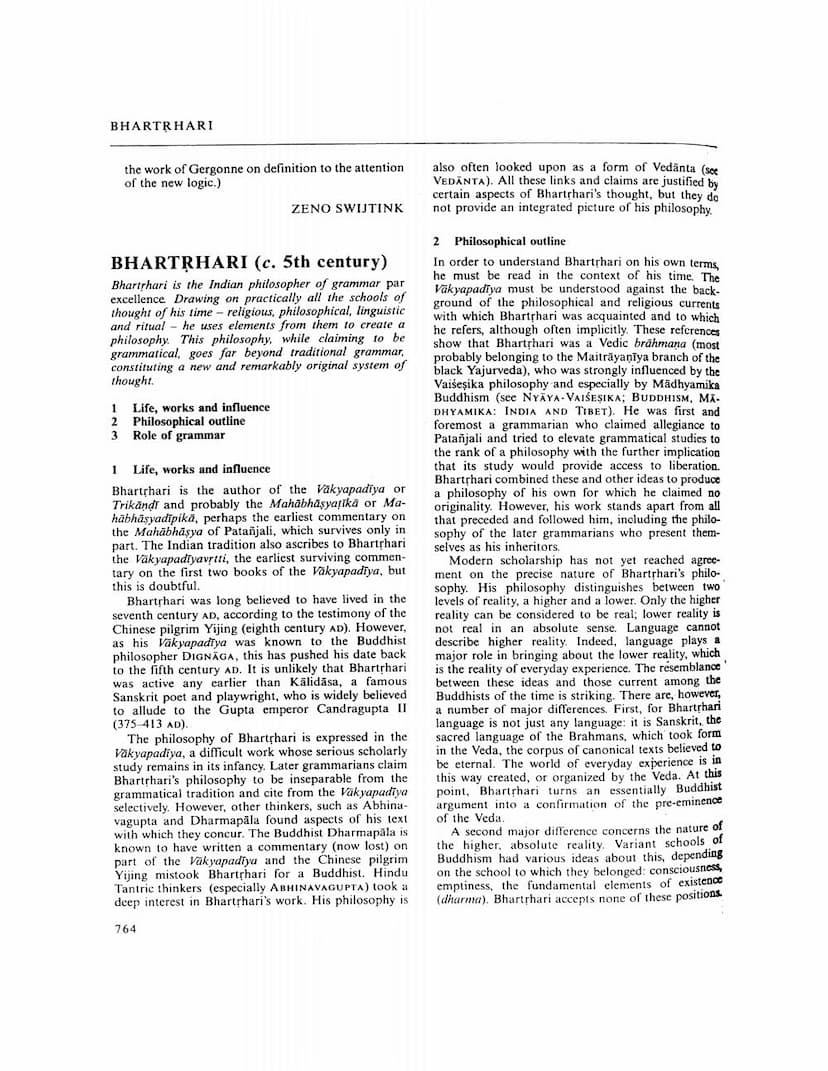
Bhartṛhari, a pivotal Indian philosopher active around the 5th century CE, is renowned as the foremost philosopher of grammar. His work, particularly the Vakyapadiya (also known as the Trikandi), transcends traditional grammatical analysis to create a remarkably original philosophical system. He drew upon a wide array of contemporary religious, philosophical, linguistic, and ritualistic schools of thought, integrating their elements into his unique vision.
Life, Works, and Influence:
- Bhartṛhari is primarily known for the Vakyapadiya. He is also credited with the Mahabhāsyadīpikā, a commentary on Patanjali's Mahābhāṣya, though it survives only in part. The attribution of the Vakyapadiya-vrtti is considered doubtful.
- His dating has been pushed back from the 7th century to the 5th century CE due to the knowledge of his work by the Buddhist philosopher Dignāga, who was active earlier. He is likely not earlier than the poet Kalidasa, who may have alluded to Emperor Candragupta II (375-413 CE).
- Bhartṛhari's philosophy, though claimed by later grammarians as inseparable from their tradition, also resonated with other thinkers like Abhinavagupta and Dharmapala. The Chinese pilgrim Yijing even mistook him for a Buddhist. Hindu Tantric thinkers, especially Abhinavagupta, were deeply interested in his work, viewing it as a form of Vedānta.
Philosophical Outline:
Bhartṛhari's philosophy must be understood within the context of his time. He was likely a Vedic brāhmaṇa, influenced by Vaiśeṣika philosophy and, significantly, by Madhyamaka Buddhism. His primary aim was to elevate grammatical studies to the status of a philosophy, suggesting that its pursuit could lead to liberation.
His system is characterized by:
- Two Levels of Reality: Bhartṛhari posits a distinction between a higher, absolute reality and a lower, everyday reality. Only the higher reality is considered truly real, while the lower reality lacks absolute existence.
- The Role of Language: Language plays a crucial role in constructing the lower, everyday reality. However, for Bhartṛhari, this is specifically Sanskrit, the sacred language of the Brahmans, intrinsically linked to the Vedas. He argues that the world of everyday experience is organized or even created by the Veda, thus transforming a Buddhist argument into a confirmation of Vedic pre-eminence.
- The Nature of the Absolute: Unlike various Buddhist conceptions of the absolute (consciousness, emptiness, or fundamental elements), Bhartṛhari views the absolute as the totality of all that exists, has existed, and will exist. This concept was borrowed from earlier Brahmanical thinkers and integrated into his philosophy.
- The Division of the Absolute: The lower reality arises from a division of the absolute, a process influenced by language and analytical imagination (vikalpa). These divisions are subject to the powers (śakti) of the absolute, such as time and space, leading to the objects of everyday experience.
- Perspectivism: Bhartṛhari’s thought is marked by perspectivism, the idea that reality differs from different points of view. This applies to the lower reality, but not to the absolute. He doesn't definitively identify the "real" parts of everyday objects, suggesting possibilities like substance or universals, reflecting this perspectival approach.
- Wholes vs. Parts: A key tenet is that wholes are more real than their constituents. A vase is more real than its parts. This directly contrasts with Buddhist thought, where only ultimate parts (dharma) exist. For Bhartṛhari, the absolute whole is therefore absolutely real.
Role of Grammar:
Bhartṛhari's grammatical perspective is integral to his philosophy:
- Language and Totality: Language, like reality, follows the principle that wholes are more real than their parts. Words, conveying meaning, are more real than their constituent stems and suffixes, which are seen as artificial grammatical inventions.
- Ascending through Speech: Grammar allows an "ascension" from linguistic elements (phonemes, stems, suffixes) to more encompassing and real units of speech. This process leads to an understanding of the world, which is largely shaped by linguistic analysis.
- Liberation through Insight: By appreciating the unreality of the everyday world and recognizing the absolute as beyond language, one can attain liberation. Insight into the totality of existence is the path to freedom, mirroring concepts in Mahāyāna Buddhism. Hence, Bhartṛhari famously states that grammar is the door to liberation.
- The Real Word (Sphota): Bhartṛhari discusses the distinction between the "real word" (often called sphota), which is non-sequential and has no duration, and the sequential sounds that manifest it. While sounds manifest the word, they don't constitute its true essence. He distinguishes between primary and secondary manifesting sounds.
In essence, Bhartṛhari masterfully synthesized grammatical analysis with profound philosophical insights, particularly on the nature of reality, language, and the path to liberation. His work, though complex and still undergoing scholarly study, offers a unique and influential perspective on Indian thought, demonstrating a remarkable ability to adapt and transform existing philosophical concepts.