
Reviews Of Diffeent Books
Added to library: September 2, 2025
Summary
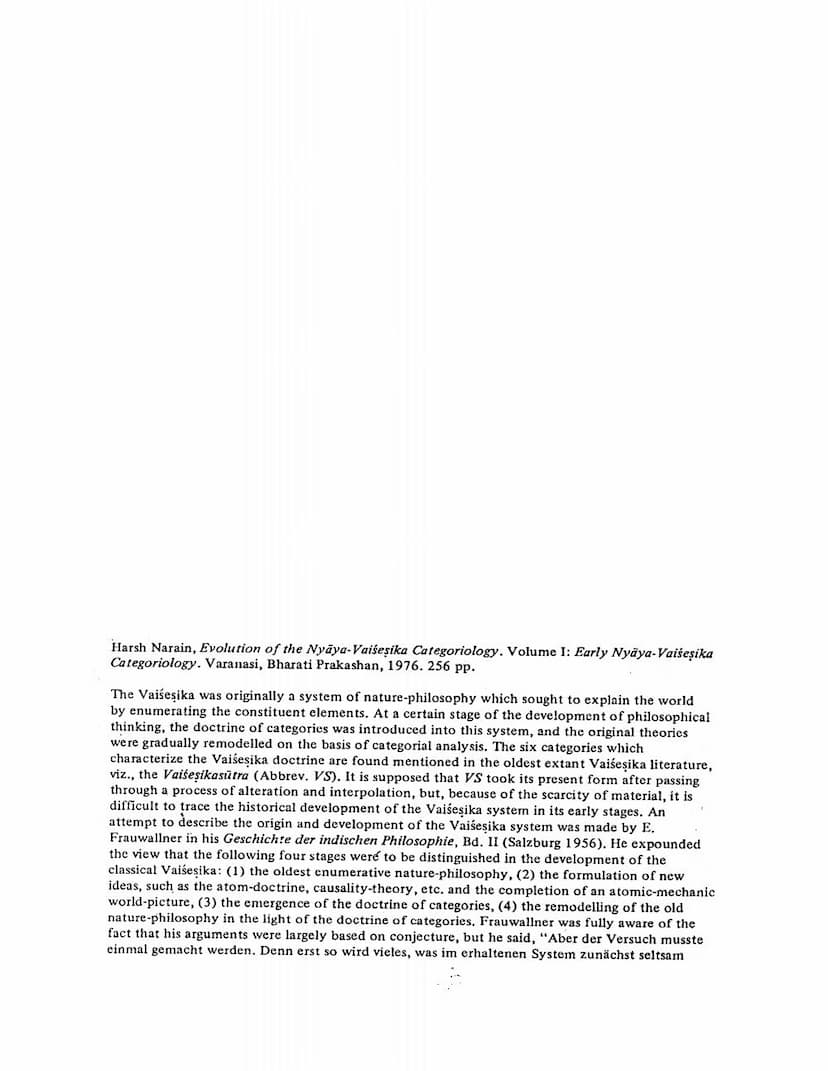
This document is a review of Harsh Narain's book, "Evolution of the Nyāya-Vaiseśika Categoriology. Volume I: Early Nyāya-Vaiseśika Categoriology," by Masaaki Hattori. The review focuses on the development of the Vaisheshika system, particularly its doctrine of categories.
Here's a breakdown of the key points from the review:
-
Vaisheshika's Origins: The Vaisheshika system began as a philosophy of nature focused on enumerating constituent elements. The doctrine of categories was introduced later, transforming the original theories.
-
Frauwallner's Stages: The review references E. Frauwallner's four stages of classical Vaisheshika development:
- Oldest enumerative nature-philosophy.
- Formulation of new ideas (atom-doctrine, causality) and an atomic-mechanic worldview.
- Emergence of the doctrine of categories.
- Remodeling of nature-philosophy based on categorial analysis. Hattori finds Frauwallner's general framework acceptable, even acknowledging that it relies on conjecture.
-
Narain's Contribution: Narain's book aims to clarify how the classical Vaisheshika doctrine of six categories gradually formed. Hattori notes that Narain's core arguments align with Frauwallner's third stage.
-
Critique of Narain's Arguments:
- Lack of Reference to Frauwallner: Hattori regrets that Narain does not cite Frauwallner's work, which could have provided a clearer perspective.
- Three Original Categories: Narain argues that early Vaisheshikas posited only three categories: substance (dravya), attribute (guna), and motion (karman). Hattori finds this argument unconvincing, suggesting it proves these categories are distinct but not that others were absent. He believes Narain could have strengthened his point by accepting the idea of an earlier stage of entity enumeration, as suggested by Frauwallner.
- Critique of Potter on Guna: Narain criticizes K. Potter's equation of 'guna' with 'quality.' Potter argued that 'quality' is repeatable across things, while 'guna' is specific to one particular thing and not shared. Narain counters by noting that Indian tradition held both views: some considered 'guna' repeatable (e.g., Vaiyakaranas), while others considered it unrepeatable (e.g., Jainas and Nyaya-Vaisheshikas). Narain's preferred equivalent for 'guna' is 'attribute,' which Hattori finds adequate.
-
Influence of Vyakarana Texts: A significant feature of Narain's book is its detailed examination of terms and concepts from early Vyakarana (grammar) texts.
- Jainas Precursory: Narain supports H. Ui's view that Jainas preceded the Vaisheshikas, but criticizes Ui for not considering Vaiyakarana theories.
- Origin of 'Existence' (Bhava/Satta): Narain traces the category of 'existence' (bhava or satta) back to the term 'bhava' in early Vyakarana texts, where it originally denoted action. Hattori finds this connection plausible and agrees that 'existence' was likely added before the concept of 'universal'.
-
Genesis of 'Universal' (Samanya):
- Terms Examined: Narain extensively discusses the origin of the 'universal' category by referencing Nyaya, Vyakarana, and Mimamsa texts, examining terms like samanya, jati, and akrti.
- Jati in Nyaya Sutra: Narain argues that the term 'jati' in the Nyaya Sutra (NS, 2.2.69) originally meant "procreative of the like" (species in a biological sense) rather than the Vaisheshika category of 'universal'. Hattori finds this interpretation acceptable.
- Jati in Vyakarana: In early Vyakarana works, 'jati' signifies a natural class.
- Samanya and Visesa in Patanjali: Narain highlights Patanjali's usage of 'samanya' and 'visesa' and suggests a passage where Patanjali states that a thing can be considered 'samanya' or 'visesa' depending on the speaker's intent (vivaksa) as a potential source for a Vaisheshika sutra.
- Samanya as an Entity: Narain concludes that Patanjali did not know 'samanya' as an entity independent of its substrata.
- Akrti in Vyakarana: 'Akrti' in early Vyakarana primarily means form or configuration, secondarily 'jati.'
- Germ of Universal: Narain suggests that the Vaisheshika concept of 'universal' has its roots in the Vaiyakarana concepts of 'jati' and 'akrti.'
-
Criticisms of Narain's Book:
- Unnecessary or Inappropriate Arguments: Hattori criticizes Narain for "wearying the reader with useless or inappropriate arguments and explanations."
- Irrelevant Comparisons: Chapter IV's panoramic sketch of Western philosophers' theories of category is deemed useless, as a detailed comparison with only one akin or contrasting theory would have been more effective.
- Irrelevant Speculations on Existence: References to Vedic speculations on 'sat' and 'asat' for the genesis of 'existence' are questioned, with Hattori doubting their connection to the Vaisheshika category.
- Irrelevant Dharmakirti Reference: Including Dharmakirti's view on the origin of the universal is considered irrelevant, as Dharmakirti lived much later and did not discuss the topic historically.
- Abbreviation Issues: The extensive list of abbreviations is found problematic, as some are rarely used and only appear once or twice. Hattori suggests full titles or simplified titles in footnotes would be more reader-friendly.
-
Overall Assessment: Despite these criticisms, Hattori acknowledges the book is "commendable in many respects" for its detailed examination of relevant terms and concepts, particularly from Vyakarana texts. The book is presented as the first half of a larger work.