
Reviews Of Diffeent Books
Added to library: September 2, 2025
Summary
Here is a comprehensive summary of the provided Jain text, focusing on the book reviews:
This document contains several book reviews published in the Indo-Iranian Journal in 1986. The reviews cover a range of scholarly works related to Indian languages, literature, philosophy, and religion.
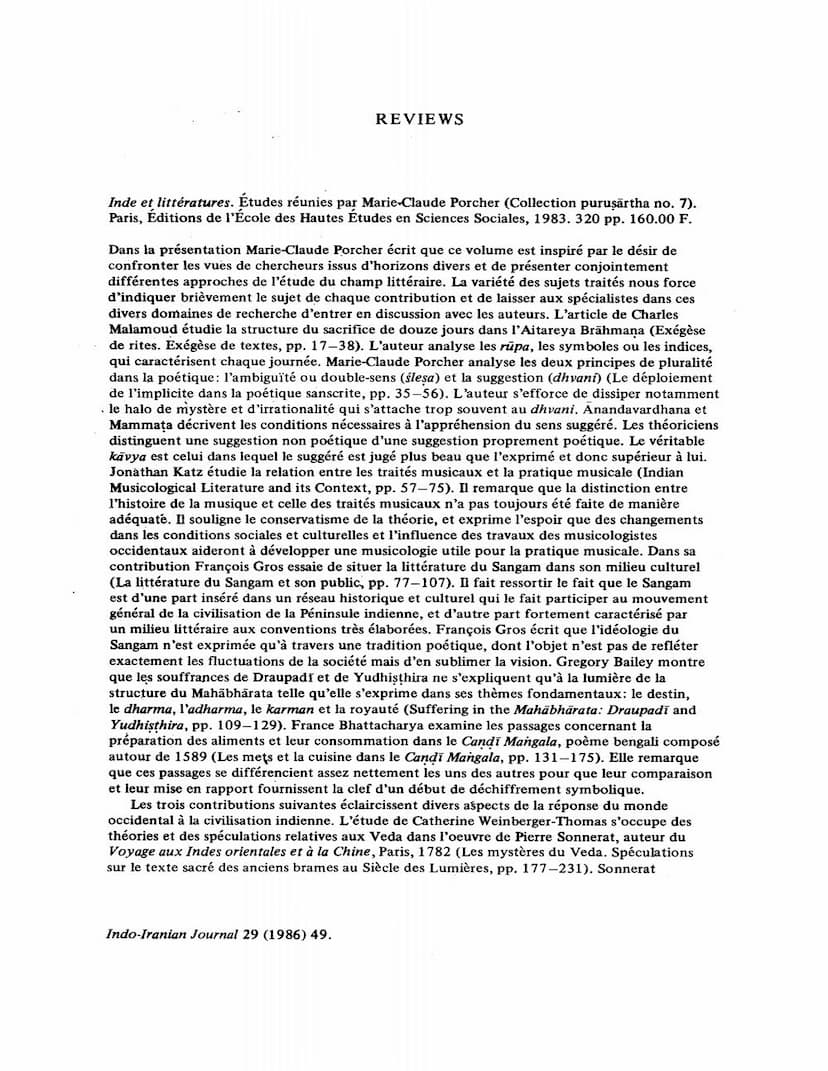
1. Reviews of "Inde et littératures. Etudes réunies par Marie-Claude Porcher" (Page 1-2)
This review discusses a collection of essays exploring Indian literature from diverse scholarly perspectives. Key contributions highlighted include:
- Charles Malamoud: Analyzes the structure of a twelve-day sacrifice in the Aitareya Brāhmana, focusing on symbolic elements of each day.
- Marie-Claude Porcher: Examines two principles of Sanskrit poetics: ambiguity (slesa) and suggestion (dhvani), aiming to demystify dhvani and highlighting the criteria for appreciating suggested meaning in poetry.
- Jonathan Katz: Investigates the relationship between Indian musicological literature and musical practice, noting the conservativism of theory and hoping for progress through socio-cultural changes and Western musicological influence.
- François Gros: Situates Sangam literature within its cultural context, emphasizing its integration into the broader Indian peninsula civilization while also being characterized by a highly elaborate literary milieu. He notes that Sangam ideology is expressed poetically to sublimate societal visions.
- Gregory Bailey: Explains the suffering of Draupadi and Yudhisthira in the Mahabharata by linking it to the epic's fundamental themes: destiny, dharma, adharma, karman, and kingship.
- France Bhattacharya: Examines passages on food preparation and consumption in the Bengali poem Candi Mangala, suggesting these passages hold clues for symbolic decipherment.
The review also covers Western responses to Indian civilization, including:
- Catherine Weinberger-Thomas: Discusses Pierre Sonnerat's theories on the Vedas, noting his recognition of the Ezour-Vedam as a Christian apocryphal text and his "Veda War" narrative about the origins of civilization.
- Sylvia Murr: Analyzes Jesuit, scholarly, and philosophical reactions to India between 1700-1782, focusing on discussions about the age of the world, the origin of Indian populations, and religion/civilization. She observes that texts about India served as pretexts in debates between Christian apologists and philosophers.
- Catherine Champion: Studies the literary image of the "sahib" in Anglo-Indian literature.
The reviewer concludes that the volume demonstrates the benefit of applying various research methods to Indian literature and that the collected studies offer a more truthful and varied understanding of Indian culture.
2. Review of "Mahābhāsyapradīpavyākhyānāni. Commentaires sur le Mahābhāşya de Patañjali et le Pradīpa de Kaiyata" (Page 2-3)
This review announces the completion of a significant publication project by the Institut Français d'Indologie. The ten volumes, published between 1973 and 1983, contain the complete text of Annambhatta's Uddyotana and fragments of five other commentaries on Patañjali's Mahābhāṣya and Kaiyata's Pradīpa. The reviewer notes the editor, M.S. Narasimhacharya, adopted a simpler expository style for pedagogical purposes. The publication is welcomed by specialists in vyākarana for its assistance in interpreting the Mahābhāṣya and Mahābhāṣyapratiḍipa. The reviewer also mentions Pierre-Sylvain Filliozat's translation of the Mahābhāṣya with the Pradīpa and Uddyota.
3. Reviews of N. R. Bhatt's Editions of Saivāgama Texts (Page 3-4)
This section reviews three critical editions of Śaivāgama texts by N. R. Bhatt, published by the Institut Français d'Indologie:
- Sārdhatrisatikālottaragama: Described as a recension of the Kālottara, derived from the Vātulāgama. The editor's extensive introduction covers different recensions, cited authors, texts, and the unique teachings of the work. The text is analyzed chapter by chapter, and the edition is based on multiple manuscripts.
- Matangapāramesvarāgama (Kriyāpāda, Yogapāda et Caryāpāda): This volume completes the edition of this upāgama. The introduction discusses authors, cited works, and the text's teachings. However, the review notes the commentary by Bhatta Ramakantha is incomplete for this volume.
- Rauravottarāgama: An upāgama of the Rauravagama. The edition is based on five manuscripts. The review notes that not all announced subjects are covered in the existing chapters, and some material might be in appended chapters. The introduction analyzes the text's teachings and chapters.
The reviewer praises Bhatt's meticulous work in collecting and editing Agamic texts, his in-depth examination of doctrines, and his significant contribution to making these texts accessible to scholars. Bhatt's assistance to scholars translating South Indian Śaivism texts is also acknowledged.
4. Review of Winthrop Sargeant's Translation of The Bhagavad Gitā (Page 5-6)
This review critically examines Winthrop Sargeant's revised translation of the Bhagavad Gitā, which aims to provide an interlinear arrangement for learning Sanskrit. While appreciating the concept, the reviewer finds significant flaws:
- Romanization: Sargeant's romanized text is criticized for its punctuation and separation of compound words, with Zaehner's approach deemed superior.
- Word-for-word Explanations: The reviewer tests the explanations and finds Sargeant ill-equipped, noting errors in distinguishing grammatical cases (nominative vs. accusative) and misinterpretations of words and compounds.
- English Translation: Numerous mistranslations are highlighted, with suggestions for better English equivalents that could have been found in existing translations.
- Ambitious Claims: The reviewer questions Sargeant's claims of competence and the endorsement by a "highest authority" (likely J.A.B. van Buitenen), expressing discomfort with the use of van Buitenen's name to guarantee the work's excellence given the identified errors.
The review concludes that despite the translator's ambitious claims, the work is replete with imperfections.
5. Review of Gustav Roth's "Malli-jñāta" (Page 7-8)
This review discusses Gustav Roth's edition, translation, and commentary on the Malli-jñāta, the eighth chapter of the Nayadhammakahāo from the Svetambara Jain canon.
- Publication History: The study, completed in 1952, was finally published after over thirty years due to the Stiftung Waldschmidt.
- Introduction: Roth analyzes manuscripts, discusses the text's date (potentially close to Kautilya's Arthasastra due to shared vocabulary), and explores the presence of "vedha" or rhythmical prose, including an excursus on the "yavanika" or screen.
- Text and Translation: The text and translation are presented on opposite pages, with variant readings in an appendix. Footnotes provide explanations and detailed discussions on grammar and content.
- Scholarly Debates: Roth's conclusions on the faithful transmission of the traditional text are questioned in light of recent studies by Colette Caillat.
- Specific Interpretations: Roth's interpretations of specific terms like "javaṇiyā" and "ghāda" are discussed, with the reviewer offering alternative readings or clarifications based on scholarly dictionaries. The reviewer also notes Roth's disagreement with Alsdorf regarding the "disākumārī-s."
The reviewer praises Roth's work but points out instances where further clarification or alternative interpretations might be warranted.
6. Review of Otto Strauss's "Kleine Schriften" (Page 9-10)
This review highlights the collected writings of Otto Strauss (1881-1940), a scholar of Indian philosophy.
- Content: The volume includes almost all of Strauss's articles, notably his "Habilitations-schrift" on ethical problems in the Mahābhārata, which details the principles of pravrtti and nivrtti. It also features his important philosophical studies on language, Udgithavidya, and the Karma-Mimamsa.
- Life and Work: The review outlines Strauss's academic journey, his dismissal from his professorship due to the political situation in Germany, and his eventual death in Holland.
- Translations: Strauss's translations of difficult texts, such as Patañjali's Mahābhāṣya, Brahma-Sutra with Samkara's bhāṣya, and Mimāṁsāsūtrabhāṣya, are praised for their fidelity and clarity.
- Additional Content: The volume includes a selection of Strauss's reviews, a list of studied texts, and indexes. The reviewer adds to the bibliography and mentions personal recollections of Strauss.
The review generally commends the collection as a valuable resource for understanding Strauss's contributions to Indology.
7. Review of "Sanskrit-Wörterbuch der buddhistischen Texte aus den Turfan-Funden" (Page 11-12)
This review focuses on the fourth fascicle of a Sanskrit dictionary for Buddhist texts from the Turfan finds, edited by Heinz Bechert and worked on by Michael Schmidt.
- Publication Timeline: The reviewer expresses a desire for more precise publication dates for each fascicle, as the dictionary's completion is a long-term project.
- Content: The fourth fascicle includes texts from the Sarvastivadin school and other texts not previously included. The reviewer notes the potential exclusion of texts from other schools and mentions the reliance on the flawed edition of the Pratimokṣasūtra by A. Ch. Banerjee.
- Editorial Work: Michael Schmidt's work on this fascicle is praised as admirable, with the reviewer pointing out an independent correction made to the entry "atmaparitapanayoga." Specific corrections and clarifications are also suggested for other entries.
The review acknowledges the quality of Schmidt's work while highlighting areas for potential improvement in the dictionary's compilation.
8. Review of Jean Dantinne's "La splendeur de l'inébranlable (Aksobhyavyuha)" (Page 12-15)
This review discusses Jean Dantinne's French translation of the Aksobhyavyuha, a text from the Mahāratnakūta, alongside comparisons with Chinese and Tibetan versions.
- Translations and Sources: Dantinne translates the first part of Bodhiruci's Chinese translation, comparing it with Lokaksema's Chinese translation and the Tibetan version. The reviewer regrets that the Tibetan version was not fully edited but acknowledges its importance.
- Dating and Origins: Dantinne proposes theories on the Indian originals of the texts, suggesting AV 1 might represent an early Indian original, while AV 2 and the Tibetan version derive from a distinct archetype. His dating proposals are discussed.
- Introduction and Commentary: The introduction thoroughly examines Chinese and Tibetan sources on the text's versions and translators. The commentary is extensive and encyclopedic, providing numerous references and careful translations of cited texts.
- Specific Points: The reviewer offers detailed philological corrections and suggestions on interpretations of specific passages, including the meaning of "iryāpatha," "arthāksiptā," and the translation of certain phrases. Disagreements with existing interpretations and suggestions for alternative readings are presented.
- Overall Assessment: Dantinne's work is lauded as a first-rate contribution to Mahāyāna literature studies, with an excellent translation and an informative commentary. The reviewer notes the presence of a Chinese-Sanskrit glossary and a list of Chinese transliterations.
9. Review of "Sprachen des Buddhismus in Zentralasien" (Page 15-16)
This review covers a volume of papers presented at a symposium honoring Professor Annemarie von Gabain, focusing on contributions relevant to Buddhist and Indian studies.
- Key Contributions:
- Heinz Bechert: Discusses challenges in compiling the Sanskrit-Wörterbuch der Turfan-Funde concerning the classification of Buddhist Sanskrit texts.
- Ronald E. Emmerick: Examines Khotanese translation techniques, particularly in translating Buddhist Sanskrit technical terms, and presents a new edition of the preface to the Khotanese translation of the Siddhasāra.
- Oskar von Hinüber: Investigates traces of Gāndhārī in the Sanskrit text of the Upaligāthās, analyzing the word "parṇajaha."
- Lambert Isebaert: Discusses vowel phonology in Indian loanwords in Tokharian.
- György Kara: Explains Sino-Uigur word borrowings from Chinese.
- Dieter Maue: Studies Uigur Brāhmī manuscripts concerning the phonology of Uigur dentals.
- Juten Oda: Analyzes Indian names of bodhisattvas and supernatural beings in the Säkiz yükmäk yaruq sūtra.
- Edwin G. Pulleyblank: Highlights the importance of Chinese transcriptions of Indian words for reconstructing Old and Middle Chinese phonology. The reviewer suggests Pulleyblank create a dictionary of these transcriptions.
- Klaus Röhrborn: Studies Indian word combinations with Turkish words in Old Turkish.
- Lore Sander: Sketches the development of the Brāhmī script in Gilgit and Bamiyan manuscripts.
- Klaus T. Schmidt: Examines the relationship between Sanskrit and Tokharian translations of Mātrceta's Varnärhavarna, noting changes from nominal to verbal constructions.
- Nicholas Sims-Williams: Discusses Indian loanwords in Parthian and Sogdian, proposing a new etymology for the title Ås Bay.
The reviewer deems the volume highly valuable for both Buddhist and Indian studies.
10. Review of Reinhold Grünendahl's "Visnudharmāh" (Page 16-17)
This review focuses on Reinhold Grünendahl's critical edition of the Visnudharmāh, a text on the worship of Viṣṇu.
- Text and Manuscripts: The Visnudharma is an extensive text important for early Viṣṇuism liturgy. Grünendahl utilized fifteen manuscripts, including ten filmed for the Nepal-German Manuscript Preservation Project, noting that the oldest dated manuscripts are from the 11th century.
- Introduction: Grünendahl analyzes the influence of the Bhārgavas on the Visnudharma, noting its compilation by Bhāgavatas more focused on kriyayoga. He suggests this "Śāstra"-literature might have been incorporated into epics and Purāṇas. Parallels with the Visnudharmottara are also discussed.
- Edition and Apparatus: The critical apparatus covers adhyāyas 1-28, with subsequent sections noting variants from principal manuscript groups. Grünendahl's detailed summary and careful edition are welcomed.
- Corrections: The reviewer provides additional errata beyond those provided by the editor.
The review highlights the significance of this edition for understanding early Viṣṇuism.
11. Review of Ch. Willemen's "The Chinese Hevajratantra" (Page 17-20)
This review examines Ch. Willemen's translation of the Chinese version of the Hevajratantra.
- Context: The Chinese version, unlike the Sanskrit and Tibetan, presents difficulties in translation and was believed by Snellgrove to offer new material for its own study rather than clarifying the Sanskrit.
- Willemen's Approach: Willemen's translation is considered an important contribution, with his notes providing explanations of technical terms and references to the Sanskrit text. He consulted manuscripts in addition to existing editions.
- Dharmapala's Translation: Willemen argues that the translator, Dharmapala, was a skilled philologist who tactfully rendered the Sanskrit original in a way that was morally acceptable in China and ambiguous enough for proper interpretation, rather than simply mistranslating.
- Critique of Willemen's Argument: The reviewer challenges Willemen's defense of Dharmapala, pointing to instances where Willemen himself notes clear mistranslations or nonsensical renderings. The reviewer suggests Willemen's admiration for Dharmapala's abilities might be misplaced, citing several examples where Dharmapala's translation is demonstrably inaccurate or deviates significantly from the Sanskrit.
- Comparison with Burnouf: The reviewer notes that in some cases, the older translation by Burnouf (1844) is more accurate than Willemen's interpretation of the Chinese.
- Glossary: The Chinese-Sanskrit Glossary and the list of Chinese transliterations of Sanskrit syllables are deemed very helpful for studying other tantric texts.
The reviewer concludes that while Willemen's work is significant, there are grounds to question Dharmapala's philological expertise and the extent to which the Chinese version accurately represents the Sanskrit original.
12. Review of "Inklusivismus. Eine indische Denkform" (Page 20-22)
This review discusses a collection of essays exploring Paul Hacker's concept of "inclusivism" in Indian thought.
- Hacker's Concept: Inclusivism, as defined by Hacker, is a mode of thinking where a central idea of an alien religious group is identified with one's own central idea, often with the implication that the former is subordinate. Hacker suggests it grows from frustration or feelings of inferiority.
- Hacker's Lecture: The volume includes Hacker's 1977 lecture, where he provides examples of inclusivism from various Indian traditions and thinkers, linking it to a sense of inferiority.
- Halbfass's Contribution: Wilhelm Halbfass discusses Hacker's concept and distinguishes between tolerance and the practice of tolerance, arguing that tolerant behavior can exist within an inclusivistic framework. He also questions Hacker's assertion that inclusivism is exclusive to India, providing examples from other cultures.
- Wezler's Critique: Albrecht Wezler shows that inclusivism appears in other religions (e.g., Japanese Buddhism) and traces its historical roots in Vedic practices of identification and substitution. He emphasizes the role of traditionalism in Indian culture and the need to consider psychological and social factors.
- Oberhammer's Epilogue: Gerhard Oberhammer reflects on the concept, distinguishing between affirming identity and adopting foreign ideas. He argues that Hacker conflated these and misinterprets passages from the Bhagavad Gitā as inclusivism, suggesting they are theological explanations of foreign rites' efficacy within Krishnaism. Oberhammer links inclusivism to the openness of Hindu traditions and their "relativistic attitude."
The reviewer finds the booklet a valuable tribute to Hacker's ideas and suggests further discussions on the exclusivity of inclusivism and "usus iustus" (a concept related to adopting foreign traditions).
13. Review of John S. Strong's "The Legend of King Aśoka" (Page 22-25)
This review critically analyzes John S. Strong's study and translation of the Aśokāvadāna, a legend about King Aśoka.
- Exegesis and Background: Strong's study focuses on interpreting the legend, but the reviewer notes his apparent ignorance of Yamazaki's comprehensive study of the Aśoka legend, which utilized Chinese, Indian, and Tibetan sources.
- Methodology and Sources: Strong's study is primarily based on the Sanskrit text of the Aśokāvadāna, with limited engagement with important Chinese sources. The reviewer points out several instances of uncritically accepted or ignored scholarly work, including interpretations of "devānāmpriya" and the attribution of the Sütrālaṁkāra.
- Sweeping Statements: Strong is criticized for making broad generalizations, such as his interpretation of early Buddhism in relation to Max Weber's theories, without fully engaging with scholarly debates.
- Translation and Interpretation: The reviewer highlights issues with Strong's translation of the Aśokāvadāna, particularly concerning terms like "iryāpatha" and "pratyudyāna." Comparisons with Burnouf's older translation reveal significant discrepancies and inaccuracies in Strong's rendering. The reviewer also points out errors in the interpretation of passages and the use of "patta" as an 'inscription plate.'
- Editorial Issues: The reviewer notes an error in the index ("gatis" instead of "gatis") and questions the editorial checking of the information provided.
The review concludes that Strong's translation and interpretation, despite his criticisms of older works, often fall short of accuracy and critical engagement with scholarship, particularly concerning earlier translations and Chinese sources.
14. Review of "The Writings of Professor Bruno Petzold" (Page 25-26)
This review assesses a bibliography of the writings of Professor Bruno Petzold, a scholar of Japanese Buddhism, particularly Tendai.
- Petzold's Life and Work: Petzold spent most of his life in Japan studying Buddhism. His published and unpublished writings, including extensive manuscripts, are cataloged.
- Bibliography: The bibliography, compiled by his son, is detailed, but the reviewer questions the repetition of certain entries. Some information within the book reviews section is noted as incorrect.
- Assessment of Petzold's Work: The reviewer questions the significance of Petzold's work to warrant such a detailed bibliography, suggesting this can only be determined after the publication of his major manuscripts.
- Editorial Care: The editor is credited with careful work, but the reviewer points out errors in the information provided by Arnulf Petzold, indicating a lack of checking. An error in the Sanskrit equivalent of "kesa" is also noted.
- Missing Review: A review by R. Schmidt of Petzold's work on Goethe and Mahāyāna Buddhism is mentioned as missing from the bibliography.
The review acknowledges the bibliography's detail but raises concerns about its comprehensiveness and the accuracy of the information presented.
15. Review of "Inklusivismus. Eine indische Denkform" (Page 20-22) - Second Mention
This seems to be a duplicated entry in the provided text, repeating the review of the volume on inclusivism. The content is identical to the previous entry.
In summary, this collection of reviews offers a critical appraisal of various academic publications in Indology and Buddhist studies. The reviews highlight both the strengths and weaknesses of the reviewed works, often engaging in detailed textual and scholarly critiques.