
Reviews Of Diffeent Books
Added to library: September 2, 2025
Summary
This document contains a series of book reviews by J. W. De Jong, published in the Indo-Iranian Journal in 1989. The reviews cover a range of scholarly works related to Indian religions, literature, and languages, as well as comparative mythology and Buddhism.
Here's a summary of each review:
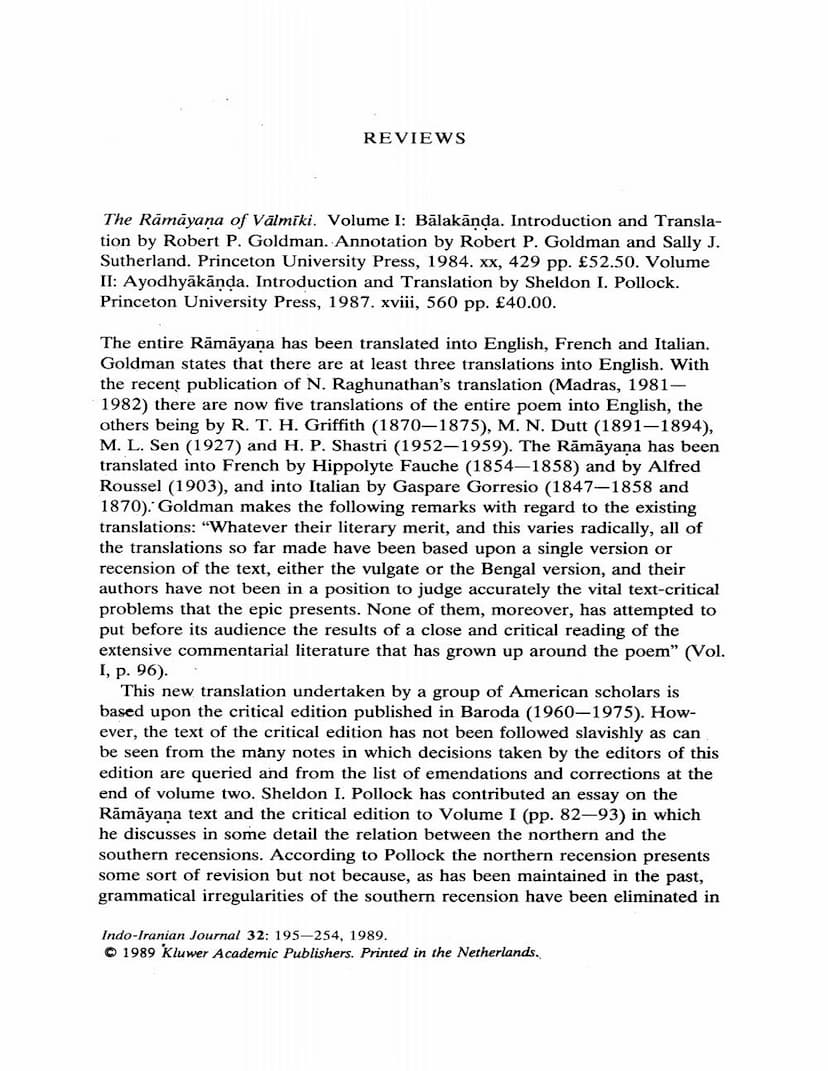
1. The Rāmāyaṇa of Valmiki. Volume I: Bālakāṇḍa and Volume II: Ayodhyākāṇḍa
- Focus: A new English translation of the Rāmāyaṇa by American scholars, based on a critical edition.
- Key Points:
- Discusses the existing translations of the Rāmāyaṇa and the critical approach of this new edition, which questions the decisions of the editors of the Baroda critical edition.
- Analyzes the differences between Northern and Southern recensions of the text, with Pollock arguing the Northern recension tends towards popularization or glossing.
- Examines Goldman's introduction, covering theories on the date and historicity of the Rāmāyaṇa, placing its oldest parts after the 7th century BCE but acknowledging a potential gap between events and composition.
- Discusses the relationship between the Rāmāyaṇa and the Rāmopākhyāna in the Mahabharata, favoring the priority of Valmiki's work.
- Highlights Rama's characterization, particularly his self-denial and emotional responses, and debates whether his character is truly "rounded."
- Praises the detailed annotation, noting its importance for understanding difficult passages and the extensive use of commentaries.
- Pollock's analysis of the Ayodhyākāṇḍa focuses on kingship, the "moralization" of political power, and narrative revisions, such as the episode of the two boons.
- Discusses the role of fate and karma, particularly in Dasaratha's story.
- Highlights the congruences and disagreements between the Rāmāyaṇa and Mahābhārata, suggesting coextensive processes rather than direct priority.
- Appreciates the translation's readability and accuracy, but offers some suggestions for alternative renderings of specific passages and epithets.
- Notes the difficulty for translators due to the "sensorially opaque" nature of Vālmīki's epithets.
2. Constantina Rhodes Bailly, Shaiva Devotional Songs of Kashmir.
- Focus: A translation and study of Utpalaadeva's Shivastotravali.
- Key Points:
- Based on a dissertation examining manuscripts and textual traditions.
- Found no major variants among the manuscripts and minor differences in the published text.
- The introduction discusses the spiritual content but less on literary form.
- Praises the translation as faithful and agreeable, conveying Utpalaadeva's devotion.
- Notes some instances of technical terms not being correctly rendered or explained.
- Critiques the romanized text for not separating words properly.
- Highlights numerous misprints in the text and the romanization process.
3. Alfred Hillebrandt, Kleine Schriften.
- Focus: A collection of the scholarly writings of Alfred Hillebrandt.
- Key Points:
- Highly welcomes the publication of Hillebrandt's "Kleine Schriften" (Minor Writings) due to his enduring influence.
- Notes Hillebrandt's active engagement in various fields: Vedic studies, linguistics, Arthasastra, drama, Kalidasa, Indian materialism, and Buddhism.
- Highlights the inclusion of many articles, including a significant review of Oldenberg's work and articles on the Mudrarakshasa and Kautilya's Arthasastra.
- Appreciates the editor's meticulous compilation of a detailed bibliography, corrigenda, and indexes.
- Considers the volume a fitting tribute to a great scholar.
4. Jaan Puhvel, Comparative mythology.
- Focus: A study of Indo-European comparative mythology.
- Key Points:
- Notes the title is slightly misleading as it focuses on Indo-European mythology.
- Critiques Lévi-Strauss's structuralist approach.
- Emphasizes a philological approach rooted in probing and comparing primary written records.
- Identifies Georges Dumézil as Puhvel's main guide.
- Systematically studies Indo-European mythologies (Vedic India, Ancient Iran, Greece, Rome, Celtic, Germanic, Baltic, Slavic).
- Discusses the "Kingship in Heaven" myth, attributing it to Near Eastern diffusionism rather than an Indo-European theme.
- Examines the concepts of "Indo-European" and "Indo-Iranian," highlighting agreements between Indic, Iranian, Italic, and Celtic traditions.
- Covers special themes like god and warrior, king and virgin, horse and ruler.
- Finds the book a lucid introduction to the topic, judiciously presented with personal views.
5. Gilgul. Essays on transformation, revolution and permanence in the history of religions.
- Focus: A collection of essays dedicated to R. J. Zwi Werblowsky.
- Key Points:
- A tribute to a scholar active in various religious studies fields.
- Includes several articles on Indian and Iranian religions.
- Mentions Heesterman on Vedic sacrifice, O'Flaherty on the shepherd metaphor, Shulman on the Rāmāyaṇa in Sanskrit and Tamil, and Shaked on Iranian mythological transformations.
- Notes Kitagawa's brief discussion of eschatological concepts and Smart's article on diaspora.
- Mentions articles on Taoism and Shin Buddhism.
- Regrets the numerous misprints in the volume.
6. Eli Franco, Perception, knowledge and disbelief. A Study of Jayarasi's Scepticism.
- Focus: A study of Jayarasi's skepticism and his text, Tattvopaplavasimha.
- Key Points:
- Jayarasi's text is the only preserved work of the Lokayata/Carvaka school.
- Jayarasi was a radical skeptic, rejecting even perception as a valid means of cognition, differing from traditional Lokayata materialism.
- Confirms Jayarasi's dating to the 8th century AD.
- Highlights the difficulty of Jayarasi's text due to his laconic references to criticized theories and use of lost texts.
- Franco identifies Jayarasi's sources and provides detailed, penetrating notes.
- Franco re-edits the text, establishing better readings.
- Discusses the arguments against skepticism and the fallacy of self-refutation in both Indian and European philosophy.
- Praises skepticism's role in understanding the development of Indian thought and its comparative value with Western philosophy.
- Notes the interesting use of the term "avicāritaramaniya" (delightful without deliberation) in Jayarasi's text and its parallels in Buddhist texts.
7. Patrick Olivelle, Renunciation in Hinduism. A Medieval Debate.
- Focus: A debate between Advaita and Visistadvaita Vedanta schools concerning the proper "emblem" (linga) of a Brahmanical renouncer.
- Key Points:
- The debate centers on three main points: wearing the sacrificial cord and topknot, the type of staff carried (triple vs. single), and the existence of a level of renunciation transcending dharma.
- Olivelle traces the history of the controversy, including the distinction between ekadanda and tridanda.
- The debate operates at two levels, depending on whether the renouncer is enlightened or aspiring.
- The controversy highlights deep doctrinal divisions, symbolized by the renouncer's emblem.
- The debate involved appealing to sruti and smrti texts, raising issues of authenticity and hermeneutical principles.
- The volume contains text and translation of Advaita and Visistadvaita texts.
- Olivelle's translations are generally careful, though a few minor points of contention are raised.
8. Mark Tatz, Asarga's Chapter of Ethics With the Commentary of Tsong-KhaPa, The Basic Path to Awakening, The Complete Bodhisattva.
- Focus: Translations of Asanga's Chapter on Ethics and Tsong-kha-pa's commentary.
- Key Points:
- Provides a good explanation of Bodhisattva ethics and relevant literature.
- Highlights Tsong-kha-pa's work as instructive due to his detailed knowledge of Indian literature.
- Notes Tsong-kha-pa's extensive reliance on Indian commentaries and other scholars.
- Critiques the translation for its arrangement (notes following the commentary) and lack of page references to certain editions.
- Suggests improvements for text subdivision.
- Points out several instances of mistranslation and misunderstanding of both Sanskrit and Tibetan texts.
- Criticizes Tatz's neglect of the Chinese version for textual correction.
- Suggests that Tatz's work would have benefited from more careful vetting.
9. David Snellgrove, Indo-Tibetan Buddhism.
- Focus: A comprehensive work on Buddhism in India, Central Asia, Nepal, and Tibet up to 1300 AD.
- Key Points:
- Covers Buddhist origins in India, later developments, Tantric Buddhism, Buddhist communities, and the conversion of Tibet.
- Snellgrove justifies his brief treatment of Indian origins due to the abundance of existing scholarship, but the reviewer questions if this makes it "easily treated."
- Notes Snellgrove's focus on correcting perceived "wrong ideas" and his own approach to social history.
- Stresses that Hinayana and Mahayana are not strictly distinct but fluctuating tendencies.
- Highlights the importance of the stupa and Buddha-image in Mahayana devotion.
- Discusses tantric iconography, noting limited material earlier than the 9th century.
- Questions Snellgrove's downplaying of layfolk influence in Mahayana development.
- Praises the chapters on Tantric Buddhism and the Conversion of Tibet as masterful contributions.
- Notes Snellgrove's distinction between Mahayana and Vajrayana, and his critical view of the traditional categorization of tantras.
- Commends the detailed overview of Tantrism and translations from Tantric texts.
- Highlights the conversion of Tibet, the relationship between Bon and Buddhism, and the influence of Indian and Chinese Buddhism.
- Appreciates Snellgrove's command of sources and experience with Tibetan Buddhism.
- Offers critiques on specific translations and interpretations, particularly regarding the letter of Buddhaguhya and the Twelve Acts of the Buddha.
10. Donald S. Lopez, Jr., A Study of Svätantrika.
- Focus: A detailed study of the Svätantrika school of Madhyamaka philosophy.
- Key Points:
- Notes that terms like Prasangika and Svätantrika originated with Tibetan scholars.
- Identifies Bhavaviveka as the founder of the Svätantrika school.
- Lopez's study primarily relies on Tibetan doxographers rather than the original Indian sources.
- Acknowledges the potential dangers of this approach, but frames his work as a preliminary study and a grid for viewing Indian masters.
- The first part systematically describes the Svätantrika system as understood by Tibetan scholars.
- The second part is a translation of ICan-skya rol-pa'i-rdo-rje's chapter on Svätantrika.
- Praises the translation's faithfulness and clarity but desires more explicatory notes.
- Critiques Lopez's use of phonetic transcriptions for Tibetan names and idiosyncratic renderings of Sanskrit terms.
- Questions the reliability of his Sanskrit knowledge and his inconsistency in identifying quotations.
- Emphasizes the need for future work to compare Tibetan interpretations with original Svätantrika texts.
11. Jeffrey Hopkins, Emptiness Yoga. The Middle Way Consequence School.
- Focus: A translation and commentary on a section of ICan-skya rol-pa'i-rdo-rje's work, specifically on the Prāsangika school of Madhyamaka.
- Key Points:
- Hopkins's book is a translation and commentary on a significant portion of ICan-skya rol-pa'i-rdo-rje's treatise on Buddhist philosophical systems.
- His commentary draws heavily on oral and written traditions of Tibetan Buddhism, particularly the dGe-lugs-pa school.
- Praises the commentary's usefulness for understanding Indian Buddhist philosophy from a Tibetan perspective.
- Critiques Hopkins's idiosyncratic translation choices and the unnecessary consulting of Tibetan texts to understand his renderings.
- Notes his excellent knowledge of Tibetan Buddhist texts but suggests more readable translations.
12. Dieter Michael Back, Rig pa no sprod gcer mthon ran grol.
- Focus: A critical edition and translation of a text from the Bar do thos-grol (Tibetan Book of the Dead) literature.
- Key Points:
- Discusses the composition of different collections of BTG texts.
- Suggests the text reflects fundamental ideas of the Vijñānavāda school, though definite influence is hard to detect.
- Critiques Evans-Wentz's earlier translation, pointing out errors in Back's own translation and misunderstanding of Tibetan terms.
- Notes that the text's telegraphic style and omission of particles caused difficulties.
- Highlights several mistranslations and issues with understanding syntactical relations.
- Hopes Back will continue editing BTG texts, emphasizing the need for critical editions of core texts.
13. René de Berval (éd.), Présence du Bouddhisme.
- Focus: A re-edition of a special issue of the journal France-Asie on Buddhism.
- Key Points:
- The original 1959 volume aimed to present a summary of 2,500 years of Buddhist action and culture.
- The re-edition omits many articles deemed "outdated" and translates English articles into French.
- Critiques the selective omission of articles and the lack of thorough revision of many contributions.
- Notes that the claim of the re-edition being a "classic of reference" is not entirely justified due to the incomplete updating.
- Appreciates the renewed illustrations and extended bibliography.
- Highlights errors in the bibliography and specific articles.
- Suggests a more complete update would have made the book a more valuable resource.
14. Carol Meadows, Arya-Sura's Compendium of the Perfections.
- Focus: Text, translation, and analysis of the Pāramitāsamāsa.
- Key Points:
- Compares the Pāramitāsamāsa (PS) with the Jātakamālā (JM), finding no strong evidence for common authorship, despite some shared verses.
- Suggests the PS was written around the 7th or 8th century AD.
- Meadows's edition is based on a Newari manuscript (K), considered superior to Ferrari's source.
- Critiques the critical apparatus, finding it clumsy and incomplete.
- Proposes several emendations to the text, some of which are questioned by the reviewer.
- Strongly criticizes the translation for numerous elementary mistakes and misunderstandings of the text and its Sanskrit equivalents.
- Suggests Meadows was insufficiently qualified for the translation.
15. Richard Gombrich, Theravāda Buddhism. A Social History from Ancient Benares to Modern Colombo.
- Focus: A social history of Theravāda Buddhism.
- Key Points:
- Praised as original and inspiring, demonstrating firsthand knowledge of Sri Lankan Buddhism and its history.
- Focuses on key problems rather than repeating well-known facts, offering clear personal opinions.
- The introduction addresses theoretical issues in social history and the reliability of Pali sources. Gombrich provisionally accepts tradition until evidence suggests otherwise.
- Distinguishes between "soteriology" and "communal religion" in defining Buddhist identity.
- Discusses the Buddha's problem situation in relation to Vedic civilization and urbanization, suggesting his message appealed to town-dwellers and new social classes.
- Highlights the ethicization of the doctrine of karma and Buddhism's appeal to businessmen and the socially mobile.
- Finds it difficult to fully explain why urban elites abandoned everything for salvation.
- Praises the chapters on Sinhalese Buddhism for their stimulating reading and insight into contemporary trends.
- Offers minor points of critique regarding the interpretation of the "Four Noble Truths" inspiration, the dating of the Canon's writing down, and the meaning of "upaniṣad."
16. Jens-Uwe Hartmann, Das Varnārhavarnastotra des Mātrceta.
- Focus: A critical edition and translation of Mātrceta's Varnārhavarnastotra.
- Key Points:
- Builds upon previous fragment editions, using newly discovered fragments to reconstruct a larger portion of the text.
- Critiques Shackleton Bailey's reconstructions based on Tibetan translations, highlighting the difficulty of precise reconstruction.
- Corrects a detail about Pauly's publication.
- Discusses sources for Mātrceta's biography and lists attributed works.
- Highlights the importance of quotations for determining Mātrceta's date, noting a prose passage in the Mahāprajñāpāramitopadeśa that differs from the verses.
- Debates whether Mātrceta was a Mahāyāna follower, arguing a verse indicates knowledge of the concept rather than adherence.
- Praises Hartmann's edition as excellent, careful, and preferring minimal reconstructions.
- Suggests some alternative readings for certain verses.
- Critiques the translation, finding Shackleton Bailey's often preferable, particularly in interpreting nuanced Sanskrit terms and wordplay.
- Notes Hartmann's omission of the word "dharma" in translations, leading to awkward phrasing.
17. Pandit Usharbudh Arya, Yoga-sūtras of Patañjali with the Exposition of Vyāsa. Volume I: Samādhi-pāda.
- Focus: A translation and commentary of Patañjali's Yoga Sūtras and Vyāsa's commentary.
- Key Points:
- Aims to open the Yoga Sūtras to serious English-reading aspirants, adhering to an initiatory tradition and incorporating all available commentaries.
- Refrains from scholarly debates on authorship and dates, viewing Patanjali and Vyasa as a single composite whole.
- Critiques Western scholars' approaches, prioritizing practice over academic study.
- Promises academic rigor while upholding traditional convictions.
- The reviewer notes the absence of a critical analysis of Vyasa's commentary and points out a controversial reinterpretation of "women" as "opposite sex" based on perceived "contemporary concerns."
- Suggests that appealing to the "experiential tradition" doesn't resolve contradictions in commentaries and that "Himalayan masters" might not approve of all interpretations.
18. Gareth Sparham (tr.), The Tibetan Dhammapada. Sayings of the Buddha.
- Focus: A translation of the Tibetan version of the Udānavarga.
- Key Points:
- The title is misleading; it is a translation of the Tibetan Udānavarga, not the Pali Dhammapada.
- Sparham believes Tibetan sources should be primary, with Sanskrit as an aid, a view criticized by the reviewer.
- Criticizes Sparham's lack of familiarity with philological problems and insufficient use of Prajñāvarman's commentary.
- Highlights instances where Sparham mistranslates Tibetan terms or misunderstands Sanskrit Buddhist terminology.
- Notes that the Tibetan version represents a different recension of the Udānavarga than the Sanskrit text.
- The reviewer states that Sparham's belief that Tibetan sources are paramount is flawed and leads to such works.
19. Gerhard Ehlers, Alttürkische Handschriften.
- Focus: A catalogue of Old Turkish manuscripts from Turfan in West Berlin.
- Key Points:
- Describes fragments belonging to the Altun Yarok (Turkish translation of the Suvarnaprabhāsa) and the Daśakarmapathāvadānamālā.
- Notes the Berlin manuscripts are generally closer to I-tsing's translation of the Suvarnaprabhāsa than the Petersburg edition.
- Highlights the careful compilation of the catalogue and hopes it will inspire similar efforts for other collections.
20. Jens Peter Laut, Der frühe türkische Buddhismus und seine literarischen Denkmäler.
- Focus: An examination of early Turkish Buddhism and its literary monuments.
- Key Points:
- Emphasizes the importance of Old Turkish literature for Indian and Buddhist studies, citing unique or differing versions of texts like the Daśakarmapathāvadānamālā and Maitrisimit.
- Discusses the "Sogdian hypothesis" and the influence of Sogdians in propagating Buddhism under the Uigurs.
- Examines the Säkiz Yükmäk Yarok Sūtra and the Maitrisimit, analyzing their loan-words and dialectical features.
- Highlights Laut's important study of loan-words and their origins (Indian, Sogdian, Tocharian).
- Notes the presence of a core Buddhist vocabulary in all Old Turkish texts.
- Concludes that Laut's findings are significant for understanding Old Turkish manuscripts and the history of Buddhism in Central Asia.
In essence, De Jong's reviews provide critical assessments of these academic works, highlighting their strengths, weaknesses, and contributions to the respective fields. He often engages in detailed philological and interpretive discussions, offering his own scholarly insights.