
Reviews Of Diffeent Books
Added to library: September 2, 2025
Summary
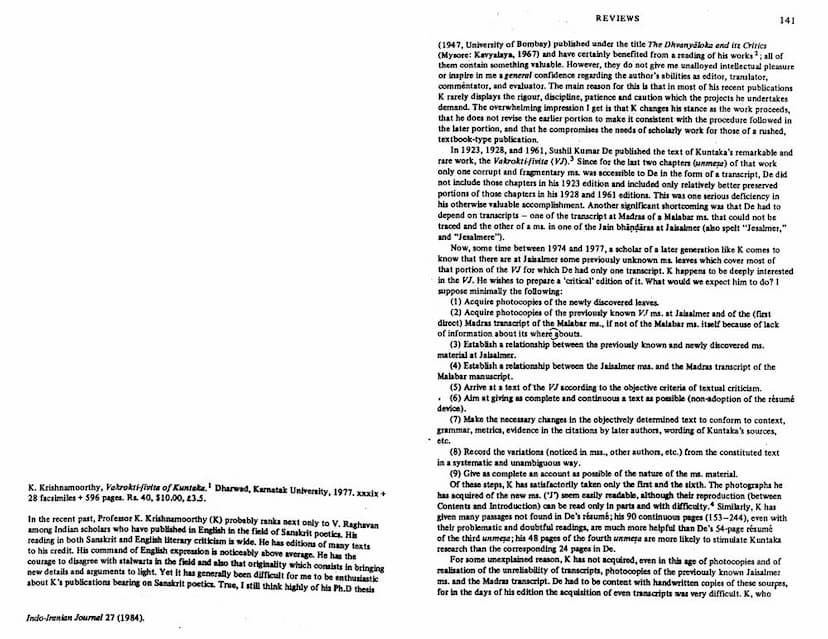
This document is a review by Ashok Aklujkar of K. Krishnamoorthy's 1977 critical edition and English translation of Kuntaka's Vakrokti-jivita (VJ), a foundational text in Sanskrit poetics. The review is largely critical, highlighting significant shortcomings in Krishnamoorthy's work.
Overall Assessment:
Aklujkar states that while Krishnamoorthy is a prominent Indian scholar in Sanskrit poetics with a wide reading and good English command, his publications in this field, including the VJ edition, generally lack the rigor, discipline, patience, and caution demanded by such scholarly projects. He finds Krishnamoorthy's approach inconsistent and prone to compromising scholarly standards for what appears to be a rushed, textbook-style publication.
Specific Criticisms of Krishnamoorthy's VJ Edition:
The review meticulously details a range of issues, categorized as follows:
1. Textual Criticism and Methodology:
- Failure to Acquire and Utilize Key Manuscripts/Transcripts: Krishnamoorthy is criticized for not acquiring photocopies of previously known Jaisalmer manuscripts and the Madras transcript, relying instead on transcripts of transcripts or indirect copies. This is seen as a significant oversight in an age of photocopies.
- Unclear Textual Basis: The description of the manuscript sources is described as incomplete, ambiguous, and difficult to piece together, leading to uncertainty about the basis of his edition.
- Problematic Variant Readings: Krishnamoorthy's method of recording variant readings is criticized as mechanical and inconsistent. He often relegates De's readings to footnotes without clear justification or systematic comparison, forcing readers to consult De's edition alongside Krishnamoorthy's.
- "Weaker" Definition of Critical Edition: Aklujkar argues that Krishnamoorthy's edition fits a "weaker" definition of a critical edition, which requires only using more than one manuscript and reporting variants, rather than establishing objective criteria for text constitution and manuscript relationships.
- Haphazard Tracing of Quotations and Identification of Kuntaka's Sentences: While Krishnamoorthy does trace some sources and identify quotations, this is done in a haphazard manner, with valuable details from earlier scholars omitted.
- Inconsistent Use of Parentheses and Brackets: The use of parentheses and brackets to indicate emendations or textual additions is inconsistent and lacks clear explanation, leading to ambiguity.
- Failure to Address Manuscript Issues: Krishnamoorthy does not adequately address issues like the sequencing of manuscript leaves or the fragmented nature of certain manuscripts, which are evident in the text.
2. The Question of the VJ's Extent:
- Krishnamoorthy's conclusion that the current version of the VJ is nearly complete is challenged. Aklujkar argues that Krishnamoorthy's justification for this view is weak, particularly his claim about rearranging misplaced leaves, and that internal references within the text should have been more thoroughly analyzed.
3. Translation:
- The English translation is described as inconsistent, sometimes literal and sometimes free, with readings not always aligning with the constituted text.
- It lacks indications of uncertainty or explanatory notes for complex philosophical points, giving the impression that there are no interpretative problems.
- A specific example of translation is analyzed, highlighting a lack of recognition of quoted material (from Panini) and a misinterpretation of Sanskrit terms.
4. General Lack of Rigor and Discipline:
- Across various aspects of the publication, including general remarks, text division, verse enumeration, punctuation, and tracing of quotations, there is a pervasive lack of discipline.
- Krishnamoorthy's approach to textual criticism is characterized by a tendency to be satisfied with an approximate understanding, failing to press for deeper answers or explanations of peculiarities.
Positive Contributions (Though Limited):
- Krishnamoorthy is credited with making the preserved text of the VJ available in its entirety and for introducing some occasional improvements over De's earlier edition.
- He also deserves credit for tracing some sources of Kuntaka's passages and identifying some of Kuntaka's sentences quoted in later works, which represents an advance over De's work.
Conclusion and Call for Future Work:
Aklujkar concludes that Krishnamoorthy's edition, while useful, is far from definitive or reliable. He emphasizes the urgent need for a rigorously executed new edition of Kuntaka's work, as progress in Kuntaka studies is unlikely without it and without a thorough discussion of textual problems.
The review also includes a detailed appendix listing manuscripts and transcripts of the VJ known to Aklujkar, which he hopes will aid future editors.