
Retention Of Medical Consonents In Grammar Of Ardhamagadhi By Hermann Jacobi
Added to library: September 2, 2025
Summary
Here's a comprehensive summary of the provided text, "Retention of Medial Consonants in the Grammar of Ardhamāgadhī by Hermann Jacobi" by K.R. Chandra:
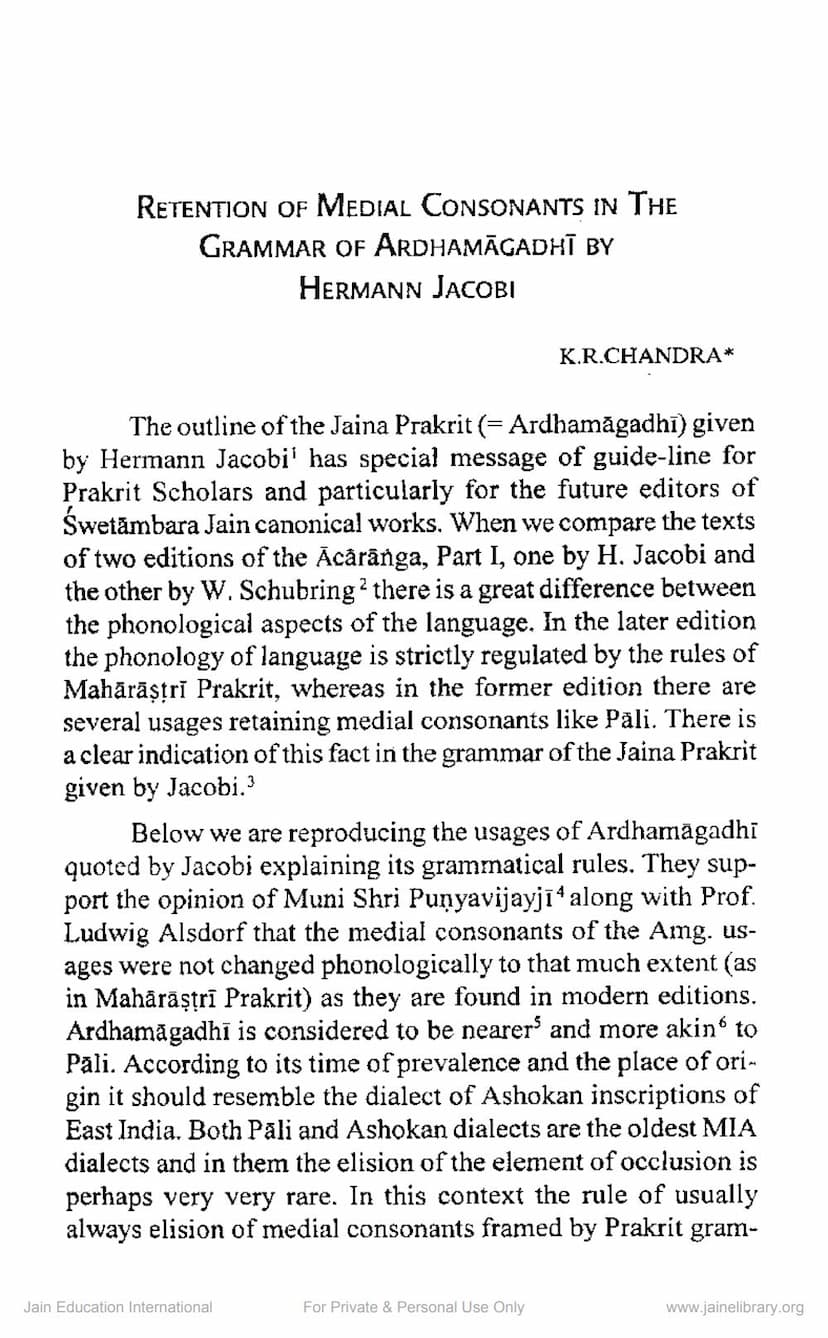
The article highlights the significant contribution of Hermann Jacobi's grammar of Jaina Prakrit (Ardhamāgadhī) for Prakrit scholars, particularly those involved in editing Śwetambara Jain canonical works. The author, K.R. Chandra, points out a notable difference in the phonological aspects of the language when comparing Jacobi's edition of the Ācārānga, Part I, with a later edition by W. Schubring. The latter strictly adheres to the phonological rules of Mahārāṣṭrī Prakrit, while Jacobi's edition retains several usages that preserve medial consonants, similar to Pali.
Chandra argues that Jacobi's grammar provides crucial evidence supporting the opinion of Muni Shri Punyavijayji and Professor Ludwig Alsdorf. They believe that medial consonants in Ardhamāgadhī were not phonologically altered to the same extent as seen in Mahārāṣṭrī Prakrit, and consequently, modern editions of Ardhamāgadhī texts might not accurately reflect the original language. Ardhamāgadhī is considered closer to Pali and, based on its time and place of origin, should resemble the dialects of the Ashokan inscriptions of East India. Both Pali and Ashokan dialects, being the oldest Middle Indo-Aryan (MIA) dialects, rarely exhibit the elision of occlusive elements. In this context, the rule of frequent elision of medial consonants, as framed by Prakrit grammarians for Mahārāṣṭrī and applied to modern Ardhamāgadhī texts, is deemed inappropriate and unjustified by Chandra. Therefore, the usages cited by Jacobi in his grammar warrant serious consideration for a linguistically accurate re-editing of Ardhamāgadhī texts.
The article then reproduces specific usages of Ardhamāgadhī quoted by Jacobi, which deviate from the typical Mahārāṣṭrī usages found in his Ācārānga text. These examples demonstrate the retention of medial consonants:
- क् = क्: Examples include ekāras, paḍikūl, sahasaṇāre.
- ग् = ग्: Examples include bhagavatā, bhagavati, bhagiṇī.
- ज् = ज्: Examples include abhijāṇati, pajāhiti.
- द् = द्: Examples include appamādo, egadā, dāyādā, paḍisaṃvedayati, vadanti, vadāsi, vedeti, samādāṇaṃ.
- थ् = थ्: Example is tathā (written as tadhā).
- ध् = ध्: Example is madhūṇi.
- न् = न्: Examples include ni'uṇ, niyatti.
- न् = न्: Example is nātā.
- न्य = न्य: Examples include anna, kannā (referring to neuter forms in Nominative and Accusative plural like phalāṇi, sappiṇi, madhūṇi).
- Medial -ī-: Various positions are shown, including in numerals (asīti, tatīya, bitiya), nouns (pitā, mātā, pitaraṃ, mātaraṃ, pitaro, mātarō), instrumental singular (bhagavatā), ablative singular (dhammāto, kannāto, devīto), locative singular (bhagavati), pronouns (etaṃ, etehi, tato), present tense (3rd person singular of verbs like kareti, kāreti, khāmeti, gacchati, giṇhati, deti, suṇeti, sevate), future (3rd person singular like parehassa, āsailela, saṃphela), passive (3rd person singular like kajati, kasthati, kīrati, gheppati, chijjati, tappati, dissaīti, bujjhiijjati, lājjati, nibbhāti), infinitive (jīvitum), past passive participle (gahaḍa, maḍaa), absolutive (atiyacca), causal (3rd person singular like parāvaṇā, nivvāvaṇā, paḍāvaṇā, anuvāvaṇā), present participle (paritappamāṇa), and optative (ativāejjā).
Chandra asserts that these usages demonstrate that Ardhamāgadhī was phonologically distinct from Saurasenī and Mahārāṣṭrī, sharing resemblances with Pali and exhibiting an archaic nature. He criticizes previous Prakrit grammarians, including Hemacandra, and even modern scholars, for not treating Ardhamāgadhī as a separate language with its distinct phonological characteristics.
Furthermore, the article discusses Richard Pischel's work. While Pischel utilized Jacobi's edition and grammar of Jaina Prakrit, Chandra notes that Pischel's grammar doesn't explicitly state that archaic Ardhamāgadhī sometimes retained medial consonants. Pischel also failed to incorporate Jacobi's examples when explaining Prakrit and Ardhamāgadhī grammar, instead quoting Mahārāṣṭrī forms for Ardhamāgadhī usages. This omission, according to Chandra, necessitates a revision of Pischel's grammar concerning Ardhamāgadhī, as it generally presents no phonological difference between Ardhamāgadhī and Mahārāṣṭrī vocables.
The footnotes further elaborate on certain linguistic points:
- Jacobi's preface to his Āyaraṃga-Sutta is referenced.
- Professor Ludwig Alsdorf's agreement with the need to reconsider the problem is noted.
- The presence of numerous medial consonants in Jacobi's Ācārānga similar to Pali is highlighted.
- Pischel's view on connecting Ardhamāgadhī with Magadhi inscriptions rather than Mahārāṣṭrī is mentioned, along with the possibility of Western influence (specifically Mahārāṣṭrī) on the dialect during the compilation of the canon, though it didn't fundamentally alter Ardhamāgadhī's character.
- The voicing of unvoiced medial consonants is attributed to an early development, predating Christianity, rather than an influence of Saurasenī.
- The retention of initial dental nasal 'n' and its cerebralization into 'ṇ' by Indian editors is deemed incorrect for Ardhamāgadhī.
- The change of 'l' and 'fl' to 'l' in Ashokan inscriptions is contrasted with the incorrect practice of changing them to 'm' in Ardhamāgadhī.
- The archaic neuter plural suffix '-ni' in Ardhamāgadhī is discussed as being replaced by '-im' in later Prakrits, and its retention is considered consistent with the archaic nature of Ardhamāgadhī, aligning with Pali and Ashokan inscriptions.
In essence, the article champions the importance of Hermann Jacobi's findings for a more accurate understanding of Ardhamāgadhī, arguing that its preserved medial consonants point to a more archaic and distinct linguistic character than often acknowledged by subsequent scholarship and modern textual editions.