
Repetition In Jaina Nrative Literature
Added to library: September 2, 2025
Summary
Here's a comprehensive summary of Klaus Bruhn's "Repetition in Jaina Narrative Literature," drawing from the provided text:
Overall Goal and Approach:
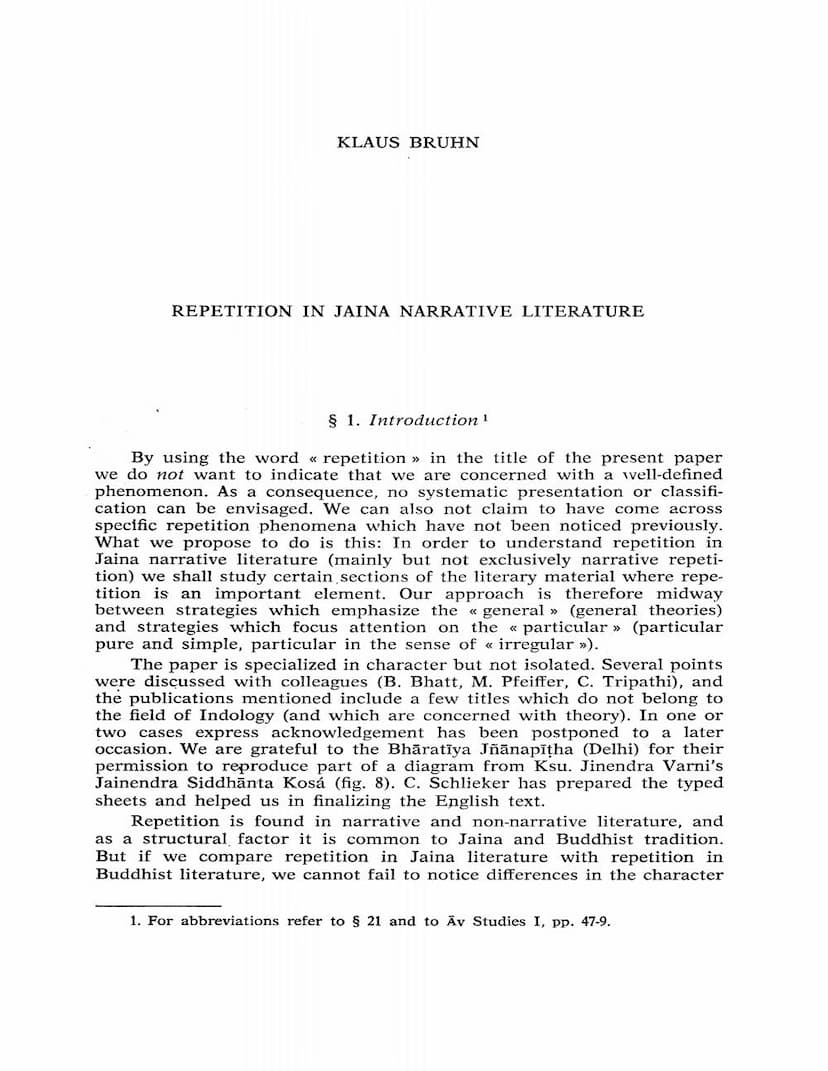
Klaus Bruhn's paper aims to understand the phenomenon of repetition within Jaina narrative literature. He acknowledges that "repetition" isn't a single, easily defined concept and therefore avoids presenting a systematic classification or claiming to discover entirely new forms. Instead, his approach is to study specific sections of Jaina literature where repetition is a significant element. This allows for a balance between general theories and particular instances, focusing on "limited and uniform sections of the material" (Page 3).
Key Literary Genres Studied:
Bruhn concentrates his analysis on two primary categories:
-
Varga Literature (Canonical): This refers to a specific group of canonical Jaina texts characterized by similarities in content, structure, and vocabulary. The author lists several examples, including Jñātādharmakathāh II, Upāsakadaśāḥ, Antakṛddaśāḥ, and others. A defining feature of Varga Literature is the "casual and sketchy repetition of stories," often multiplied with minor variations like names. Bruhn identifies two main types of repetition within this genre:
- Varnaka-Repetition: This involves the reuse of descriptive passages (varnakas) for typical objects, persons, or events across different stories. A "cliché" description can be applied to multiple cities, for example. This requires distinguishing between "source-passages" (providing the varnaka) and "target-passages" (needing the varnaka).
- Hero-Variation: In contrast to varnaka-repetition, this involves instructing that a story be repeated with substitutions for the hero's name or other details. The story itself is narrated once, and then a "variation unit" provides the instruction for changes.
-
Universal History (UH): This refers to the mythological theme of the "history of the sixty-three great men" (Jinas, Cakravartins, and Triads). The UH is characterized by its mythological subject matter and a systematic approach to narrative repetition, where members of the same series (e.g., Jinas) have similar biographies. Bruhn notes that the UH is not unique to Jainism, with parallels in Buddhist and Brahmanical literature. He categorizes the Svetambara UH literature into:
- Hemacandra's encyclopedic version (12th century).
- Earlier versions (varying in date, size, and character).
- Later versions (incomplete and unoriginal).
Specific Examples and Analysis:
- Antakṛddaśāḥ (Anga 8): This text is used as a primary example to demonstrate the types of repetition found in Varga Literature. Bruhn discusses its structure, highlighting "narrative units" (original stories) and "variation units" (instructions for repetition). He analyzes the varnaka-repetition and hero-variation techniques within Antakṛddaśāḥ, including detailed figures and line references.
- Conversion Stories: These are identified as a significant part of Varga Literature and link it to other Jaina texts. Bruhn notes their often simple structure but emphasizes their importance in understanding Jaina narrative patterns.
- Universal History in Samavāya and Kalpasūtra: Bruhn examines how the UH is presented in these texts, discussing the "slot-filler" technique in Samavāya (where categories like "Jina" are filled with specific names) and the repetition of "standard episodes" (like janmābhiṣeka) in the Kalpasūtra.
- Universal History in the Āvaśyaka Tradition: He analyzes how the UH is integrated into commentaries on the Āvaśyaka Sūtra, noting both tabular and narrative sections.
- Hemacandra's Triṣaṣṭiśalākāpuruṣacaritra: This is presented as the only truly complete version of the UH, characterized by a high degree of repetition through standard episodes and fillers, contributing to its extraordinary size.
- Somatilaka's Saptatiśatasthānaprakaraṇa: This specialized work further illustrates the "slot-filler" technique, focusing on enumerating numerous "slots" (attributes or aspects) related to the Jinas.
Key Concepts and Observations:
- "Ètiquette" of Repetition: Bruhn suggests that repetition in Jaina literature is not merely a stylistic flourish but often serves as a structured generative principle, consciously employed by ancient authors. This "state of being built or fabricated" (Gebautheit) is a key impression conveyed by many works.
- Scholasticism: The author extensively discusses "scholasticism" as a pervasive tendency in ancient Indian thought, including Jainism. He describes it as a "passion for presenting a systematic and detailed view of the entire universe," characterized by categorization, schematization, and a focus on form over content. This scholasticism is directly linked to the elaborate forms of repetition found in Jaina texts, contributing to their "arid," "dry," and "artificial" character for some modern readers.
- "Fields and Zones": To manage the complexity of literary analysis, Bruhn proposes distinguishing between "fields" (broad literatures like Jaina literature) and "zones" (genres, works, or texts). This allows for a more focused and manageable study of specific phenomena like repetition.
- Quantitative Data: Bruhn emphasizes the importance of quantitative data (e.g., line counts, percentages) for understanding the extent and nature of repetition.
- "Generative Principles": The recurring structures in Jaina literature are seen as "generative principles" that shaped the production of literary material. These are distinct from categories imposed by modern scholars.
- "Concatenation of Terms": Several techniques, including systematic chains of synonyms and nikṣepas, are identified as contributing to a "concatenation of terms," reinforcing the structured nature of Jaina intellectual discourse.
Overall Argument:
Bruhn argues that repetition in Jaina narrative literature is a deeply ingrained feature, closely tied to the "scholasticism" and the intellectual habits of ancient Indian authors. It manifests in various forms, from the reuse of descriptive passages (varnaka-repetition) and substitution of characters (hero-variation) in "Varga Literature" to the systematic, almost formulaic, presentation of biographies in the "Universal History." While these repetitive structures can be seen as forms of "fabrication" or "generation," they are fundamental to understanding the character and development of Jaina literary tradition. The paper emphasizes the need for detailed, structural analysis to appreciate these phenomena and their connection to the broader intellectual landscape of Jainism.