
Rencontres Indo Britanniques Au Gujerat A Propos Dune Nouvelle De Dhumketu
Added to library: September 2, 2025
Summary
Here's a comprehensive summary of the provided Jain text, focusing on the interaction between British individuals and Gujarat, and specifically the story of James Forbes and Dabhoi, as interpreted through the lens of Dhumketu's short story:
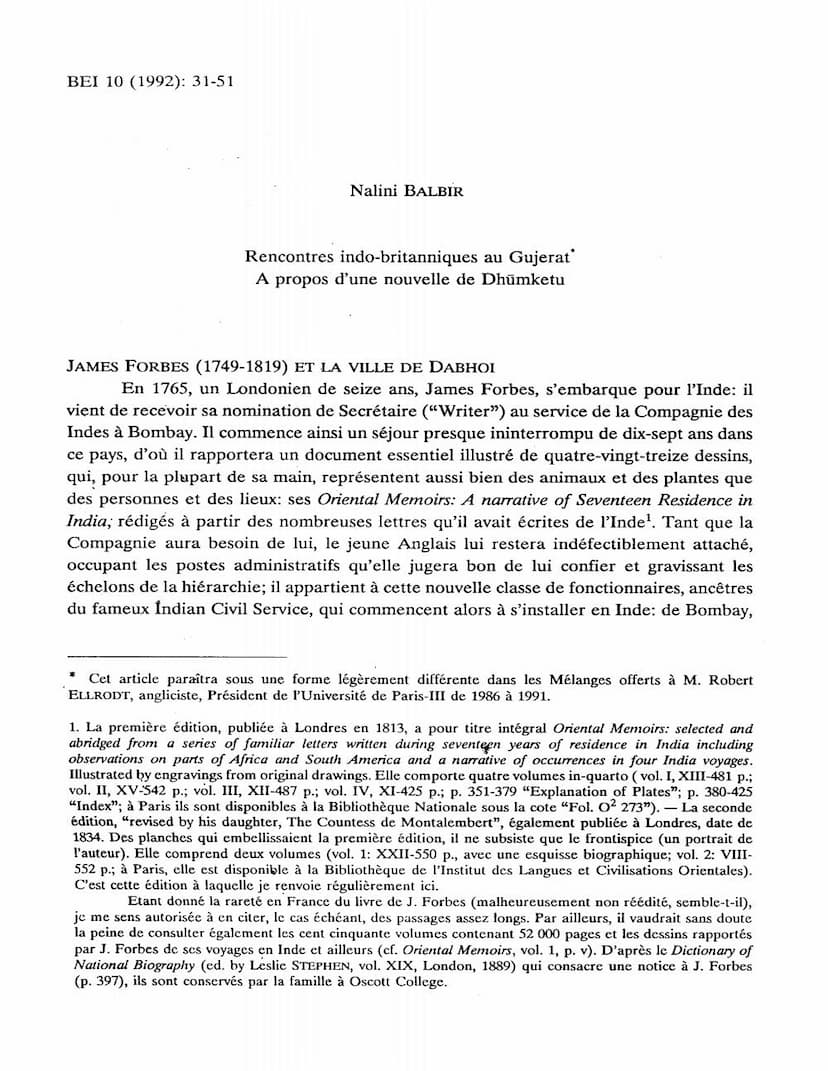
This article, "Rencontres indo-britanniques au Gujerat A propos d'une nouvelle de Dhumketu" by Nalini Balbir, explores the significant cultural and historical encounters between the British and the region of Gujarat, India, particularly through the lens of James Forbes's experiences and his writings, contrasted with the Gujarati short story "Vinipat" by Dhumketu.
James Forbes and his Admiration for Gujarat:
- Early Life and Service: James Forbes, a sixteen-year-old Londoner, arrived in India in 1765 to serve the East India Company as a "Writer" (an administrative official). He spent seventeen years in India (1765-1784), a period characterized by internal conflicts and the gradual assertion of British dominance against regional powers like the Marathas.
- Oriental Memoirs: Forbes's experiences were meticulously documented in his "Oriental Memoirs: A narrative of Seventeen Residence in India," a work illustrated with his own drawings. This book became a crucial document for understanding India at that time.
- Gujarat as a "Paradise": Forbes developed a deep affection for Gujarat, calling it "the paradise of nations" and the "most beautiful part of India."
- Dabhoi - A City of Wonder: During his service, Forbes was stationed in or near Dabhoi, a fortified city in Gujarat. He was captivated by its magnificence, particularly its fortifications, gates, and temples. He describes in detail the city's quadrangular shape, impressive stone fortifications, a large tank with grand steps, and the surrounding sacred groves.
- The Gate of Diamonds: The "Gate of Diamonds" (Hira Gate) on the eastern side of Dabhoi particularly impressed Forbes. He lauded its intricate sculpture, comparing it favorably to Greek and Roman art. He notes its elaborate carvings, depictions of elephants, warriors, and even a scene reminiscent of Adam and Eve. The gate's name, possibly derived from the legend of the deity's diamond eyes or its costly architecture, added to its mystique.
- Personal Connection and Departure: Forbes's departure from India, and specifically from Dabhoi, was a poignant moment. The city represented a symbol of India's rich past and a reflection of its tumultuous history. The transfer of Dabhoi to the Marathas led to Forbes's departure, leaving him with a sense of regret and perhaps bitterness. He requested and was granted permission to take some small fragments of the city's ancient sculptures back to England, where he intended to build a temple for them in his garden, a testament to his deep connection with the place.
Dhumketu's "Vinipat" and its Interpretation:
- The Story's Context: The article then introduces "Vinipat" (meaning "decadence" or "fall"), a short story by Gaurishankar Govardhanram Joshi, known as "Dhumketu" (1892-1965), a prominent Gujarati writer. The story is implicitly based on the circumstances of James Forbes's departure from Dabhoi.
- Dhumketu's Approach: Dhumketu, a respected historical novelist, celebrated Gujarat's people, daily life, and past grandeur. His work often reflects on the past with a sense of regret but also carries a message for the present.
- Narrative Similarities: The story by Dhumketu mirrors many aspects of Forbes's account: the historical context of 1783, the Maratha influence, the local dignitaries' desire to offer a farewell gift to Forbes, and Forbes's specific request for sculptures.
- Dhumketu's Creative Choices: The article highlights several discrepancies between Forbes's memoirs and Dhumketu's story, suggesting they are deliberate literary choices:
- "Master Hirādhar": Dhumketu names the sculptor of the Hira Gate "Master Hirādhar," referencing a Gujarati tradition. This emphasizes Dhumketu's scholarship and his engagement with local lore.
- Scotland vs. Middlesex: Dhumketu places Forbes's estate in Scotland, while Forbes's actual property was near London. This likely serves a poetic purpose, evoking the romantic imagery of Scotland's wild landscapes.
- Someshvar Shastri: Dhumketu creates a single, wise Brahmin character, Someshvar Shastri, who becomes the intellectual counterpart to Forbes, instead of the group of Brahmins mentioned by Forbes. This allows for a deeper philosophical dialogue.
- The Role of Someshvar Shastri: Someshvar represents a contemplative, scholarly Indian perspective. He struggles with the religious implications of offering damaged religious idols to a non-Hindu. His musings on the loss of heritage and the decline of artistic appreciation resonate deeply with the themes of the story. He recognizes a kindred spirit in Forbes, someone who can appreciate the artistic value of the sculptures beyond their religious context.
- Deeper Meanings and Allusions:
- "Vinipat" as a Title: The title itself, "Vinipat," alludes to the concept of downfall or decadence, reflecting the sentiment of losing cultural heritage.
- The Second Forbes: The article suggests that Dhumketu might have subtly woven in elements related to Alexander Kinloch Forbes (1821-1865), another British administrator and admirer of Gujarati culture, who contributed significantly to preserving Gujarati literature and traditions. This parallel highlights a broader pattern of British engagement with Indian culture.
- Precursors to Archaeology: Both James and Alexander Kinloch Forbes are presented as precursors to modern archaeology in India, by documenting and appreciating India's past, laying the groundwork for institutions like the Archaeological Survey of India.
- Cultural Exchange and Understanding: The story underscores the potential for genuine understanding and shared appreciation between enlightened individuals from different cultures, even amidst political and societal shifts. Someshvar and Forbes find common ground in their admiration for art and history.
- Symbolism of the Marathas: The Marathas are portrayed with a dual nature: as formidable warriors in the Western view, and as freedom fighters in the Indian nationalist perspective (especially as interpreted through Dhumketu's story, written during India's pre-independence era).
- The "Original" Brahmin: Someshvar's classification as an "original" by the local dignitaries mirrors the later veneration of figures like Mahatma Gandhi, suggesting a certain prophetic quality or a wisdom that transcends ordinary understanding.
Conclusion:
The article concludes by emphasizing that both James Forbes's personal account and Dhumketu's fictionalized narrative of the same episode offer valuable insights. Forbes's memoirs document the British encounter with Gujarat and their initial appreciation for its culture, while Dhumketu's "Vinipat" demonstrates how Indian writers engaged with this history, imbuing it with their own cultural understanding, literary traditions, and political sensibilities, particularly concerning themes of heritage preservation and national identity. The story serves as a microcosm of broader Indo-British encounters, highlighting both shared appreciation and underlying cultural and political tensions.