
Remarks On Sarvasarvatmakatvavada
Added to library: September 2, 2025
Summary
Here's a comprehensive summary of Albrecht Wezler's "Remarks On Sarvasarvatmakatvavada," based on the provided text:
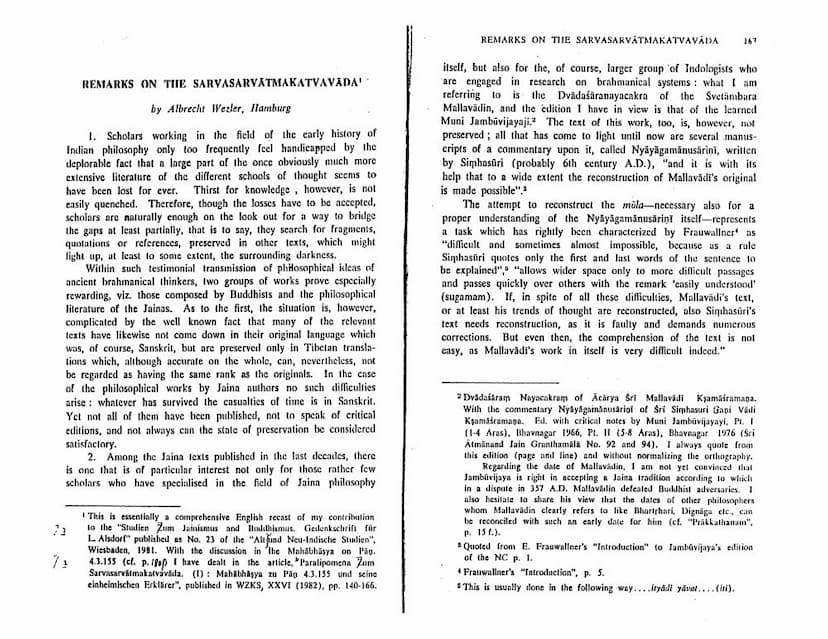
I. Introduction and Context of Jaina Philosophy Research
- The Challenge of Lost Texts: The author, Albrecht Wezler, begins by lamenting the significant loss of early Indian philosophical literature. He highlights the need for scholars to reconstruct knowledge from fragments, quotations, and references found in other texts.
- Buddhists and Jains as Crucial Sources: Wezler identifies Buddhist and Jaina philosophical literature as particularly valuable for bridging these gaps. While Buddhist texts often survive only in Tibetan translations, Jaina works that have survived are in Sanskrit, making them more directly accessible, though not always in satisfactory condition or fully published.
- The Dvādaśaranayacakra as a Key Text: The author singles out the Dvādaśaranayacakra by the Svetambara Jain scholar Mallavadin as a work of immense interest for both Jaina and Brahmanical studies. He praises the critical edition by Muni Jambūvijaya for making Mallavadin's original work, and its commentary by Simhasuri, accessible.
- Difficulties in Reconstruction: Wezler acknowledges the significant challenges in reconstructing Mallavadin's original text due to the commentary's nature (often quoting only the first and last words of sentences) and the need for textual corrections. He cites E. Frauwallner's assessment of this task as "difficult and sometimes almost impossible."
- Frauwallner's Assessment of Mallavadin: Wezler discusses Frauwallner's positive view on the Dvādaśaranayacakra's value as a source for non-Jaina philosophy, noting that it provides information on many little-known authors and works. However, he also points out Frauwallner's critical remarks about Mallavadin being "self-willed," "headstrong," and employing "reckless" or "forceful" methods in his polemics against other systems. This raises a question about the objectivity of Mallavadin's accounts.
II. The Core Subject: Sarvasarvatmakatvavada and its Identification with Samkhya
- Dialectical Structure of Chapter 3 of the NC: The central focus shifts to Chapter 3 of the Dvādaśaranayacakra (vidhyubhayāra), which discusses a particular worldview. Wezler notes a divergence between Frauwallner's analysis and Jambūvijaya's interpretation regarding the dialectical structure and the identity of the proponent of the sarvasarvatmakatvavada.
- Jambūvijaya's Interpretation: Jambūvijaya identifies an opponent who refutes Samkhya metaphysics and, as a consequence, proposes the sarvasarvatmakatvavada. This proponent is then, in turn, criticized by an Iśvaravādin (a proponent of a creator God).
- Wezler's Own Analysis and the Meaning of Sarvasarvatmakatva: Wezler delves into passages from the Nyāyāgamanusarini to clarify the meaning and attribution of sarvasarvatmakatvavada.
- Definition: He explains that sarvasarvatmakatva means "everything consists of everything else." This is supported by the observation that phenomenal reality involves transformation, where one thing becomes another (e.g., through consumption).
- Samkhya Connection: Wezler presents compelling evidence from Simhasuri's commentary that directly links sarvasarvatmakatvavada to the Samkhya system. He cites passages explaining that for Samkhya exponents, a single thing cannot be differentiated by its attributes (like color, taste) or sensory organs because it, in essence, contains everything else. This is contrasted with other schools that posit absolute distinctness.
- Examples and Parallels: The author provides detailed examples and parallels, showing how this doctrine is discussed in relation to Samkhya concepts like sarkārya-vāda (the effect pre-exists in the cause) and the nature of causation. He also points to parallels in the Yogabhāṣya and commentaries on Īśvarakṛṣṇa's Sāṅkhyakārikā.
- Prajñākaragupta and Theistic Circles: Wezler notes that Prajñākaragupta also associates sarvasarvatmakatvavada with Samkhya. However, he speculates that the concept of error formulated on its basis might not be purely Samkhya, but rather originated in theistic circles, possibly influenced by Samkhya tenets. Ramanuja's views on error and his referencing of similar Vedic passages are brought in to support this.
III. The Origin and Development of Sarvasarvatmakatvavada
- Critique and Samkhya Response: The sarvasarvatmakatvavada was attacked with the argument that if it were true, everything would be visible everywhere. The Samkhya exponents, according to Wezler, responded by invoking their concept of abhivyakti (manifestation), explaining that while things contain all others, their manifestation is conditioned by place, time, and form.
- Relationship to Prakrti and Satkaryavada: Wezler probes the deeper philosophical underpinnings. He suggests that sarvasarvatmakatvavada is not merely an empirical observation but is deeply connected to Samkhya's theory of causation (satkaryavada) and its concept of being. He discusses Frauwallner's view that satkaryavada was a later development to justify earlier arguments for the existence of prakṛti (primordial matter), but Wezler finds this improbable.
- The "Ur-Sat" and Uddalaka Aruni: Wezler posits that the Samkhya concept of being likely originated from passages like Chandogya Upanishad 6.2.1 f., which asserts that "existence alone was in the beginning, one only, without a second." He argues that Uddalaka Aruni's emphasis on "sat" originating from "sat" provided the basis for Samkhya's ontological view.
- Two Divergent Paths: He suggests that this concept of "ur-sat" led to two divergent interpretations:
- For Samkhya: Sat was interpreted as unintelligent prakṛti, the basis of the phenomenal world.
- For theistic thinkers: Sat was interpreted as a personal God from whom the world emanates.
- Theistic Proponents of Sarvasarvatmakatvavada: Wezler proposes that theistic thinkers also adopted the sarvasarvatmakatvavada, though without the Samkhya metaphysical "superstructure." He believes it is these theistic proponents whom Mallavadin identifies as the target of his critique of Samkhya's central tenets, and that an exponent of this theistic school can rightly be called a "sarvasarvatmakatvavadin."
- Mahabhasya Evidence: The author provides significant new evidence from Patanjali's Mahabhasya on Panini 4.3.155. He argues that Patanjali's answer, explaining how a word denoting a living being can be used for a dead pigeon, is based on the philosophical view that the original (the living bird) remains existent in its transformation (the dead bird). Wezler contends that this teaching is the sarvasarvatmakatvavada, tracing its origin back to the 2nd century BCE.
IV. Conclusion
- Revisiting the Identity of the "Sarvasarvatmakatvavadin": Wezler concludes that while sarvasarvatmakatvavada is strongly associated with Samkhya, it was also held by theistic groups. Mallavadin's critique of Samkhya's central tenets is directed at a specific theistic school whose exponents can be labeled "sarvasarvatmakatvavadin."
- Hypothetical Nature of Findings: He acknowledges that his analysis, especially regarding the origin and precise connections, is partly hypothetical, requiring further detailed investigation. However, he believes his approach offers a stronger, more nuanced understanding of the sarvasarvatmakatvavada's place in early Indian philosophy.
In essence, Wezler's article meticulously traces the sarvasarvatmakatvavada, demonstrating its strong ties to the Samkhya system while also uncovering its presence and development within a specific school of theistic thought. He uses textual evidence from Jain sources, particularly Mallavadin's Dvādaśaranayacakra, and cross-references it with Brahmanical and Buddhist texts to reconstruct the intellectual landscape surrounding this concept. The article highlights the importance of critical textual analysis and the potential for reinterpreting historical connections between philosophical schools.