
Remarks On J W De Jongs Notes On Suvikrantavikramiparipraccha Prajnaparamita Text
Added to library: September 2, 2025
Summary
Here's a comprehensive summary of Hiromasa Tosaki's "Remarks on J. W. de Jong's Notes on the Suvikrāntavikrāmiparipṛcchā Prajñāpāramitā Text":
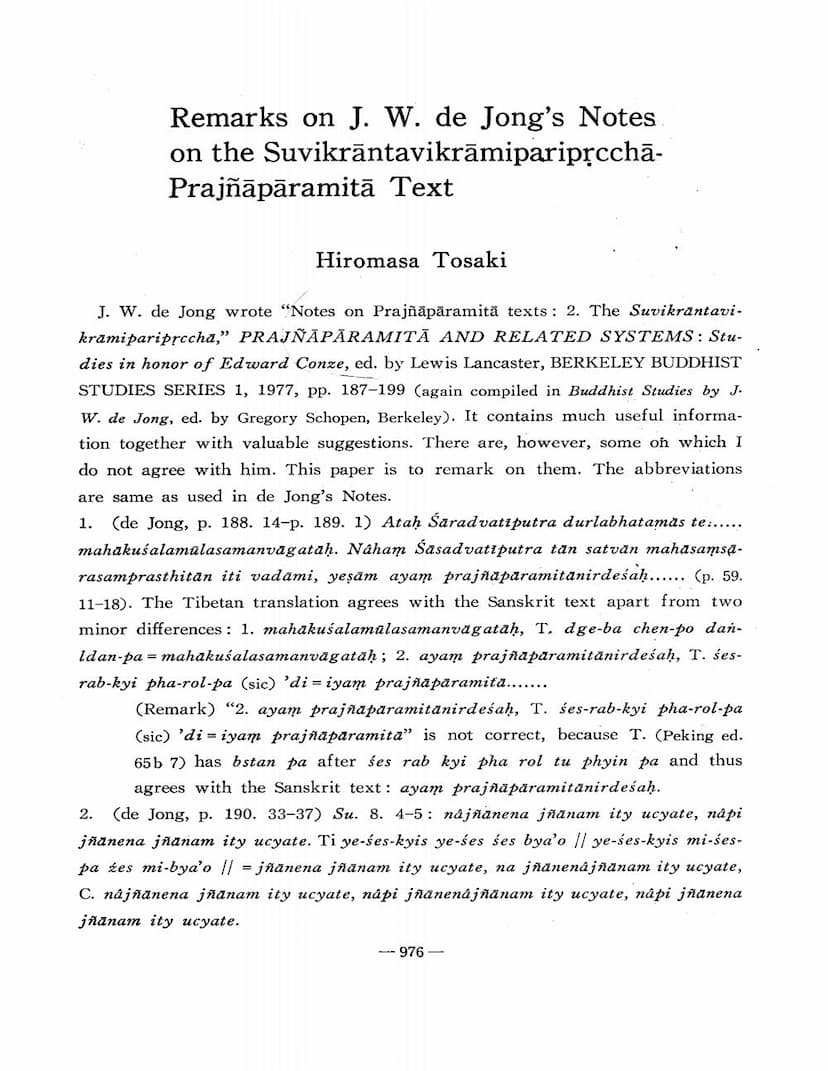
This paper by Hiromasa Tosaki offers a critical examination of J. W. de Jong's "Notes on Prajñāpāramitā texts: 2. The Suvikrāntavikramipariprccha." While acknowledging the valuable information and suggestions in de Jong's work, Tosaki focuses on several points of disagreement, primarily concerning textual readings and interpretations. Tosaki uses the same abbreviations as de Jong, referring to Sanskrit (Su.), Tibetan (Ti.), and Chinese (C.) translations of the Suvikrāntavikrāmiparipṛcchā Prajñāpāramitā Sūtra.
Tosaki addresses thirteen specific points:
-
"ayam prajñāpāramitānirdeśaḥ": Tosaki corrects de Jong's assertion that the Tibetan translation differs, stating that the Tibetan version (Peking ed.) does agree with the Sanskrit text by including "bstan pa" (meaning "teaching" or "doctrine") after "śes rab kyi pha rol tu phyin pa" (the Tibetan for Prajñāpāramitā), thus supporting "ayam prajñāpāramitānirdeśaḥ" (this exposition of Prajñāpāramitā).
-
"nâjñānena jñānam ity ucyate, nāpi jñānenâjñānam ity ucyate": Tosaki notes that the Chinese translation has "nā jñānenajñānam ity ucyate" before "nāpi jñānenâjñānam ity ucyate," and provides the corresponding Chinese characters for these phrases.
-
Punctuation in Su. 8.12–14: Tosaki disputes de Jong's claim that Hikata's punctuation is incorrect. He argues that Hikata's reading, which places a full stop between "vişayam" (corrected to "vinayaḥ") and "ayam," and omits the full stop after "jñānanirdeśaḥ," is supported by the Chinese translation. However, Tosaki also concedes that it's difficult to definitively determine the original reading based on the available evidence.
-
"dhātuḥ samketena": Tosaki points out that "dhātuḥ" is present in the Chinese translation, contradicting de Jong's claim that it is not found in Tibetan or Chinese. The Chinese translation supports the Sanskrit reading.
-
"Tena tad": Tosaki disagrees with de Jong's proposed emendation "Naitad" and argues that the Tibetan "de" generally corresponds to "tad" or "etad" in Sanskrit. He supports the reading "tena" (or "te na" in Tibetan) as meaning "they" (referring to Buddhadharmas), aligning with the Tibetan translation. The Chinese translation, he suggests, likely indicates that "Buddhadharma" is not a designation of the real Buddhadharma.
-
"te najñatacittena bodhim ca paśyanti": Tosaki argues that the Chinese translation does translate the phrases "na bodhau cittam paśyanti" and "na citte bodhim paśyanti," even though the sentence order might differ from the Sanskrit. He provides a breakdown of how the Tibetan and Chinese correspond to different parts of the Sanskrit passage.
-
"anulomam ca samdhayanti": Tosaki defends the original reading "samdhayanti" (from samdhaya), arguing it can be translated as "to harmonize" or "to make agree" when paired with "anulomam" (in agreement). He states that a change to "samdhayanti" (proposed by Matsumoto) is unnecessary, as "samdhayanti" itself can convey the meaning of harmony, as supported by the Chinese translation.
-
"prajñāpāramitānirdeśapadam câdhigacchati śravanaya": Tosaki asserts that no emendation is needed for the Sanskrit text, even according to the Chinese translation. He clarifies that the Sanskrit conveys the same idea as the Chinese, meaning that the words explaining Prajñāpāramitā reach the ear. He also suggests a minor correction to the Sanskrit punctuation.
-
"prajñāpāramitaya nirdeśaḥ kāryam ca karoti": Tosaki argues that the Chinese translation does not support de Jong's emendation "tasya nirdesena karyam ca karoti." He believes the Chinese abridged the word "prajñāpāramitaya" because the preceding mention of Prajñāpāramitā served the same function. He also questions the necessity of de Jong's emendation, highlighting the difference in subject between the Sanskrit sentence and a preceding sentence.
-
"nâsyam kaścid upalabhyate yo 'bhisambuddhaḥ": Tosaki states that the Chinese translation can also stand for "abhisambuddha" with an active meaning, and thus doesn't necessitate reading "abhisamboddha." He concludes that it's impossible to determine if the manuscript reading "'bhisambuddha" is an error.
-
"Asangalakṣaṇ[esu] hi Saradvattputra [sajanti] sarvabalapṛthagjanaḥ": Tosaki contends that the Chinese translation does not agree with the Tibetan translation in this instance. He highlights the differing readings between Chinese ("Asangalakṣaṇeşu sajanti balapṛthagjanaḥ") and Tibetan ("Asangasangaḥ [or Asangasaktaḥ] sarvabalapṛthagjanaḥ").
-
"dharmo nidarianam nopaiti kasyacid dharmasya...": Tosaki clarifies that Hikata's reading of "tasya evo-" is correct and stands for "tasya." He also explains that his own omission of "dharmo" was in accordance with the Tibetan translation, and he now believes the passage should be read with "dharmo" and a slightly different emendation, which aligns with the Chinese translation.
-
"Yavat kalpanā tavad vikalpanā, nasty atra vikalpanasamucchedah...": Tosaki argues that de Jong is incorrect in asserting that "kalpanavikalpanasamucchedah" is certainly the original reading. He points out that the Tibetan text has "rtog-pa" (thought) which corresponds to "vikalpana," not "vikalpanasamucchedah." He also notes discrepancies in the Tibetan text and suggests corrections based on the Sde-dge edition.
In essence, Tosaki's paper is a scholarly engagement with de Jong's work, offering detailed linguistic and textual analyses to support his counter-arguments and proposing alternative interpretations based on a thorough comparison of the available textual witnesses of the Suvikrāntavikrāmiparipṛcchā Prajñāpāramitā Sūtra.