
Remarks On History Of Jaina Meditation
Added to library: September 2, 2025
Summary
Here's a comprehensive summary of Johannes Bronkhorst's "Remarks on the History of Jaina Meditation," based on the provided text:
Overall Argument:
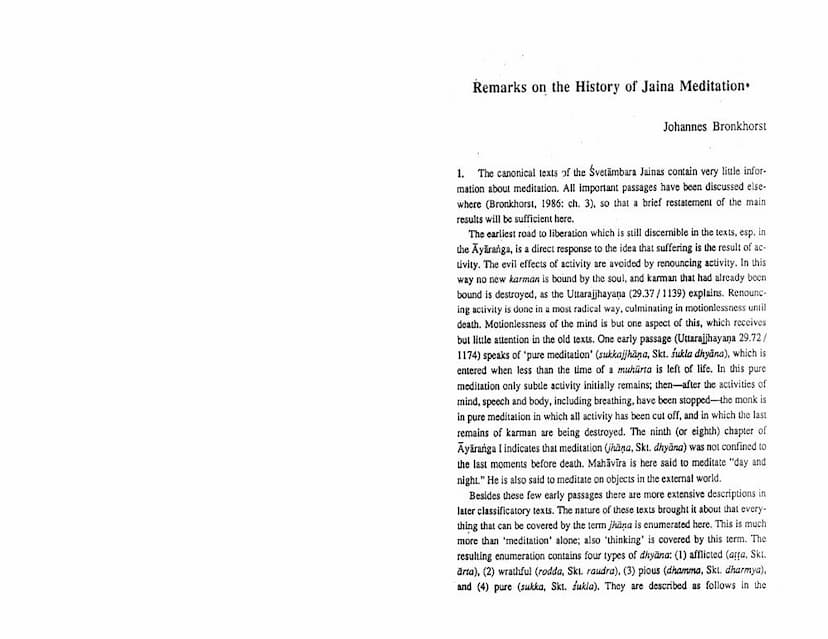
Bronkhorst argues that the history of Jaina meditation is not a continuous, unbroken tradition. Instead, it's characterized by significant shifts in understanding and practice, influenced by scholastic interpretations of canonical texts, the gradual exultation of the Jina's status, and the adoption of practices from other Indian religious traditions. The early canonical descriptions of meditation, particularly "pure meditation" (sukla dhyāna), became increasingly inaccessible and eventually fell out of practical consideration for most Jaina practitioners.
Key Points and Developments:
-
Early Canonical Basis:
- Ayāranga and Uttarājjhayaṇa: The earliest discernible path to liberation in these texts is the renunciation of activity to avoid the binding of new karma and destroy existing karma. This is achieved through radical motionlessness, including mental stillness.
- "Pure Meditation" (Sukla Dhyāna): Mentioned in Uttarājjhayaṇa (29.72/1174) as a state entered in the final moments before death, where subtle activity ceases, followed by the stopping of mind, speech, and body, leading to the destruction of remaining karma.
- "Meditation" (Dhyāna) Beyond Death: The Ayāranga (9th or 8th chapter) suggests that meditation wasn't limited to the end of life, with Mahavira meditating "day and night" on external objects.
-
The Four Types of Dhyāna (Classification Texts):
- Later classificatory texts (like Thānanga and Viyahapannatti) expanded the concept of dhyāna to encompass more than just meditation, including thinking.
- The Four Categories:
- Afflicted (arta): Associated with unpleasant experiences, attachment to pleasant ones, illness, and distress (characterized by crying, grief, etc.).
- Wrathful (raudra): Connected to injury, robbery, theft, and protection of worldly goods (characterized by hatred).
- Pious (dharma): Involves examination of commandments, sins, actions' results, and worldly constituents (characterized by liking for commandments, scriptures, etc.). This category is described with supports like recitation, questioning, repetition, and reflection, and reflections like being alone, transitoriness, no refuge, and birth/rebirth.
- Pure (sukla): Described with four manifestations (consideration of multiplicity, oneness, subtle activity, and cessation of activity) and characterized by absence of agitation, delusion, discriminating insight, and renunciation.
- The Problem of Confusion: Bronkhorst highlights a "strange confusion" in these texts, where even "afflicted" and "wrathful" states are listed under dhyāna, and the term "meditation" is applied broadly. The Avussaya Sutta even suggests repenting these states, implying they are not true meditation. This leaves later traditions with a canonical description where only "pure meditation" truly fits the modern understanding of the term.
-
The Inaccessibility of "Pure Meditation":
- Loss of the Pūrvas: Bronkhorst argues that "pure meditation" came to be considered inaccessible in the present age. This is explicitly stated in works like Hemacandra's Yogaśāstra and implicitly by requiring knowledge of the lost Pūrvas (the twelfth Anga of the Jaina canon) to attain the initial stages of pure meditation.
- Tattvärtha Sūtra's Evidence: The Tattvärtha Sūtra (9.40) already stated that knowledge of the Pūrvas is a prerequisite for pure meditation, indicating that by 150-350 CE, it was considered unattainable in this world.
- Exclusion from Later Lists: The four reflections associated with sukla dhyāna are absent from later lists of anuprekshā (reflections) that are incorporated into dharmya dhyāna. This further supports the idea that "pure meditation" was no longer a practical goal.
-
Consequences for Later Practice:
- Assimilation to "Pious Meditation": All actual Jaina meditative practice had to be assimilated into the descriptions of "pious meditation" (dharmya dhyāna).
- Scholastic Bias: Bronkhorst attributes these developments partly to scholars with more "scholastic than meditational capability" shaping the interpretation and understanding of canonical texts.
- Minor Role of Meditation: The relatively minor role of meditation in Jaina circles generally meant that individuals interested in practice often had to seek guidance outside of traditional Jaina texts or interpret them in new ways.
-
Later Developments and Adaptations:
- Independent Authors: Some later authors, recognizing the limitations of the canonical descriptions, developed their own approaches.
- Virasena's Dhavalā: This work drops arta and raudra dhyāna, retaining only dharmya and sukla dhyāna, but differentiates them solely by duration (short for pious, long for pure), a distinction not found in the canon.
- The Four New Meditations (Pindastha, Padastha, Rūpastha, Rūpātita): These were often considered part of dharmya dhyāna (specifically "examination of forms"). They involved visualization of objects and mantras within the body. Bronkhorst notes suspicion of Hindu Tantric influence here, as similar practices are found in Tantric texts. This allowed dharmya dhyāna to be understood as actual meditation rather than mere thinking.
- Haribhadra's Yogadrstisamuccaya: Haribhadra boldly incorporated practices that went beyond the scriptures, drawing from "various works on Yoga" and describing an eight-stage Yoga system comparable to Patanjali's. This marked a "complete break with tradition" in terms of the methods described.
- Hemacandra's Yogaśāstra: Hemacandra's work is a "special case." While he presents traditional meditation in earlier chapters, his twelfth chapter introduces practices focused on non-restraint of the mind. He suggests that the mind, when unrestrained, finds peace, likening it to an elephant in rut. He even expresses indifference about whether these practices lead to liberation, focusing on "highest bliss." Bronkhorst points out similarities to the Amanaska Yoga attributed to Gorakṣa Nātha, suggesting Hemacandra again introduced new, possibly non-Jaina, practices.
-
Continuity and Revival:
- Despite these shifts, Jainism never entirely abandoned meditation.
- Bronkhorst mentions Adelheid Mette's work on a legend where Mahavira's disciple emphasizes control of thought.
- He notes that later individuals interested in meditation often had to start "almost from scratch," seeking teachers and critically evaluating canonical guidelines, leading to the peculiar developments observed.
- He speculates that current revivals, like among the Terapanthis, might be linked to broader interests in meditation, potentially including non-Indian influences.
In essence, Bronkhorst's analysis reveals a complex and dynamic history of Jaina meditation, marked by the reinterpretation and eventual deemphasizing of core canonical meditative practices, particularly "pure meditation," due to evolving theological and philosophical currents within Jainism, and the adoption of new techniques influenced by other Indian spiritual traditions.