
Reconsidering Date Of Nirvana Of Lord Mahavira
Added to library: September 2, 2025
Summary
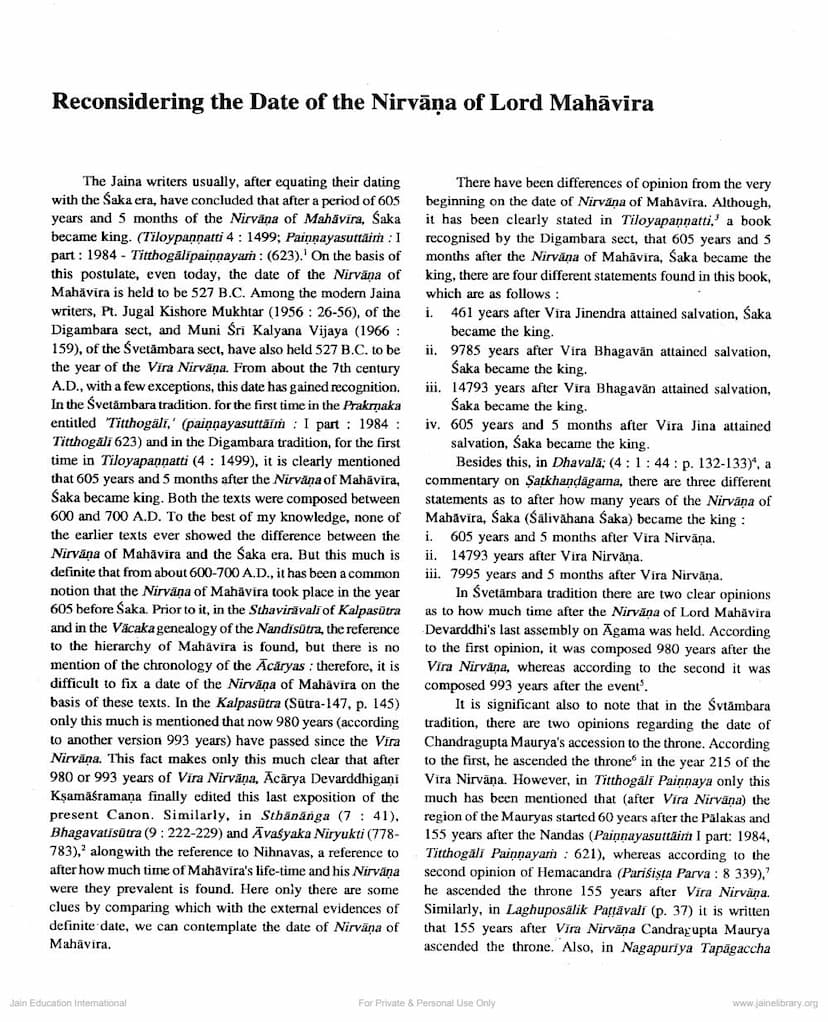
This document is an excerpt from "Reconsidering Date Of Nirvana Of Lord Mahavira" by Sagarmal Jain. It critically examines the traditional date of Lord Mahavira's Nirvana, which is widely accepted as 527 BCE. The author delves into various Jain textual traditions (Svetambara and Digambara) and external evidence, including inscriptions and contemporary historical figures, to propose a revised date.
Here's a breakdown of the key points:
The Traditional Date and its Origins:
- The traditional date of 527 BCE for Mahavira's Nirvana is largely based on the assertion in texts like Tiloyapannatti and Titthogali that King Saka ascended the throne 605 years and 5 months after Mahavira's Nirvana.
- This notion gained recognition from around the 7th century CE.
- Modern scholars from both Digambara (Pt. Jugal Kishore Mukhtar) and Svetambara (Muni Sri Kalyana Vijaya) traditions have upheld this 527 BCE date.
Inconsistencies in Jain Texts:
- The author highlights that even within recognized Jain texts like Tiloyapannatti and Dhavala, there are multiple conflicting statements regarding the time elapsed between Mahavira's Nirvana and the rise of the Saka era. This suggests an early lack of consensus.
- For example, Tiloyapannatti offers four different figures, and Dhavala offers three, for the number of years between Mahavira's Nirvana and Saka's reign.
The Role of Chandragupta Maurya and Acarya Bhadrabahu:
- A significant part of the argument revolves around establishing the contemporaneity of key Jain Acaryas with historical figures.
- The date of Chandragupta Maurya's accession to the throne is a crucial anchor. The text notes differing opinions within the Svetambara tradition regarding this date, with some placing it 155 years after Mahavira's Nirvana, and others 215 years.
- The author argues that accepting Chandragupta's accession at 155 years after Nirvana aligns better with historical records (like the end of the Mauryan dynasty) and leads to a revised date for Mahavira's Nirvana.
- This revised date is necessary to prove the contemporaneity of Acarya Bhadrabahu and Sthulibhadra with Chandragupta Maurya and the last Nanda king. The author points out that if Chandragupta ascended 215 years after Nirvana, Bhadrabahu would have died 45 years before his accession, making their contemporaneity impossible.
External Evidence and Scholarly Opinions:
- The text acknowledges that Western scholars have relied on external evidence to propose various dates for Mahavira's Nirvana.
- It lists the opinions of several scholars, including:
- Hermann Jacobi (476 BCE)
- J. Charpentier (467 BCE)
- A. Shanti Raja Shastri (663 BCE)
- Kashi Prasad Jayaswal (546 BCE)
- S.V. Venkateswara (437 BCE)
- Jugal Kishor Ji Mukhtar (528 BCE)
- Muni Sri Kalyana Vijaya (528 BCE)
- P.H.L. Eggermont (252 BCE)
- V.A. Smith (527 BCE)
- K.R. Norman (around 400 BCE)
Analysis of Buddhist Sources and Contemporaneity:
- The author discusses the relationship between Mahavira and Buddha, noting that Buddhist sources mention Mahavira (as Nirgrantha Jnatiputra) as a contemporary.
- The text analyzes conflicting references in the Dighanikaya, where Mahavira is described as middle-aged in one instance and as recently deceased during Buddha's lifetime in another.
- The author, citing Muni Kalyana Vijaya, dismisses the latter as a misinterpretation or a rumor of Mahavira's death, linking it to a dispute with Makkhali Gosala.
- This analysis attempts to synchronize Mahavira's and Buddha's Nirvanas, suggesting Buddha's Nirvana occurred about 14 years, 5 months, and 15 days before Mahavira's.
The Argument for 467 BCE:
- Chronological Consistency: The author strongly argues that accepting 467 BCE as the date of Mahavira's Nirvana is the most logical way to prove the contemporaneity of key Jain Acaryas (Bhadrabahu, Sthulibhadra, and Suhasti) with historically verifiable rulers like Chandragupta Maurya and Samprati.
- Inscriptional Evidence: The text examines several Mathura inscriptions mentioning Acaryas like Arya Mangu, Nandil, Nagahasti, and Krsna. The author finds that most of these inscriptions, when reconciled with Pattavali traditions, point towards a Nirvana date closer to 467 BCE, though some discrepancies remain.
- King Dhruvasena: The inscription of King Dhruvasena of Valabhi, linked to the recitation of the Kalpasutra after an assembly, is presented as strong evidence. If this event is dated to the early years of Dhruvasena's reign (around 526 CE), it supports a Mahavira Nirvana date of 467 BCE (993 VNS - 526 AD).
Conclusion:
The author concludes that while discrepancies exist, the majority of textual, epigraphical, and historical evidence leans towards 467 BCE as the most probable date for Lord Mahavira's Nirvana. This date allows for a more consistent and provable timeline of key Acaryas and their relationship with historical figures, challenging the long-held traditional date of 527 BCE. The author suggests that accepting 467 BCE would also necessitate accepting Buddha's Nirvana around 483 BCE, aligning with the views of many Western scholars.