
Recent Buddhist Studies In Europe And America
Added to library: September 2, 2025
Summary
This document, "Recent Buddhist Studies in Europe and America 1973-1983" by J.W. de Jong, is a comprehensive review of the scholarly output in Buddhist studies within Europe and America during the decade following 1973.
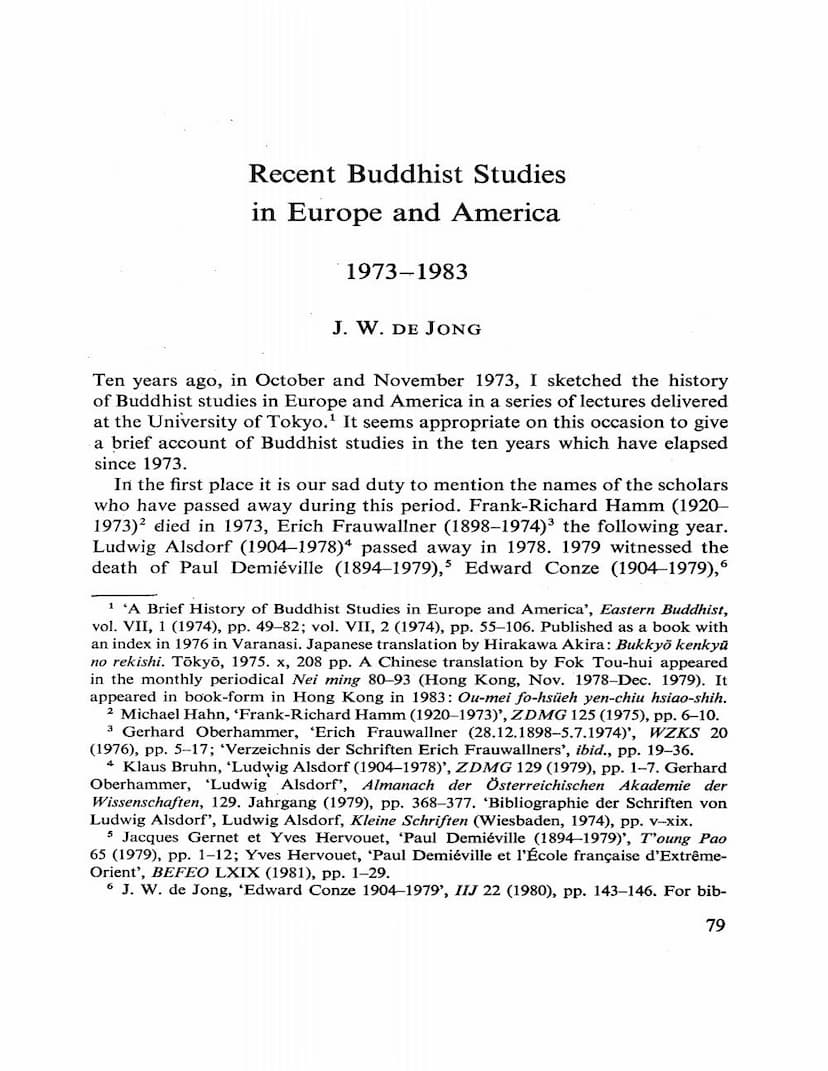
The paper begins by mourning the loss of several prominent scholars in the field, including Frank-Richard Hamm, Erich Frauwallner, Ludwig Alsdorf, Paul Demiéville, Edward Conze, Christiaan Hooykaas, Valentina Stache-Rosen, Friedrich Weller, Isaline Horner, Jean Filliozat, and Étienne Lamotte. De Jong specifically highlights the monumental translation work of Étienne Lamotte on the Mahāprajñāpāramitāśāstra. He also notes that many scholars were honored with felicitation volumes during this period, a practice he commends as a way to make their work more accessible.
De Jong expresses optimism about the emergence of young scholars who are contributing significantly to the field, despite the challenging economic climate for universities. He states his primary focus will be on studies of Buddhist texts in Indian languages or translated into Tibetan and Chinese, emphasizing their foundational importance for understanding Buddhism.
A significant development highlighted is the proliferation of facsimile editions of Buddhist Sanskrit manuscripts. De Jong argues that these are crucial for accurate textual scholarship, allowing for the study of scribal errors and the history of textual transmission. He points to important manuscript finds from Central Asia and Gilgit, particularly noting the extensive work on the Saddharmapundarika, with numerous facsimile and romanized editions and scholarly analyses of its various recensions. He also discusses the importance of the Gilgit manuscripts for understanding the Vinayavastu of the Mūlasarvāstivāda school and the Patna collection of Tibetan manuscripts.
The paper then surveys developments in the study of specific Buddhist texts and schools:
- Hīnayāna texts: De Jong mentions editions of parts of the Vinaya of the Mūlasarvāstivāda school, the "Patna Dharmapada," and fragments from the Turfan collection. He notes a growing interest in Abhidharma literature, with new translations and studies of texts like Amṛtarasa, Abhidharmavatāraśāstra, and Abhidharmahṛdaya.
- Prajñāpāramitā literature: Edward Conze's continued contributions and influence are recognized, with new editions and translations. The volume honoring him demonstrates how he inspired younger scholars in this area.
- Mahāyāna Sūtras: The extensive work on facsimile and romanized editions of the Saddharmapundarikasūtra is reiterated. Other important Mahāyāna texts discussed include the Pratyutpanna-buddha-sammukhāvasthita-samadhi-sūtra, Kāśyapaparivarta, Vimalakirtinirdeśasūtra, Vinaya-viniscayaupāli-pariprcchā, and the Śrīmālāsimhanādasūtra.
- Madhyamaka school: De Jong highlights David Seyfort Ruegg's comprehensive work on the literature of the Madhyamaka school and Christian Lindtner's Nagarjuniana, which critically examines texts attributed to Nāgārjuna. The importance of the Mūlamadhyamakakārikās is stressed, with new editions and detailed philosophical analyses. Studies on Āryadeva's Catuhśataka and commentaries on Mūlamadhyamakakārikās are also mentioned, as well as various new translations of Śāntideva's Bodhicaryāvatāra.
- Yogācāra and Tathāgatagarbha schools: While noting less attention given to these schools, de Jong points to important articles by Lambert Schmithausen, particularly on the literary history of early Yogācāra texts.
- Epistemological school: The significant work of Ernst Steinkellner on Dharmakīrti and related philosophers is detailed, including editions, translations, and verse indexes. Other scholars' contributions to this field are also noted.
- Tantric studies: Alex Wayman's work on the Guhyasamājatantra and Christopher S. George's edition and translation of the Candamahāroşaņa tantra are mentioned. The lack of Western interest in the philological study of Tantric texts is lamented, but the work of Horiuchi Kanpin on the Sarvatathāgatatattvasamgraha and Per Kvaerne on the Caryāgīti are highlighted.
- Other literary studies: Michael Hahn's significant contributions to the study of various Sanskrit and Tibetan Buddhist literary works, including Candragomin, Haribhatta, Gopadatta, Kṣemendra, and Buddhist epistolary literature, are detailed.
- Inscriptions: The importance of Aśokan inscriptions is emphasized, with mention of critical editions and ongoing studies.
- Pāli literature: The ongoing work of the Pali Text Society, under the guidance of Miss Horner and K.R. Norman, is recognized, including new translations and indexes. Studies on the Vessantara-jātaka, the Paññāsa-jātaka, and the Lokapaññatti are also discussed, along with detailed philological and etymological studies of Pāli texts by Norman and von Hinüber.
- Dictionaries, Catalogues, and Bibliographies: The development of important reference works, such as the Sanskrit Dictionary of the Buddhist manuscripts from the Turfan Discoveries, the Critical Pāli Dictionary, and the Hõbõgirin, are noted, alongside catalogues of various manuscript collections. The lack of a continuation of the Bibliographie bouddhique is lamented, but useful bibliographies by Yuyama, Nakamura, and Webb are welcomed.
De Jong concludes by acknowledging that his survey, while comprehensive, cannot cover all aspects of Buddhist studies, especially those related to Tibetan, Chinese, and Theravāda Buddhist traditions, as well as philosophy, religion, history, and art. He expresses hope that other scholars will build upon his bibliographical information. The paper also includes an addendum with further information and mentions the passing of Arnold Kunst and Constantin Regamey. It also addresses a question about the omission of Japanese scholars' work, clarifying the focus on Europe and America.