
Quantum Mechanics And Jain Philosophy
Added to library: September 2, 2025
Summary
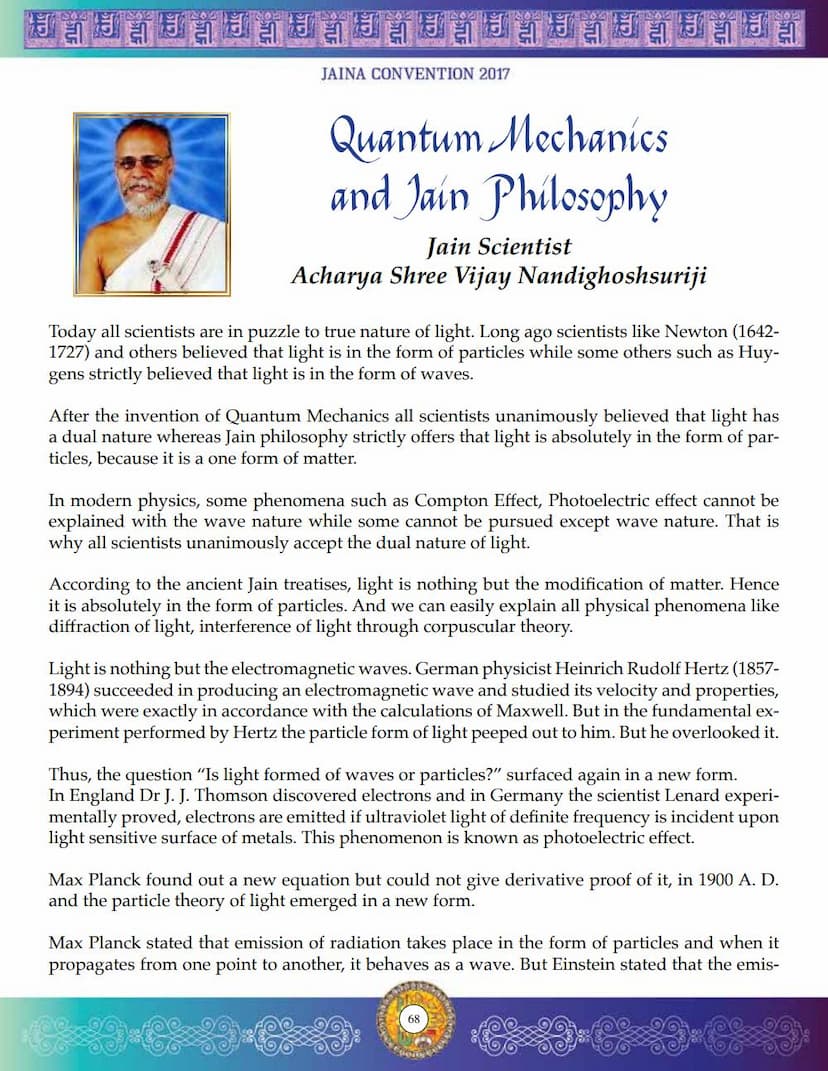
Here's a comprehensive summary of the provided Jain text, "Quantum Mechanics And Jain Philosophy" by Acharya Shree Vijay Nandighoshsuriji, focusing on the relationship between quantum mechanics and Jain philosophy:
The text explores the long-standing scientific debate about the nature of light, initially divided between particle (Newton) and wave (Huygens) theories. Modern quantum mechanics has established that light exhibits a dual nature, acting as both a wave and a particle. However, the author, Acharya Shree Vijay Nandighoshsuriji, argues that Jain philosophy has always maintained that light is fundamentally composed of particles, considering it a form of matter.
Key Arguments and Connections:
- Light as Matter: Jain philosophy, as presented in ancient treatises, views light not as something ethereal but as a modification of prime matter (pudgala). This aligns with the idea of light being composed of microscopic particles, called paramanu-units or vargas. Photons, encompassing all visible and invisible light, are classified under the Taijas Varga (light or electricity), which is rooted in matter.
- Explaining Quantum Phenomena with Jain Philosophy:
- Corpuscular Theory and Interference: The author claims that phenomena like diffraction and interference, which are challenging to explain solely with a wave nature, can be understood through the corpuscular (particle) theory of light. He posits that light particles propagate in a serpentine path, which allows for interactions that explain constructive and destructive interference.
- Constructive Interference: When two light particles (photons) meet crest-to-crest or trough-to-trough, they "collide" and propagate as if following the parallelogram law, leading to an increase in light intensity.
- Destructive Interference: When a crest of one photon meets a trough of another, they don't collide directly. This absence of photons in those specific interaction lines creates dark fringes, effectively reducing light intensity to zero.
- Intensity and Photons: Jain physics, according to the author, determines light intensity by the number of photons per unit area per unit time. This concept is used to explain why in constructive interference, where photons from two slits fall on a reduced area, the intensity quadruples (double the photons on half the area).
- Influence of Jainism on Modern Physics:
- Dr. Satyendra Nath Bose: The text highlights Dr. S.N. Bose's pivotal work in quantum statistics, particularly his 1924 research paper. The author asserts that Bose found inspiration in Jain literature and discussions with scholars familiar with Jain texts like the Bhagawati Sutra. Specifically, Bose's groundbreaking work in formulating quantum statistics was achieved by accepting radiation as electromagnetic particles, a concept deeply rooted in Jain philosophy.
- Planck's Law and Bose-Einstein Statistics: While Max Planck introduced the idea of radiation in discrete packets (quanta), Einstein proposed that emission and propagation occur in quanta. However, it was Bose who logically formulated quantum statistics, embracing the particle nature of radiation.
- Electron Behavior and Jain Philosophy: The text addresses the perplexing behavior of electrons in experiments (like the double-slit experiment), where they act as particles when observed through one slit but as waves when passing through two. While modern physics finds this unresolved, Jain scriptures offer an explanation: various phenomena like sound, darkness, and different forms of light are all modifications of prime matter (paramanu-units). The distinction between particle and wave behavior is seen as different manifestations of these fundamental material particles.
- Mass and Gravity: The author touches upon the mass of photons, suggesting that phenomena like the solar deflection of starlight prove light particles have some mass. He also links this to the idea that radiating energy from stars, like light/photons, possesses mass, which is why gravitational forces influence them. This aligns with the Jain concept of paramanu as the dominant entities in the universe.
- Science vs. Religion: The text concludes with a philosophical reflection on the roles of science and religion. Science, focused on matter and experiments, can break things down. Religion, centering on the soul (atma), aims to unite and transform. The author suggests that while science changes matter, true religion can change the soul, offering direction and clarity.
In essence, "Quantum Mechanics And Jain Philosophy" presents a compelling argument that ancient Jain philosophical concepts, particularly regarding the particulate nature of light and the fundamental essence of matter, predate and offer a coherent framework for understanding phenomena explained by modern quantum mechanics. The text emphasizes the profound insights of Jainism and suggests a potential for cross-disciplinary understanding between ancient spiritual traditions and contemporary scientific discoveries.