
Qualities Of Sankhya
Added to library: September 2, 2025
Summary
Here is a comprehensive summary of Johannes Bronkhorst's "The Qualities of Sankhya":
Core Argument: The article argues that early forms of the Sankhya philosophy, as understood by grammarians and other scholars like Bhartṛhari and Mallavādin, viewed material objects as being constituted primarily of "qualities" (like sound, touch, color, etc.). This contrasts with the "classical" Sankhya, as represented by the Sānkhya Kārikā and its commentaries like the Yuktidīpikā, which posits a more complex evolutionary process from prakṛti through tanmātras to the gross elements. Bronkhorst suggests that there was a significant evolution and change in Sankhya doctrine, possibly around the 5th century CE, which led to this shift away from the emphasis on qualities as the fundamental constituents of matter.
Key Points and Sections:
-
Introduction (Section 1):
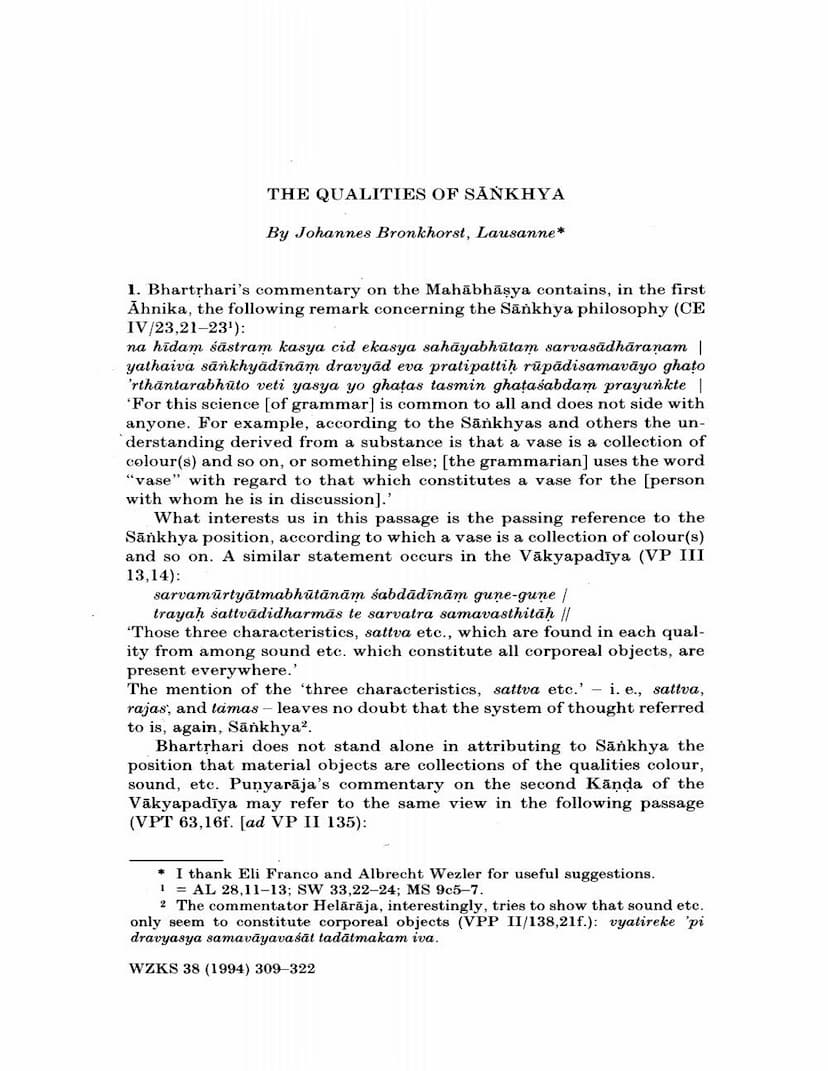
- Bronkhorst begins by citing passages from Bhartṛhari's commentary on the Mahābhāṣya and the Vākyapadīya, and Punyarāja's commentary on the Vākyapadīya. These passages attribute to Sankhya the view that material objects like vases are simply collections of qualities such as "colour and so on" (rūpādi) or "sound and so on" (śabdādi).
- Dharmapāla's commentary on Āryadeva's Catuḥśataka and Simhasūri also ascribe this view to Sankhya, defining objects as "collections of colours etc." (rūpādisamūha).
- These quoted sources suggest that for early Sankhya, material objects were fundamentally composed of the five qualities: sound, touch, color, taste, and smell.
-
Reconciling with Classical Sankhya (Section 2):
- Bronkhorst notes the difficulty in reconciling this view with the classical Sankhya doctrine presented in the Yuktidīpikā. Classical Sankhya describes the material world evolving from prakṛti through intermediate stages, with material objects consisting of the five elements (earth, water, fire, wind, ether).
- The classical system elaborates on the elements, each possessing specific qualities: ether (sound), wind (sound, touch), fire (sound, touch, color), water (sound, touch, color, taste), and earth (sound, touch, color, taste, smell).
- These elements are traced back to five tanmātras, which are often distinguished from qualities themselves.
- However, Bronkhorst points out that the Sānkhya Kārikā itself is not entirely clear on this distinction. It allows for an interpretation where the tanmātras might be equivalent to the five qualities. This ambiguity leaves open the possibility that the Sānkhya Kārikā might have shared the view attributed to Sankhya by other scholars.
-
Mallavādin's Criticism and Simhasūri's Interpretation (Section 3):
- Mallavādin's Dvādaśāra Nayacakra criticizes Sankhya for claiming that ether is produced from the single quality sound, arguing this contradicts the idea that a product is a collection (samudra or samāhara) of qualities.
- Simhasūri, Mallavādin's commentator, supports this critique by referencing the idea that "a material object is a collection of qualities" (gunasamudravo dravyam).
- Bronkhorst analyzes a particular passage in Mallavādin and its interpretation by Wezler. He argues that Mallavādin likely believed Sankhya viewed material objects as collections of qualities, and that ether's origin from a single tanmātra (sound) violated Sankhya's own principle of material objects being collections.
- Crucially, Bronkhorst suggests that Simhasūri reinterpreted Mallavādin's words to align with a more classical Sankhya where tanmātras, not directly qualities, are the constituents. This indicates a possible divergence in understanding Sankhya between these two authors, with Simhasūri being aware of the later, classical form.
-
Evolution of Sankhya Doctrine (Section 4):
- Bronkhorst concludes from the preceding sections that several classical authors knew a form of Sankhya different from the one passed down to us. This earlier Sankhya apparently included the five qualities as key components of material objects.
- He suggests that texts like the Vārṣagaṇa Tantra (identified with the Ṣaṣṭitantra) might be the source for these earlier interpretations and that this text predates Bhartṛhari.
- The evolution of Sankhya might be due to reinterpretations by commentators on its foundational texts, potentially aligning with the idea that the Sānkhya Kārikā predates some of these modifications.
-
Possible Reason for the Change: Satkāryavāda (Section 5):
- Bronkhorst speculates on the reason for this change in Sankhya doctrine, suggesting a connection with the doctrine of satkāryavāda (the effect pre-exists in its cause).
- Classical Sankhya's understanding of pariṇāma (transformation) emphasizes a continuous series of modifications of a substrate that doesn't lose its essence. This implies material objects are more than mere collections of properties; they have an underlying substrate.
- Bronkhorst proposes that the doctrine of satkāryavāda may have pressured Sankhya to abandon the simpler view of material objects as mere collections of qualities, as it necessitates a more complex understanding of causation and substance.
-
The Mahābhāṣya and Nageśa's Interpretation (Section 6 & Appendix):
- The Mahābhāṣya (Patañjali, mid-2nd century BCE) contains statements like "a material object is a collection of qualities" (gunasamudayo dravyam). While not necessarily Patañjali's own view, it proves this idea existed during his time. The qualities are explicitly identified as the five senses.
- Bronkhorst cautions against directly linking these Mahābhāṣya statements to Sankhya, as the view of matter as a collection of qualities was also held by other schools like the Sarvāstivādins.
- The appendix discusses Nageśa Bhatta's commentary on Kaiyaṭa, which attributes the "collection of qualities" view to Patañjali and links it to the Yoga Bhāṣya. Nageśa interprets the Yoga Bhāṣya's discussion of sāmānyas and viśeṣas (generic and specific qualities) as supporting the idea that material objects are collections of qualities.
- However, Bronkhorst suggests that Nageśa's interpretation might be flawed because the Yoga Bhāṣya doesn't explicitly call sāmānyas "qualities" (gunas), the term used by Bhartṛhari and others in this context. He concludes that the Yoga Bhāṣya's view of sāmānyas and viśeṣas might represent a development of an earlier Sankhya form, possibly with Buddhist influence.
Overall Conclusion:
Johannes Bronkhorst's article demonstrates that the understanding of Sankhya philosophy has evolved significantly over time. Early sources, external to Sankhya itself, suggest a view where material objects are fundamentally composed of sensory qualities. This contrasts with the later, classical Sankhya, which elaborates a sophisticated cosmology involving prakṛti, tanmātras, and the five gross elements. Bronkhorst posits that the doctrine of satkāryavāda may have been a catalyst for this doctrinal shift, moving Sankhya away from a simplistic "collection of qualities" model towards a more nuanced understanding of transformation and substance. The interpretation of ancient texts, particularly the divergences between commentators like Mallavādin and Simhasūri, is crucial in tracing this historical development.