
Punya Ka Fal
Added to library: September 2, 2025
Summary
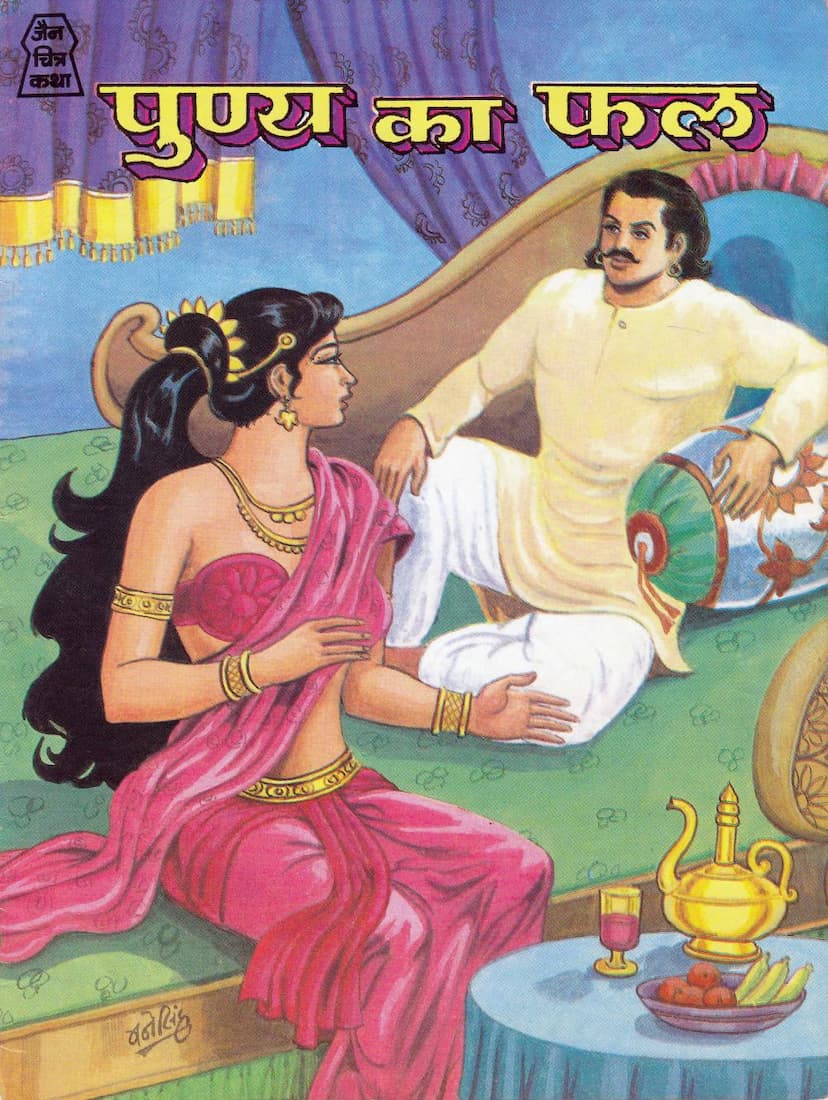
This Jain text, titled "Punya ka Fal" (The Fruit of Merit), authored by Dharmchand Shastri and published by Acharya Dharmshrut Granthmala, is a collection of Jain stories presented in a comic book format. The primary aim of these stories is to illustrate the Jain principles of karma, merit (punya), and demerit (paap), and their consequences in this life and future lives.
The book begins with an editorial that likens human life to a river, characterized by its fluctuating pace, ups and downs, and a mix of happiness and sorrow, merit and demerit. It emphasizes the importance of maintaining a healthy mind and spirit to navigate life successfully. The editorial notes that modern humans have lost patience and desire immediate results, urging them to perform good deeds for their own and others' happiness, which leads to merit.
The main narrative of "Punya ka Fal" revolves around Veeravati, the daughter of Dhanmitra, a wealthy merchant in Rajagriha, and Datt, the son of Anand, a householder in Bhumigriha. Veeravati and Datt get married. Datt goes to the Snadweep for business, leaving Veeravati in her parents' home.
During Datt's absence, Veeravati encounters Garak, a handsome thief. Veeravati falls in love with Garak, and they begin to meet secretly.
Meanwhile, Sahastabhat, another thief, spots Datt returning from Snadweep laden with wealth. Sahastabhat begins to follow Datt, intending to rob him. Datt arrives at his in-laws' house and is welcomed, but Veeravati appears sad, her mind occupied with Garak. Datt, unaware of her secret, gifts her precious jewels.
Garak is eventually caught red-handed stealing from Seth Chandan's house and is brought before the king. Due to his past crimes, including theft and murder, the king sentences Garak to death by crucifixion.
Veeravati is devastated by Garak's impending execution. She plans to visit Garak's body after he is crucified. Unbeknownst to her, Sahastabhat is still lurking and following her.
Veeravati goes to the cremation ground where Garak's body is displayed. While trying to reach Garak, she climbs over corpses, and in the process, her lips are cut. She flees home, crying out that her husband, Datt, has harmed her.
The neighbors, hearing Veeravati's cries, bind Datt and present him to the king. Veeravati falsely accuses Datt of cutting her lips.
At this critical moment, Sahastabhat appears in the royal court. He confesses his actions, revealing that he was following Datt and that Veeravati's lips were cut accidentally while she was trying to reach Garak's body. Sahastabhat's truthful testimony saves Datt. The king then orders Veeravati to be punished by having her head shaved and being paraded through the city before being hanged. Sahastabhat is acknowledged for his act of merit in saving an innocent person.
The book also includes another story titled "Abhaydaan ki Katha" (The Story of Fearless Gift). This story features Devli, a potter, and Dharmil, a barber, who decide to jointly build a धर्मशाला (a resting place for travelers and ascetics). They invite ascetics to stay there. However, Dharmil becomes angry when Devli invites a muni (ascetic) without his explicit permission, leading to a heated argument. The conflict escalates, and both Devli and Dharmil kill each other in their anger.
As a consequence of their actions, they are reborn as a pig (Devli) and a lion (Dharmil) in the same forest. They encounter two munis who are meditating in a cave. The pig, remembering its past life, tries to protect the munis from the lion. The lion attacks the pig, and both die in the fight.
The munis emerge and observe that they have again died fighting each other. The pig, who had taken a vow to protect the munis, is rewarded with a heavenly rebirth due to its merit. The lion, due to its intention to kill, is sent to hell.
The book concludes with a list of other Jain comic books published by the same publisher, covering various themes of Jain teachings, biographies of Tirthankaras and important figures, and moral stories. It encourages readers to read these stories and share them with others, highlighting the rich treasury of Jain literature that imparts virtues like righteousness, morality, detachment, wisdom, courage, humility, patience, friendship, simplicity, forgiveness, vows, fasting, and penance.