
Prof K S Murtys Philosophy Of Peace And Non Violence
Added to library: September 2, 2025
Summary
Here's a comprehensive summary in English of the provided text about Prof. K.S. Murty's philosophy of peace and non-violence, as discussed by Sagarmal Jain:
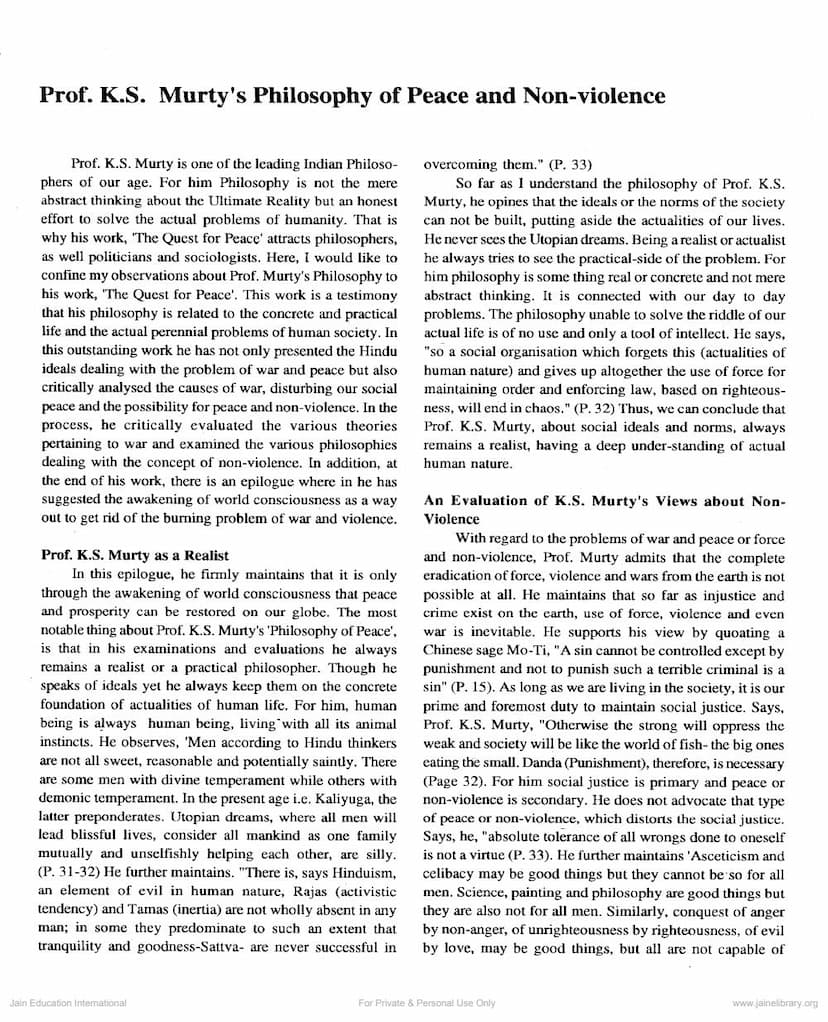
This article by Sagarmal Jain analyzes Professor K.S. Murty's philosophy of peace and non-violence, primarily focusing on his work "The Quest for Peace." Jain highlights Murty's view of philosophy not as abstract speculation but as a practical tool for solving humanity's real-world problems.
Key Aspects of Murty's Philosophy:
- Realism and Practicality: Murty is presented as a realist philosopher who grounds ideals in the actualities of human life and nature. He rejects utopian dreams, acknowledging that human beings possess both positive and negative (divine and demonic) temperaments. He argues that a social organization that entirely abandons the use of force for maintaining order will descend into chaos.
- Critique of Absolute Non-Violence: Murty, while valuing peace and non-violence, believes that complete eradication of force, violence, and war is impossible as long as injustice and crime exist. He asserts that the use of force, including war, is sometimes inevitable to maintain social justice and prevent the strong from oppressing the weak. He quotes Mo-Ti and emphasizes the necessity of "Danda" (punishment) for social order.
- Social Justice as Primary: For Murty, social justice is paramount. He critiques a type of peace or non-violence that compromises or ignores social justice. He states that absolute tolerance of all wrongs is not a virtue and that "peace achieved at the cost of injustice is not good." He advocates for meeting evil with justice.
- Just and Defensive Wars: Murty, in line with Hindu thought, supports the idea of just and defensive wars undertaken as a duty, but with a spirit free from malice or ill-will.
- Critique of Non-Injury Motivated by Compassion: Jain disagrees with Murty's assertion that non-injury motivated solely by compassion can become a superstition or lead to injury. Jain argues that non-violence should stem from reasoning and a sense of duty, not merely emotional compassion, which can be rooted in attachment.
- Morality and Practicability: Jain criticizes Murty's equation of morality with practicability and immorality with impracticability, suggesting this could lead to selfishness. He also disagrees with Murty's statement that it's "silly to admit that all life is equally worthy of reverence," asserting that the intrinsic value of non-injury shouldn't be dismissed due to practical challenges.
- Selection between Evils: Murty acknowledges situations where one must choose between two violences (major and minor). He believes it's ethically right to preserve human life at the cost of other living beings (like germs) when necessary, citing the use of antibiotics or rat poison. However, Jain objects to the terms "ethically or morally right" in this context, arguing that violence is always an evil and selection between evils doesn't make the lesser one morally right. Jain also points out that the value of human life isn't absolute in all contexts.
- Concept of Peace (Internal and External): Murty acknowledges both internal (mental peace/tranquility) and external (social peace) aspects of peace. He quotes the Gita on achieving inner peace through purity, non-attachment, and equanimity.
- Interdependence of Inner and Outer Peace: While Murty emphasizes the social/external aspect of peace, Jain highlights that inner peace is a prerequisite for outer peace. He quotes Dr. P.V. Narasimha Rao, who stresses that outer peace cannot exist without inner peace, defined as freedom from fear, mistrust, and self-aggrandizement.
- Causes of War (Realistic Approach): Murty's approach to the causes of war is realistic. While agreeing that wars begin in the mind, he emphasizes the influence of social, cultural, and political environments. He critiques purely psychological, economic, or tension-based theories of war, suggesting that modern warfare is often a product of ingrained social and cultural structures.
- A Way Out to Peace: Murty proposes that ending war and violence requires fundamental alteration of social and cultural structures. This can be achieved through the awakening of "peace consciousness." He advocates for the development of a unified world view based on human brotherhood (Homonoia), tolerance, and universal ethics. He suggests establishing a "Respublica-Litteraria" (a republic of letters) for intellectuals to work towards this goal through hard work and sacrifice. He concludes that a "world family" consciousness is essential for peace and prosperity.
In essence, Sagarmal Jain's article presents Prof. K.S. Murty as a pragmatic philosopher who grapples with the complexities of peace and non-violence in the real world, advocating for social justice and a grounded approach to achieving a more peaceful existence, even while acknowledging the unavoidable realities of human nature and societal conflict. Jain, while largely agreeing with Murty's realistic outlook, offers critical insights from a Jain perspective, particularly regarding the nature of non-violence and the ethical implications of choosing between evils.