
Preface On Shalibhadra Dhanna Charitra
Added to library: September 2, 2025
Summary
Here is a comprehensive summary of the preface of "Preface On Shalibhadra Dhanna Charitra" by Ernest Bender:
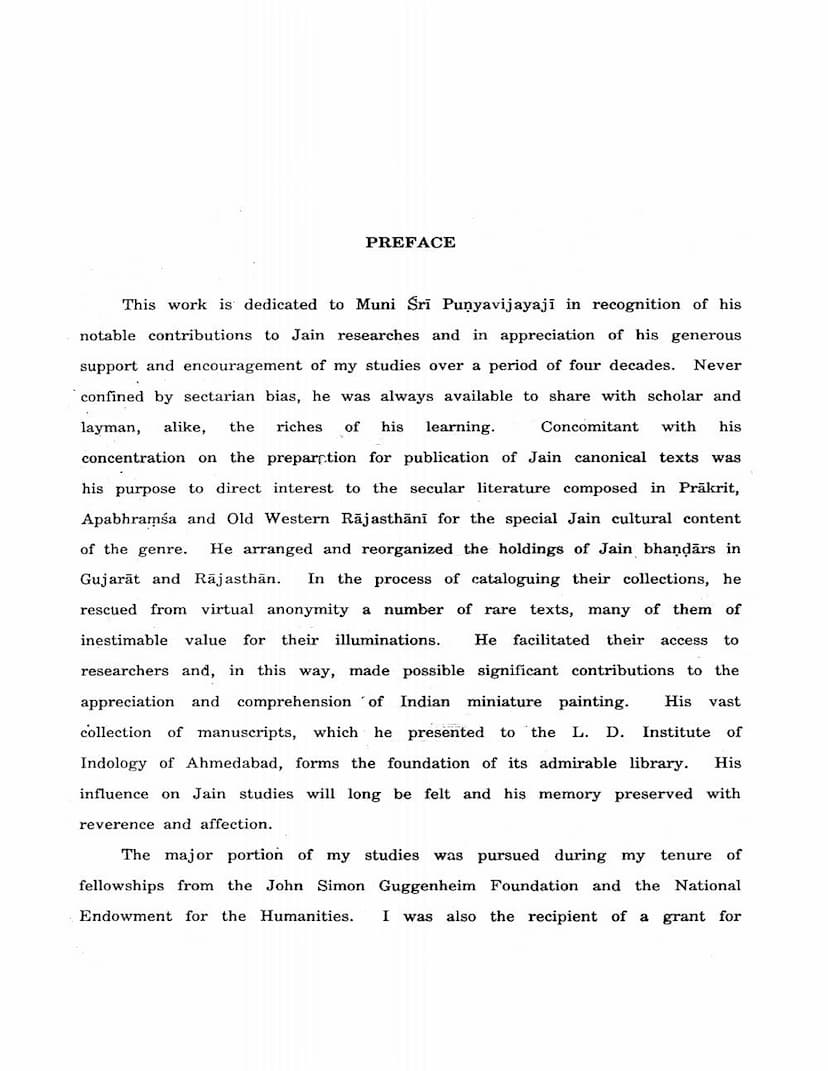
This preface serves as an acknowledgment of the significant support and encouragement Ernest Bender received for his scholarly work on the "Shalibhadra Dhanna Charitra."
The author dedicates the work to Muni Sri Punyavijayaji, recognizing his profound contributions to Jain research and his generous, lifelong support of Bender's studies. Muni Sri Punyavijayaji is lauded for his lack of sectarian bias and his willingness to share his extensive knowledge with both scholars and laypeople. He is credited with a crucial role in making Jain canonical texts available for publication and, importantly, for directing scholarly interest towards secular literature in Prākrit, Apabhramsa, and Old Western Rājasthānī, highlighting the unique Jain cultural content within these genres. Muni Sri Punyavijayaji was instrumental in organizing and cataloging the vast collections of Jain bhaņdārs (libraries/archives) in Gujarat and Rajasthan, thereby rescuing numerous rare and invaluable texts, many of which provided crucial insights into Indian miniature painting. His personal collection of manuscripts, donated to the L. D. Institute of Indology in Ahmedabad, forms the foundation of its esteemed library, and his influence on Jain studies is expected to endure.
Bender expresses deep gratitude to the foundations and institutions that provided financial support for his research, specifically mentioning the John Simon Guggenheim Foundation, the National Endowment for the Humanities, and the Committee on the Advancement of Research of the University of Pennsylvania for a grant focused on the Old Gujarati language.
He then lists and thanks the directors and staffs of numerous institutions that assisted him in his search for manuscripts. This extensive list includes prominent Jain collections and academic institutions across India (Bhāvnagar, Baroda, Bombay, Jaipur, New Delhi, Pāțan, Surat) and internationally (Boston Museum, Heeramaneck Galleries in New York, India Office Library in London).
Special thanks are extended to Miss Kanta Bhatia for her assistance as the Bibliographer for South Asian Studies at the University of Pennsylvania, and to Dr. Richard J. Cohen, a former student and dedicated Jain scholar. Dr. Cohen's expertise was vital in facilitating the transfer of Bender's materials to a computer and ensuring the successful completion and publication of the work, including the preparation of the camera-ready copy.
Bender also acknowledges the support of the South Asia Regional Studies Department of the University of Pennsylvania. He highlights the exceptional hospitality and assistance received from Sri Kantilal D. Kora (Director of the Shri Mahavira Jaina Vidyalaya, Bombay) and the directors of the L. D. Institute of Indology (Pt. Dalsukh Malvania and Dr. Nagin J. Shah), whose interactions made his library visits particularly pleasant and social. He also thanks Dr. H.C. Bhayani for his interest in his research.
The preface includes a poignant note of remembrance for his "good friend and colleague," Dr. Umakant P. Shah, an eminent historian of Indian art, whose loss is keenly felt, while cherishing the shared work.
Finally, Bender echoes the sentiment of his teacher, Professor W. Norman Brown, from the preface of "The Story of Kalaka," emphasizing his appreciation for the courtesy, scholarship, lofty ideals, and noble lives of Jain monks and laypeople. He describes them as embodying the "greatness that is India," possessing a unique blend of helpfulness, tolerance, sacrifice, intelligence, and religious devotion that marks them as a "choice community." Bender states that his study is a small token of his admiration for the manifold contributions of Jains – as scholars, artists, and patrons – to India's cultural heritage. He concludes with heartfelt thanks to a "special few" who supported him during challenging times.