
Prakrit Riddle Poetry
Added to library: September 2, 2025
Summary
Here's a comprehensive summary of Nalini Balbir's "Prakrit Riddle Poetry," based on the provided text:
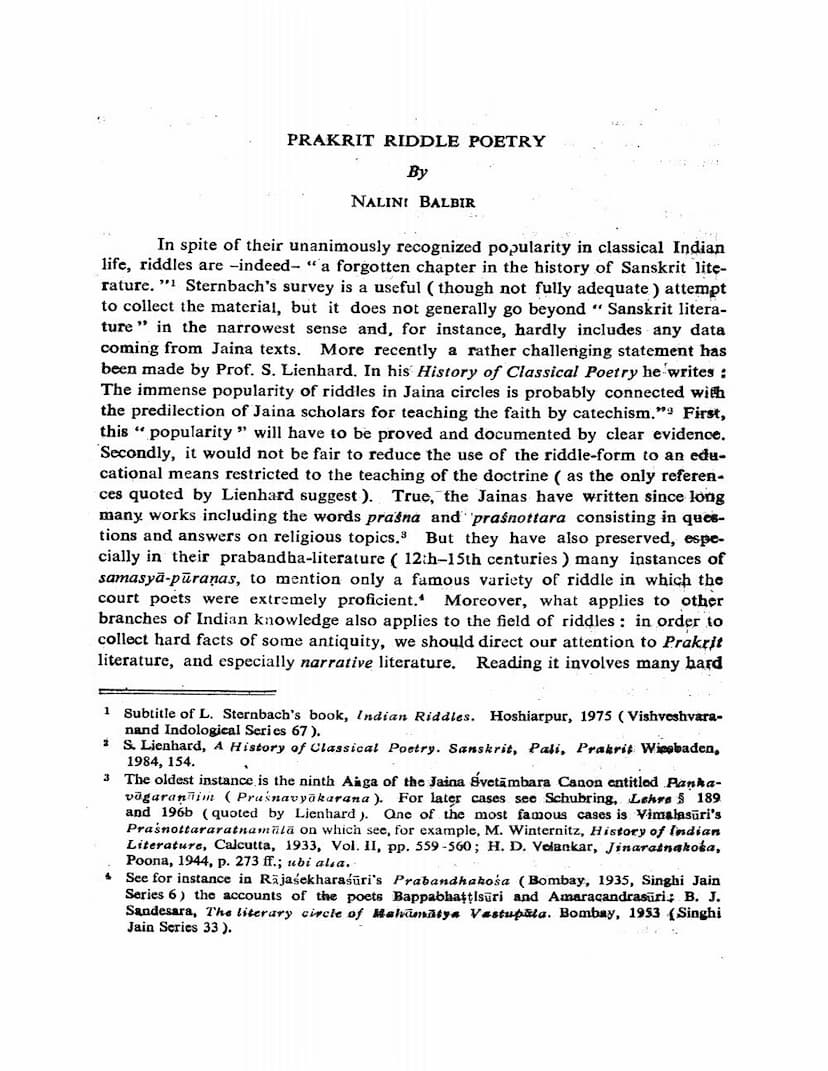
Nalini Balbir's "Prakrit Riddle Poetry" delves into a fascinating, often overlooked, aspect of classical Indian literature: riddles found within Prakrit texts, particularly those of Jain origin. Balbir challenges the perception of riddles as solely a "forgotten chapter" of Sanskrit literature and argues against a narrow view that limits their use to catechismal religious instruction, as suggested by some scholars like S. Lienhard. Instead, she highlights the significant presence and variety of riddles in Jain circles, emphasizing their role in both religious teaching and secular entertainment.
The paper distinguishes between two main categories of riddles:
-
Wordplay Riddles: These include graphical plays and more numerous "praśnottaras," comparable to Western charades. Balbir notes that this category warrants a separate, in-depth investigation.
-
Riddle Poetry: This is the primary focus of the paper. Balbir defines this as stanzas, often in the āryā meter, that are framed as questions, closely resembling muktaka poetry (independent verses) and sometimes bordering on dhvani (suggested meaning). These riddles are typically set in an erotic context (śṛngārarasa) and involve common characters of Indian lyric poetry: the lover (nāyaka), the beloved (nāyikā), and often the beloved's female friend (sakhi) or a go-between (dūti).
Balbir identifies and analyzes three specific types of "riddle poetry" found in the Kuvalayamālā by Uddyotanasūri (dated 779 A.D.), a key text for her research:
-
Bhaṇievviya (§ 1): Characterized by the use of the past participle "bhaṇiya" (said). These riddles present a scenario where someone says something, and the stanza poses a question about why the protagonist (often the nāyikā) reacts in a particular way. The implied meaning, often revealed by the commentator, explains the protagonist's seemingly unusual behavior through a hidden intention or emotion. Examples from other works like the Cauppannamahāpurisacariya and Vajjālagga are provided to show the prevalence of this pattern. The term "bhaṇievviyā" likely refers to stanzas where "bhaṇiya" is central and might have been a specific term for this micro-genre that later got absorbed into broader categories like "hiyāli."
-
Hiyaya-gāhā (§ 2): These riddles are etymologically related to "heart" (hrdaya). They feature a situation where a particular sight or event prompts a reaction from the protagonist, the reason for which is not immediately obvious to an outsider and must be inferred from the "heart" or true intention. The Kuvalayamālā provides an example of a farmer's wife weeping upon seeing a kadamba flower, which her lover had placed as a signal. Similar stanzas, focusing on hidden meanings provoked by external stimuli and subtle interactions, are found in Dharmadāsa's Sanskrit treatise, the Vidagdhamukhamandana. These often involve a network of significant glances and unspoken emotions.
-
Samvihāṇaya (§ 3): This category marks a blurring of the lines between riddle and poetry, as the stanza is not always formulated as a direct question. These are described as "arrangements" or "combinations" of meanings, requiring interpretation. Uddyotanasūri's explanation of a stanza about a beloved whose anger towards her lover and messenger is expressed through ambiguous language exemplifies this. The stanza can be understood on multiple levels: as a moral statement about karma, as a reproach to the lover, and as a signal to the messenger. The ambiguity of words and the context are crucial for deciphering the intended meaning, revealing the beloved's complex mix of bitterness and love. The term "samvihāna" itself suggests this multi-layered construction.
In conclusion, Balbir emphasizes that the formal structure of these Prakrit riddles, particularly the bhaṇiya-pattern, points to a distinct micro-genre that was enjoyed by cultured circles. While these bhaṇiya-stanzas might not be considered "high" poetry, they represent an ephemeral but preserved form of literary amusement. The investigation into these riddles offers valuable insights into the "archeology" of muktaka poetry and the Indian penchant for classification based on formal criteria. The study highlights the richness of Prakrit literature, particularly Jain texts, in providing a different perspective on the evolution and usage of riddles in classical India.