
Prakrit Avvo
Added to library: September 2, 2025
Summary
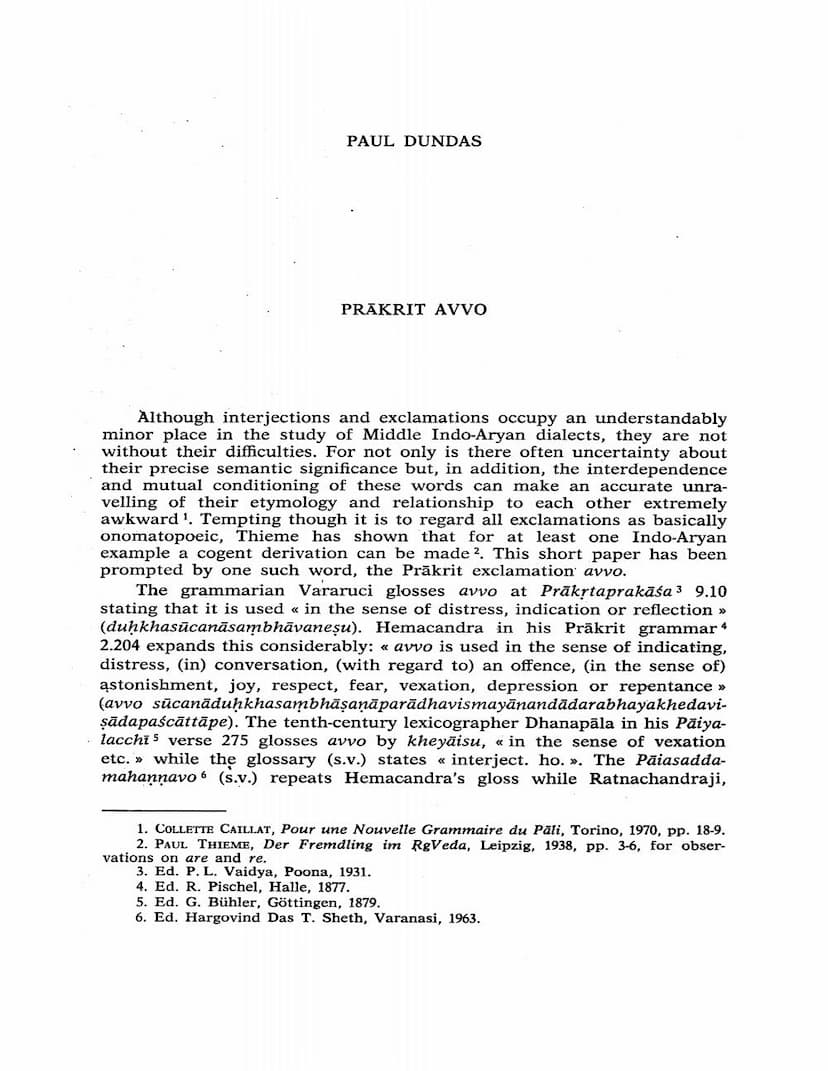
This paper, "Prakrit Avvo" by Paul Dundas, delves into the meaning and origins of the Prakrit exclamation "avvo." Dundas acknowledges that interjections are often overlooked in linguistic studies but highlights their inherent difficulties due to semantic uncertainty and the complex interrelationships between such words.
The paper then meticulously examines the historical linguistic understanding of "avvo":
-
Grammarians' Definitions:
- Vararuci (in Prākṛtaprakāśa) defines "avvo" as signifying "distress, indication, or reflection."
- Hemacandra (in his Prakrit grammar) greatly expands this, listing "indicating, distress, conversation, offence, astonishment, joy, respect, fear, vexation, depression, or repentance" as its meanings.
- Dhanapala (in Paiyalacchi) glosses it as "in the sense of vexation etc." and identifies it as an interjection equivalent to "ho."
- Later lexicographers, like in the Paiasaddamahannavo and the Ardha-Māgadhi Dictionary, largely reiterate Hemacandra's broad semantic range and note its use as a particle expressing sorrow.
-
Occurrences in Literature: Dundas provides numerous examples of "avvo" in Prakrit literature to illustrate its usage and semantic range:
- In the Vasudevahindi, it's used by monks struck by fruit, with their pupils laughing.
- In the Sattasai, it frequently appears in verses about love affairs, expressing emotions like distress or astonishment. One particular verse (821) shows "avvo" used in a context of refusal and exasperation.
- In Koühala's Līlāvai, it's used to express longing and perhaps distress.
- Jayasimhasūri's Dharmopadeśamālāvivaraṇa (a version of the Mūladeva story) showcases "avvo" in various contexts: admiring a noble man, expressing shame, seeking help with provisions, disappointment in generosity, recognizing piety, and simple curiosity about someone's presence.
- "Avvo" is also found in Apabhramśa literature, such as in Puṣpadanta's Nāyakumāracariu and Somaprabha's Kumārapālapratibodha.
-
Etymological Considerations and Comparisons: Dundas then explores the potential origins and related forms:
- He notes the common final "-o" in exclamations like āmo, ambho, and bho, suggesting a derivation from the Sanskrit "-aḥ".
- He dismisses a simple derivation of "avvo" from āmo (meaning "yes" or "indeed") because "avvo" has a much broader semantic scope than mere affirmation.
- He introduces the vocative form "ammo" (meaning "O mother!"), which is well-attested in literature. Examples from the Uvāsagadasāo and Vasudevahindi demonstrate its use when addressing mothers or mother-figures.
- Dundas posits a potential connection between "avvo" and "ammo." He suggests that "avvo" might have originally been a vocative form, perhaps related to the Dravidian words avva ("mother, grandmother, old woman") and ammā ("mother, matron, lady; exclamation of pity, surprise or joy").
- He proposes that an original specialized sense of "mother" for "avvo" could have broadened, akin to how "mother" itself can be used as an exclamation of surprise or dismay in English, or "mamma mia" in Italian.
-
Vocative vs. Exclamatory Use: Dundas considers whether "avvo" ever retains a concrete vocative sense, like "ammo." While the Sattasai, a text potentially influenced by Dravidian culture, contains many instances where "avvo" appears in contexts similar to a girl addressing her mother or an elder, he notes one verse (273) where "avvo" is followed by a masculine vocative, strongly suggesting it's purely exclamatory in that instance. However, he leaves open the possibility that some verses in the Sattasai might preserve the original vocative meaning.
In conclusion, Dundas's paper systematically analyzes the Prakrit exclamation "avvo," tracing its documented meanings through ancient grammarians and literary examples. He proposes a compelling theory linking "avvo" to the vocative "ammo" and ultimately to Dravidian kinship terms, suggesting a semantic evolution from an address to a mother to a broader range of emotional expressions.