
Philological Remarks On Sakyamatis Pramanavarttikatika
Added to library: September 2, 2025
Summary
Here's a comprehensive summary of Ernst Steinkellner's "Philological Remarks on Śākyamati's Pramāṇavārttikāṭīkā," drawing from the provided pages:
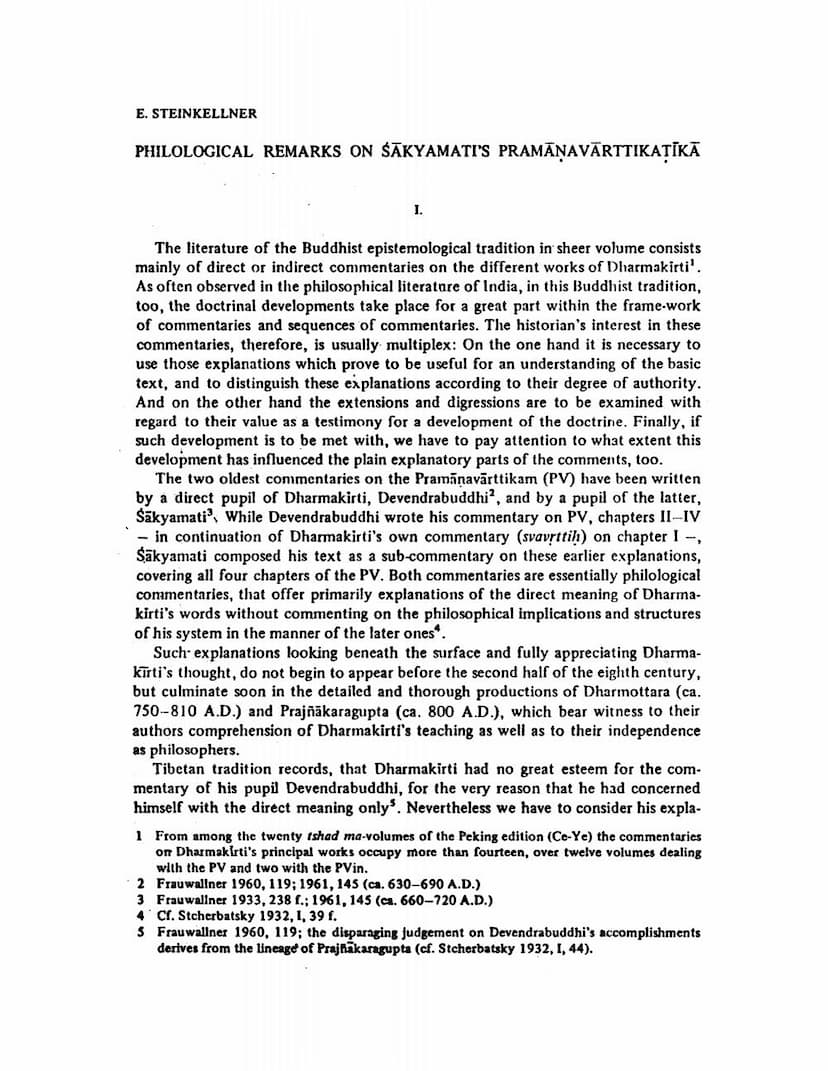
This article by Ernst Steinkellner focuses on Śākyamati's commentary on Dharmakirti's Pramāṇavārttika (PV), highlighting its significant philological value and its influence on later Buddhist philosophical literature. The core argument is that Śākyamati's commentary, particularly on the first chapter of the PV, serves as a crucial and authoritative source for understanding Dharmakirti's original work, and its reconstructions are vital for tracing the development of Buddhist epistemology.
Key Points and Arguments:
-
The Importance of Commentaries in Indian Philosophy: Steinkellner begins by emphasizing that in Indian philosophical traditions, including Buddhist epistemology, doctrinal developments often occur within the framework of commentaries and commentarial sequences. Thus, understanding these commentaries is essential for both understanding the primary texts and tracing intellectual history.
-
Dharmakirti's Pramāṇavārttika and its Commentaries: The Pramāṇavārttika (PV) is a central text in Buddhist epistemology, and its literature consists largely of commentaries on it. Steinkellner identifies the two oldest commentaries as being by Devendrabuddhi (a direct pupil of Dharmakirti) and Śākyamati (a pupil of Devendrabuddhi).
-
Śākyamati's Role as a Sub-Commentator: While Devendrabuddhi commented on chapters II-IV of the PV (following Dharmakirti's own commentary on chapter I), Śākyamati composed his work as a sub-commentary on these earlier explanations, covering all four chapters of the PV. Crucially, Steinkellner notes that both Devendrabuddhi and Śākyamati's commentaries are primarily philological, focusing on the direct meaning of Dharmakirti's words rather than extensive philosophical implications.
-
The Value of Śākyamati's Commentary:
- Authoritative Philological Explanation: Steinkellner asserts that Śākyamati's commentary is considered the authoritative philological explanation of the PV.
- Older than Karnakagomin: It has been clarified that Śākyamati's explanation of the first chapter is older than that of Karnakagomin.
- Influence on Later Authors: Śākyamati's explanations were used by many other Buddhist and non-Buddhist authors, including the Jain scholars Haribhadra and Kalyanacandra.
- Reconstruction Potential: The availability of Sanskrit materials and Tibetan translations makes a reconstruction of Śākyamati's commentary possible, at least for the first chapter. This reconstruction is desirable for two main reasons:
- To easily delineate the creative sections in later commentaries, thereby understanding the development of Dharmakirti exegesis.
- To re-establish the authoritative value of Śākyamati's commentary in its original Sanskrit wording, as Tibetan translations can be ambiguous in details.
-
The "Literary Polarization" of the PV: The first chapter of the PV holds a special place due to Dharmakirti's own commentary on it. This led to a "literary polarization," where commentaries were often composed solely for the first chapter, or separately for chapters II-IV. Śākyamati's commentary reflects this, with a significantly larger volume dedicated to the first chapter (487 folios) compared to the remaining chapters (251 folios). This is attributed to the need to explain both Dharmakirti's commentary and the verses for the first chapter, while for the others, only the basic verses and Devendrabuddhi's commentary needed explanation.
-
Śākyamati's Relationship with Karnakagomin: Karnakagomin's commentary (PVSVT) is a key source for reconstructing Śākyamati's PVT, especially for the first chapter. Karnakagomin incorporated Śākyamati's word explanations into his own, but not mechanically. He also critically considered their value, sometimes discarding them for other explanations drawn from Dharmakirti's other works like the Hetubinduḥ and Pramāṇaviniścayaḥ. This makes Karnakagomin an early example of an eclectic commentator.
-
Śākyamati's Commentary on Chapters II-IV: For chapters II-IV, Śākyamati commented not directly on Dharmakirti's verses, but on Devendrabuddhi's commentary. Steinkellner points to Appendix I in Manorathanandin's edition of the PVV as a source for fragments of Śākyamati's commentary on these chapters, noting that these fragments also incorporate texts from Jinendrabuddhi's Viśālāmalavatī.
-
Methodology and Examples: The article illustrates its points with detailed textual comparisons and synopses, showing how Karnakagomin used Śākyamati's work and how fragments of Śākyamati's commentary can be identified and analyzed. Specific examples are provided from the second chapter (pramānasiddhih) and third chapter (pratyakşam) of the PV, demonstrating how Steinkellner traces the use of Śākyamati's explanations in later works.
In essence, Steinkellner's work argues for the foundational importance of Śākyamati's philological commentary for understanding Dharmakirti's Pramāṇavārttika and the subsequent evolution of Buddhist logical and epistemological thought. He advocates for the reconstruction of this commentary to better grasp the historical development of this influential school of thought.