
Perche Esiste La Filsofia In India
Added to library: September 2, 2025
Summary
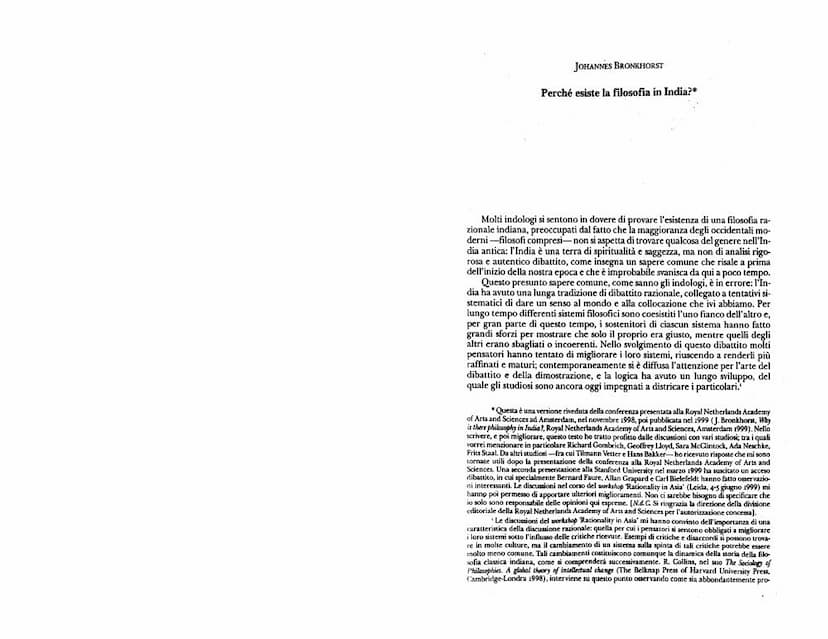
Here is a comprehensive summary of Johannes Bronkhorst's "Perché esiste la filosofia in India?" (Why there philosophy in India?):
The book challenges the common Western perception of ancient India as a land of spirituality and wisdom but not rigorous analysis and debate. Bronkhorst argues that India possessed a long and vibrant tradition of rational inquiry, which he defines by two key characteristics:
- Rational Debate and System Improvement: This involves different philosophical systems coexisting and actively engaging in critiques of each other. The proponents of these systems strive to refine their own doctrines and demonstrate the flaws in opposing views. This process fostered the development of argumentation, demonstration, and logic.
- Unrestricted Critical Examination: In a tradition of rational inquiry, no area of reality is considered fundamentally beyond the scope of critical examination. Matters are not automatically reserved for tradition, revelation, or intuition.
Bronkhorst contends that only ancient Greece and ancient India independently developed such traditions of rational inquiry. He contrasts this with China, which, according to his analysis of sinologist A.C. Graham's work, lacked this characteristic. While China had periods of intellectual debate and sophisticated argumentation (like the Mohists), it did not develop the radical, all-encompassing critical spirit that questions even traditional or intuitive beliefs. Chinese thought, he suggests, tended to remain more focused on practical ethics or mysticism, and when rationalism appeared, it was often met with anti-rationalist reactions (like in Taoism), preventing the establishment of a sustained tradition of unbounded rational inquiry.
Key Arguments and Examples:
- The Role of Conflict: Bronkhorst emphasizes that intellectual conflict and criticism are crucial for the dynamism of philosophy. When thinkers are compelled to improve their systems in response to criticism, it drives progress. He notes that while criticism exists in many cultures, the systemic change of a system due to critique might be less common.
- Distinguishing Rationality from Intelligence: The author clarifies that having a tradition of rational inquiry does not equate to being universally intelligent or rational in all aspects. One can be highly intelligent in specific areas without subjecting all beliefs to critical scrutiny.
- The Case of Greece: He draws parallels with ancient Greece, where the political climate of open debate and discussion in city-states likely fostered the willingness to challenge deeply held assumptions about nature, the gods, and the order of things. This led to a tradition of rational inquiry that influenced subsequent Western thought.
- The Case of India:
- Vaisheshika School: Bronkhorst uses the Vaisheshika school as a prime example of rational inquiry in action. He traces its development in grappling with the problem of karma (the efficacy of actions across lifetimes). Initially, the system invoked the concept of adṛṣṭa (the unseen). Later, merit (dharma) and demerit (adharma) were conceived as qualities of the soul. The most significant development, however, was the introduction of a creator God to explain the mechanism of karmic retribution. This move, while seemingly introducing dogma, was driven by a rational attempt to solve an internal philosophical problem, demonstrating a willingness to revise even foundational beliefs.
- Vasubandhu and Buddhism: He also examines the Buddhist philosopher Vasubandhu, who, facing similar issues with karma, adopted an idealist stance, arguing that actions, their residues, and results are ultimately mental events. Bronkhorst suggests this move to idealism was motivated by a critical need to make karmic retribution intelligible, rather than solely by meditative experience.
- The Sarvāstivāda School: The development of the Sarvāstivāda school in Northwest India is presented as a crucial instance. Bronkhorst posits that the presence of Hellenistic kingdoms in this region may have influenced Buddhist thinkers. He argues that while specific Greek philosophical ideas were not directly imported, the method of rational debate and the willingness to subject traditional beliefs to critique were likely adopted from the Greeks. This is evidenced by the general revision of Sarvāstivāda doctrines and the introduction of new classifications like the pañcavastuka. The Milindapañha, a dialogue between King Menander and a Buddhist monk, further suggests interaction and debate between Greeks and Buddhists.
- Distinguishing from Vedic Traditions: Bronkhorst contrasts this with earlier Vedic traditions, including the Upanishads. He argues that while these texts contain debates, they are not characterized by rational inquiry in his defined sense. The focus was often on winning debates through possessing more knowledge or making authoritative pronouncements, rather than through logical argument or critical examination of fundamental assumptions. He points out that the question of the teacher being wrong simply did not arise in the Upanishadic context.
- Panini: He addresses the potential influence on the grammarian Panini, acknowledging his profound intellect. However, Bronkhorst argues that Panini's work, while a systematic elaboration of linguistic tradition, does not necessarily demonstrate adherence to a tradition of rational inquiry, as it doesn't appear to have challenged established beliefs.
Conclusion:
Bronkhorst concludes that the emergence of a tradition of rational inquiry, characterized by critical debate and the systematic refinement of thought, was a rare phenomenon in human history, appearing independently only in ancient Greece and ancient India. He suggests that this tradition, particularly its emphasis on questioning and critique, was instrumental in the development of modern science and, consequently, the modern world. The book aims to situate the study of Indian philosophy within the broader history of human thought and to highlight the unique contribution of India to the development of rational inquiry, posing the significant question of how and why this tradition arose in India, suggesting it was not an automatic occurrence but a result of specific historical circumstances and intellectual responses.