
Peacocks Egg Bhartrhari On Language And Reality
Added to library: September 2, 2025
Summary
Here's a comprehensive summary of Johannes Bronkhorst's "The Peacock's Egg: Bhartrhari on Language and Reality," based on the provided text:
Core Argument: Understanding Indian Philosophy Beyond Historical Context
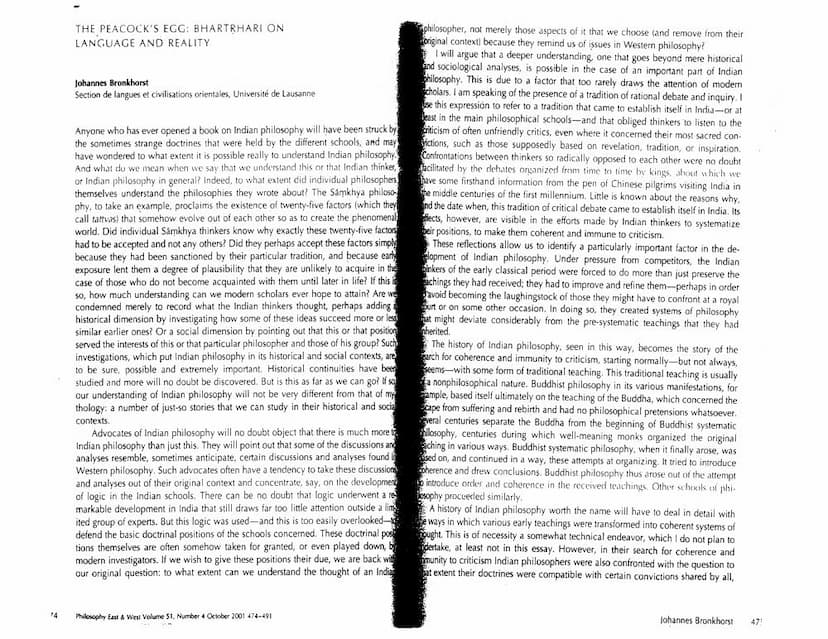
Bronkhorst argues that a deeper understanding of Indian philosophy is possible beyond mere historical and sociological analysis. This is achieved by recognizing the crucial role of a tradition of rational debate and inquiry that developed in India. This tradition compelled thinkers to refine their positions, make them coherent, and withstand criticism, even from radically opposed viewpoints. This pressure forced them to move beyond simply preserving traditional teachings (often non-philosophical, like the Buddha's message) and to develop systematic philosophies.
The Centrality of Shared Convictions: Language and Reality
A key factor influencing the development of these philosophical systems was the reflection on and analysis of certain convictions shared by almost all Classical Indian thinkers. Two particularly important ones were the doctrine of karma and the belief in a close correspondence between language and reality. Bronkhorst focuses on the latter.
The Correspondence Between Language and Reality: A Problem and Its Solutions
The belief that language corresponds to reality meant, at its most basic, that words correspond to objects. However, this seemingly simple notion led to complex philosophical problems, particularly when dealing with statements about things coming into being.
- The Problem of Becoming: Statements like "John makes a pot" or "The pot comes into being" posed a challenge because the "pot" is not yet fully formed. If words must correspond to existing things in a situation, what does the word "pot" refer to in these instances?
- The Indian Response: No Rejection of the Premise: Crucially, Bronkhorst highlights that, to his knowledge, all Indian thinkers of the first five centuries CE refused to conclude that the words of a statement do not always correspond to the elements of the situation described. Instead, they developed various ingenious solutions to reconcile this belief with the apparent contradictions.
- Reasons for this Adherence: This seemingly counter-intuitive adherence was fueled by two factors:
- Pre-existing Buddhist Convictions: Many Buddhists already believed the phenomenal world was not ultimately real due to its composite nature. This made them less inclined to see a contradiction between language and a potentially unreal phenomenal world.
- Confidence in Reason: The development of rational inquiry gave thinkers confidence that their arguments, rather than tradition or revelation, could support their positions, even if it meant reinterpreting perceived reality.
Key Thinkers and Their Solutions:
- Samkhya: Proposed Satkaryavada, the doctrine that the effect (the pot) already exists before it is produced, albeit in a latent form within the material (the clay). This ensures the word "pot" always has a referent.
- Nagarjuna (Buddhist): Argued that statements about coming into being are self-contradictory. Using the example of a pot coming into being, he reasoned that if a pot exists, it doesn't need to come into being; if it doesn't exist, then the subject of "the pot is produced" has no referent. This led to his "nihilistic" arguments and the Madhyamaka school.
- Bhartrhari (Brahmanical, 5th century CE): A prominent "linguistic philosopher," Bhartrhari also confronted the problem of becoming and offered four distinct solutions:
- Universals: The word "pot" refers to the universal of "pot," which actively manifests the pot.
- Substance: The word "pot" refers to the substance (clay) from which the pot is made.
- Metaphorical Reality (Aupacārikī Sattā): Words refer to a metaphorical reality, which shows things in all their states, including their future state. So, "pot" refers to the future pot.
- Mental Reality: The word "pot" refers to the mental representation of the pot that the speaker has in mind.
- Bhartrhari's Perspectivism: Bronkhorst notes that Bhartrhari doesn't seem to prefer one solution, characteristic of his "perspectivism." However, he draws a significant conclusion: phenomenal reality is unreal and different from absolute reality.
Bhartrhari's Unique Contribution: Language as the Creator of Phenomenal Reality
Bhartrhari builds upon Buddhist ideas of phenomenal unreality but offers a distinct perspective. He agrees that phenomenal reality is a result of language, but not in the sense that language combines ultimately real constituents. Instead, language divides the ultimately real totality of all there is, which is absolute reality.
- The Peacock's Egg Analogy: This is illustrated by the "peacock's egg" metaphor. The word, like the essence of a peacock's egg, is indivisible and lacks the multiplicity of colors. However, it "unfolds" to produce something that appears to have parts and distinctions – much like the peacock emerges from its egg.
- Words as Distinguishers: Words are the means by which this division of absolute reality into phenomenal objects occurs. The world, and every object in it, has both a real (undivided) and an unreal (divided) aspect. Phenomenal reality is the result of an unreal division of the undivided absolute.
- The Role of the Veda: For Bhartrhari, the Veda is the organizing principle or creator of the world. Vedic sentences, in particular, are responsible for the division of absolute reality. This means that the world, including its rules and duties, is structured according to the Veda. Consequently, only Vedic Brahmins, who understand the Veda, truly know the nature of the world and can influence it.
- Synthesis of Traditions: Bhartrhari's work represents a significant synthesis, drawing elements from various philosophical schools (Vaiśeṣika, Buddhist, Samkhya, and even Jainism) to create a system that places the Veda at its center. He bridges the gap between traditional Brahmanical beliefs and the contemporary philosophical debates, making the Veda the ultimate authority and the foundation for understanding reality.
Conclusion:
Bronkhorst's analysis of Bhartrhari demonstrates how complex philosophical doctrines can arise from seemingly simple shared beliefs and the subsequent rigorous debate and refinement of those beliefs. Bhartrhari's focus on language, particularly its role in dividing and structuring reality, and his integration of the Veda into this framework, represent a profound contribution to Indian philosophical thought. The "peacock's egg" serves as a potent metaphor for how an apparently simple, unified essence can manifest into a complex, differentiated reality through the transformative power of language, guided by the Veda.