
Peacock Egg A Parable Of Mahavira
Added to library: September 2, 2025
Summary
Here's a comprehensive summary of the Jain text "The Peacock Egg: A Parable of Mahavira," translated by Willem Bollée, based on the provided text:
Overall Context:
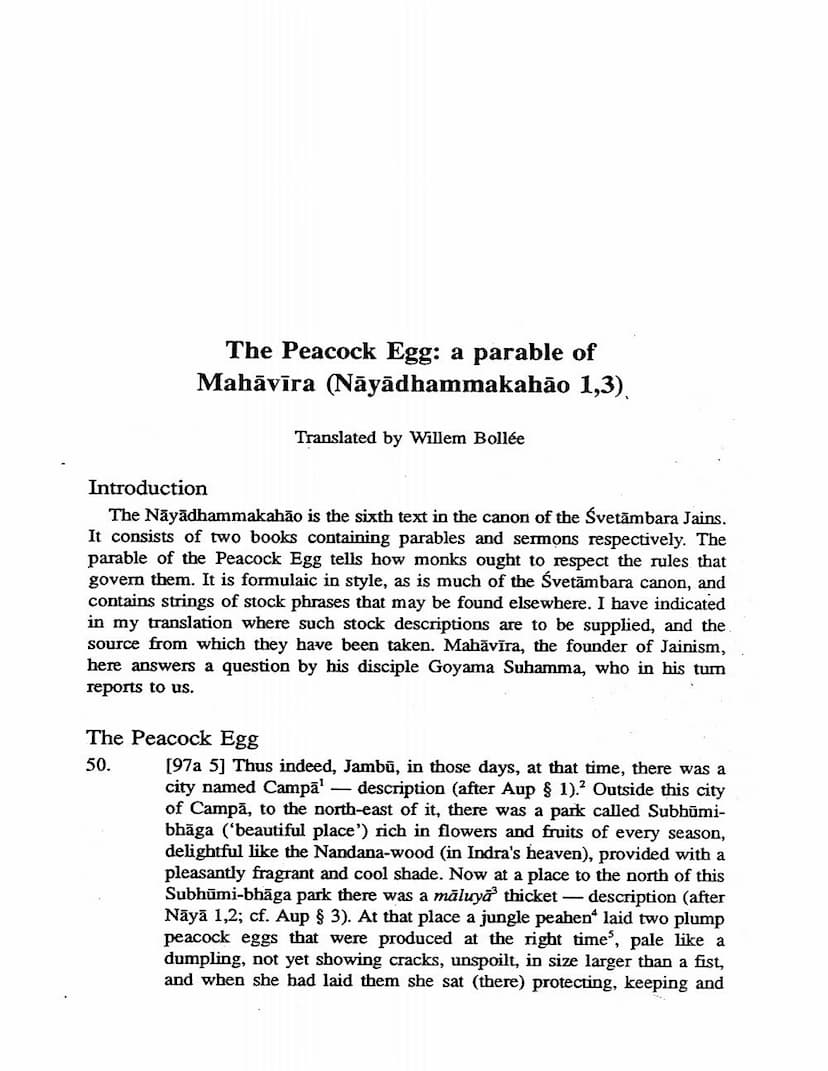
The "Peacock Egg" is a parable found within the Nāyādhammakahāo, the sixth text in the Svetāmbara Jain canon. This text contains parables and sermons. The parable itself is a didactic story designed to teach monks about the importance of respecting and adhering to their monastic rules. It's noted for its formulaic style and use of stock phrases common in the Svetāmbara canon, with the translator indicating where these phrases are borrowed from other texts. The story is presented as Mahāvira, the founder of Jainism, answering a question from his disciple Goyama Suhamma, who then relays the narrative to Jambū.
The Story:
-
Setting the Scene: The parable begins with a detailed description of the city of Campā and a beautiful park called Subhūmibhāga, filled with flowers, fruits, and pleasant shade, resembling Indra's heavenly Nandana-wood. To the north of this park is a thicket of māluya creeper.
-
The Peacock Eggs: In this māluya thicket, a jungle peahen lays two plump, pale, and unspoiled peacock eggs. She then sits to protect and incubate them with her own feathers.
-
The Two Friends: The story then introduces two sons of caravan leaders in Campā, Jinadatta-putta and Sāgaradatta-putta. They are portrayed as lifelong friends, sharing everything and acting in concert.
-
The Courtesan Devadattā: In the same city lives a wealthy, famous, and accomplished courtesan named Devadattā. She is described in detail, highlighting her wealth, skills (sixty-four arts), virtues, and allure, along with her grand lifestyle and influence.
-
The Friends' Proposal: One day, the two friends decide to spend time enjoying the pleasures of the Subhūmibhāga park with Devadattā. They make elaborate arrangements, including preparing lavish food, perfumes, clothes, and a decorated pavilion by the Nandā pond. They then go to Devadattā's house, invite her, and spend the day with her, enjoying the park and its various bowers.
-
The Discovery and Theft of the Eggs: After their enjoyable day, the friends proceed to the māluya thicket. The peahen, frightened by their arrival, flies to a tree branch, squawking and observing them. The friends notice her fear and suspect there's a reason. Upon entering the thicket, they find the two peacock eggs. They decide to take the eggs and place them amongst their own fowl, hoping to have young peacocks to play with. They instruct their servants to do this. The friends then return to Devadattā's house, offer her a gift, and go their separate ways.
-
Sāgaradatta's Impatience and Destruction: The next day, Sāgaradatta-putta goes to his peacock egg. He becomes anxious and doubtful about whether he will be able to raise a young peacock. In his agitation, he repeatedly throws the egg up, turns it, shakes it, and taps it against his ear. This rough handling causes the egg to become addled. When he realizes this, he is dejected and filled with regret, lamenting that he won't have a young peacock to play with.
-
Jinadatta's Patience and Success: In contrast, Jinadatta-putta visits his egg with confidence and a lack of worry, assured of a successful outcome. He leaves the egg undisturbed. Eventually, the egg hatches, and a young peacock emerges. Jinadatta-putta is overjoyed and entrusts the peacock to professional peacock breeders to raise and teach it to dance. The peacock grows beautifully, displaying all the desirable qualities, including a hundred eyes on its tail. When presented back to Jinadatta-putta, he is thrilled and rewards the breeders. The peacock then dances impressively, bringing Jinadatta-putta considerable wealth through public performances.
The Moral and Application:
The parable concludes by drawing a parallel between the fate of the peacock eggs and the conduct of Jain ascetics (monks and nuns).
-
The Impatient Ascetic (like Sāgaradatta): An ascetic who becomes fearful, anxious, doubtful, or wavering regarding the five major vows or the six groups of souls (essential principles of Jain doctrine) will face disgrace, criticism, and contempt in this life from the monastic community and lay followers. In the next life, they will suffer severe punishments, be tormented, experience misfortune, and wander endlessly in the cycle of rebirth (samsāra).
-
The Patient Ascetic (like Jinadatta): Conversely, an ascetic who is trustful, free from doubt, and firm in their commitment will be respected, honored, and worshipped by the monastic community and lay followers. They are considered excellent, auspicious, divine, and sacred.
Significance:
The parable of the Peacock Egg serves as a powerful illustration of how patience, steady faith, and adherence to principles lead to positive outcomes and spiritual advancement, while impatience, doubt, and wavering result in downfall and suffering. It emphasizes the importance of maintaining equanimity and unwavering commitment to the Jain path, especially when faced with internal or external challenges. The detailed descriptions of the park, the courtesan, and the friends' opulent lifestyle also highlight the worldly temptations that ascetics must overcome.