
Patanjali And Buddhists
Added to library: September 2, 2025
Summary
Here's a comprehensive summary of Johannes Bronkhorst's article "Patanjali and the Buddhists" based on the provided text:
The article by Johannes Bronkhorst argues that the influential Indian grammarian Patañjali, author of the Mahābhāṣya, may have been influenced by Buddhist texts and thought, particularly in both literary themes and philosophical ideas. Bronkhorst bases his argument on several striking similarities between passages in the Mahābhāṣya and early Buddhist canonical texts.
Key Arguments and Examples:
-
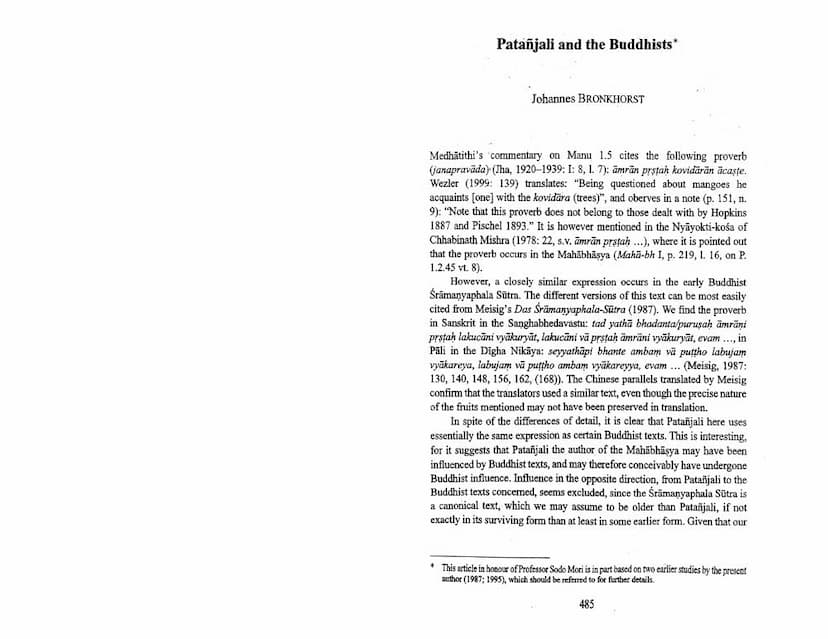
Proverbial Similarities: Bronkhorst highlights the use of a proverb in Patañjali's Mahābhāṣya that is strikingly similar to one found in the early Buddhist Śrāmaṇyaphala Sūtra. The proverb, concerning someone asked about mangoes but describing kovidāra trees (or vice-versa), appears in various versions of the Buddhist text. Bronkhorst suggests that if the Śrāmaṇyaphala Sūtra, being a canonical text, predates Patañjali, then Patañjali might have adopted this proverb from Buddhist circles. While acknowledging the possibility of independent origin, he notes this as a potential indicator of influence.
-
"Auspicious in Beginning, Middle, and End" Concept: Patañjali uses the phrase "sciences which have something auspicious in the beginning, in the middle and in the end" to describe certain texts. Bronkhorst argues that this concept doesn't fit Panini's Aṣṭādhyāyī well. Instead, he points to numerous early Buddhist texts that describe the Dharma taught by the Buddha as being "auspicious in the beginning, in the middle and in the end" (adikalyāna, majjhekalyāna, pariyosanakalyāna). This suggests Patañjali may have adopted this characterizing phrase from Buddhism.
-
Story of Absent-mindedness: Patañjali recounts a story about the grammarian Śākaṭāyana, who, despite being awake, did not perceive a group of carts passing by. Bronkhorst identifies a very similar account in the Buddhist Mahāparinirvāṇa Sūtra, where the protagonist is Araḍa Kālāma. Bronkhorst finds the story more plausible in an ascetic context, where the suppression of senses is a concern, making the Buddhist milieu a more likely source for Patañjali's anecdote.
-
Ontology of Words and Sounds (Phonemes and Morphemes): This is presented as a significant philosophical parallel. Bronkhorst points to Patañjali's discussions where he seems to consider material objects as collections of qualities. More importantly, Patañjali distinguishes the individual speech sound, sometimes called sphoṭa, from the dhvani (noise) that expresses it. He describes these sounds and words as eternal and unchanging, existing as single, objective entities situated in ether.
Bronkhorst connects this to the Sarvāstivāda Buddhist school, which categorized linguistic entities (like nāmakāya, padakāya, vyañjanakāya) as fundamental, independent dharmas. The Sarvāstivadins' ontology focused on the ultimate, indivisible constituents of reality. By including words and sounds as independent dharmas, they asserted their real existence. Bronkhorst argues that Patañjali's detailed discussions on the nature of words and sounds, their eternal existence, and their independent reality, while not directly tied to his grammatical project's needs, align remarkably with Sarvāstivāda Buddhist philosophical concerns. He suggests that Patañjali likely encountered these ideas, directly or indirectly, from Sarvāstivāda Buddhism.
Conclusion:
Bronkhorst concludes that while direct proof is difficult due to the nature of early Indian texts and the lack of explicit source citations, the evidence strongly suggests that Patañjali was influenced by Buddhist thought, particularly the Sarvāstivāda school. This influence appears in both literary motifs (proverbs, stories) and in more abstract philosophical concepts, such as the ontology of language. He emphasizes that these conclusions are tentative but probable given the striking parallels presented.