
Patanjali
Added to library: September 2, 2025
Summary
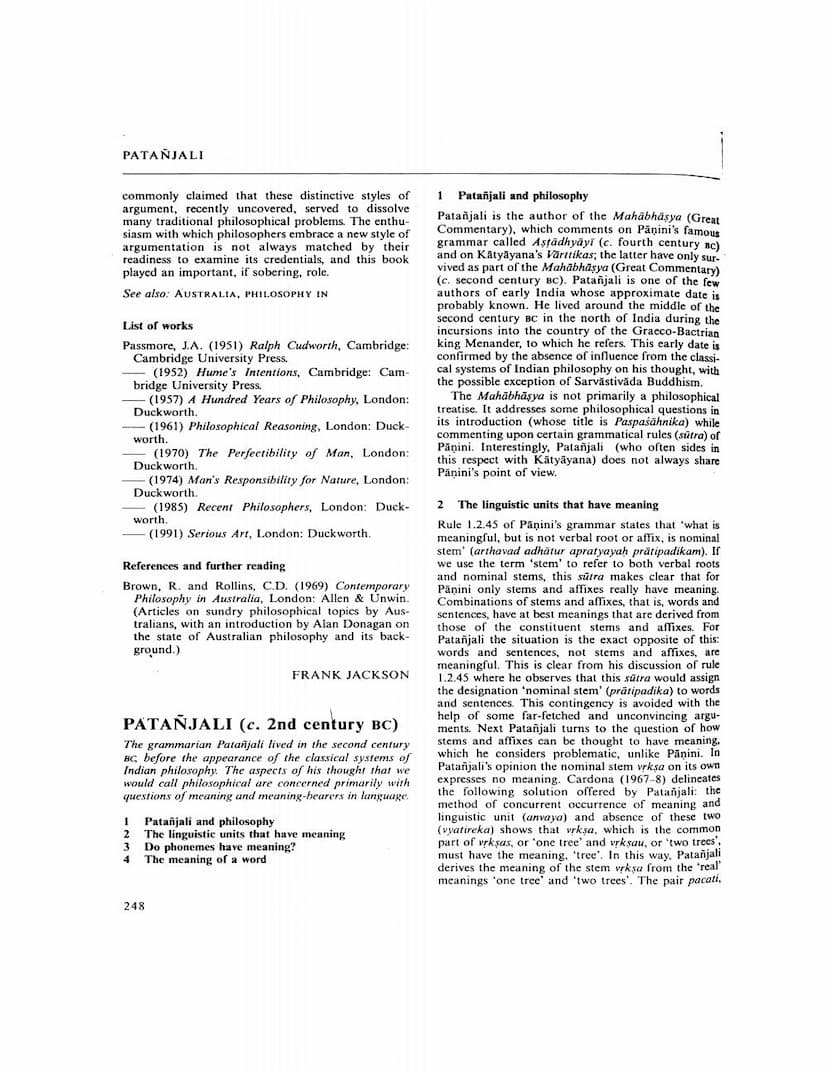
This document appears to be an excerpt from an encyclopedia or a scholarly work, likely an encyclopedia of philosophy, focusing on the Indian grammarian and philosopher Patanjali. The text highlights his contributions to grammar and his philosophical views on language and meaning, placing him in the context of early Indian thought and its interaction with other traditions.
Here's a comprehensive summary based on the provided text:
Who was Patanjali?
- Patanjali was an influential Indian grammarian and philosopher who lived around the middle of the second century BC in North India.
- He is known as the author of the Mahābhāṣya (Great Commentary), a monumental work that elaborates on Panini's renowned grammar, the Astādhyāyi (circa 4th century BC), and Katyāyana's Vārtikas.
- His approximate dating is significant because it predates the development of classical systems of Indian philosophy, allowing scholars to observe the influences (or lack thereof) on his thought. The text suggests a possible exception of influence from Sarvāstivāda Buddhism.
- Patanjali's work is situated during a period of incursions by the Graeco-Bactrian king Menander, which he references in his writings.
Patanjali and Philosophy: Focus on Language and Meaning
While the Mahābhāṣya is primarily a grammatical treatise, its introduction (the Paspaśāhnika) and commentary on specific grammatical rules touch upon philosophical questions, particularly concerning meaning and meaning-bearers in language.
- Deviation from Panini on Meaning: A key point of divergence between Patanjali and Panini (and Katyāyana) lies in their understanding of what constitutes meaningful linguistic units.
- Panini: Believed that only stems (verbal roots and nominal stems) and affixes have inherent meaning. Combinations like words and sentences derive their meaning from these constituent parts.
- Patanjali: Argued for the opposite: words and sentences are the primary meaningful units, not stems and affixes. He found Panini's view problematic, suggesting that stems like "vrkṣa" (tree) are meaningless on their own.
- Patanjali's Method for Deriving Stem Meaning: To explain how stems gain meaning, Patanjali employed a method of concurrent occurrence (anvaya) and absence (vyatireka). This involves observing where a linguistic unit and its meaning appear together and where they are absent. For example, by comparing "vrkṣa" (singular) and "vrkṣas" (plural), Patanjali deduced the meaning "tree" for the stem "vrkṣa." Similarly, he used the example of "pacati" (he cooks) and "pathati" (he recites) to derive meaning for the common affix "-ati."
- Influence of Sarvāstivāda Buddhism: Patanjali's emphasis on words and sentences as independently meaningful entities, and his acceptance of phonemes and words as "eternally existing entities," is linked to the Sarvāstivāda Buddhist concept of dharma, where certain elements (phonemes and words) were reified.
- Sphota and Sound (Dhvani): Patanjali uses the term sphota, which later grammarians would heavily debate. However, unlike later scholars, Patanjali did not see sphota solely as a meaning-bearer. He spoke of the sphota of individual phonemes, differentiating it from dhvani (sound), which is the manifesting element. The word or phoneme (śabda) is the sphota, while sound is a property of it. Different pronunciations (e.g., slow vs. fast speech) alter the dhvani but not the underlying sphota.
Do Phonemes Have Meaning?
- Patanjali actively engaged with the question of whether individual phonemes carry meaning.
- He presented arguments in favor of phonemic meaning, noting that some stems and affixes consist of a single phoneme (e.g., the verbal root "i" meaning "go"). He also pointed out how changing a single phoneme alters a word's meaning (e.g., "kūpa" vs. "sūpa" vs. "yūpa," or "vrkṣa" vs. "rksa").
- However, Patanjali ultimately rejected these arguments. He reasoned that sounds can be modified, omitted, or shifted in grammatical derivations, implying they lack inherent meaning. He argued that collections of phonemes can possess meanings that their individual constituents do not, likening it to how a chariot performs functions its individual parts cannot. He concluded that only collections of phonemes (words and sentences) have meaning.
The Meaning of a Word
- Patanjali discussed different classifications of words and their meanings, drawing from Yaska's Nirukta.
- Classification by Reference: He distinguished words referring to a genus (jāti), quality (guṇa), action (kriya), and arbitrary proper nouns.
- Classification by Grammatical Function (from Yaska): He also enumerated nominal words (nāman), verbs (ākhyāta), preverbs (upasarga), and particles (nipāta). Yaska described nouns as primarily denoting "entity" (sattva) and verbs as primarily denoting "being" (bhāva).
- Form vs. Individual Object: Patanjali addressed the debate about whether words denote the abstract form (ākṛti) or concrete individual objects (dravya). While some, like Vajapyāyana, favored form and Vyādi, the individual object, Patanjali's view was that both form and individual object constitute the meaning of words. The text also suggests that for Patanjali, "form" and "genus" might have been synonymous.
In essence, this excerpt portrays Patanjali as a foundational figure in Indian linguistics and philosophy whose detailed grammatical analysis led him to profound insights about the nature of language, meaning, and the relationship between abstract concepts and concrete expression. His work demonstrates a critical engagement with existing grammatical theories and a nascent philosophical exploration of linguistic units that would influence later Indian intellectual traditions.