
Paralipomena Zum Sarvasarvatmakatvada II
Added to library: September 2, 2025
Summary
Here's a comprehensive summary of the provided text, "Paralipomena Zum Sarvasarvatmakatvada II" by Albrecht Wezler:
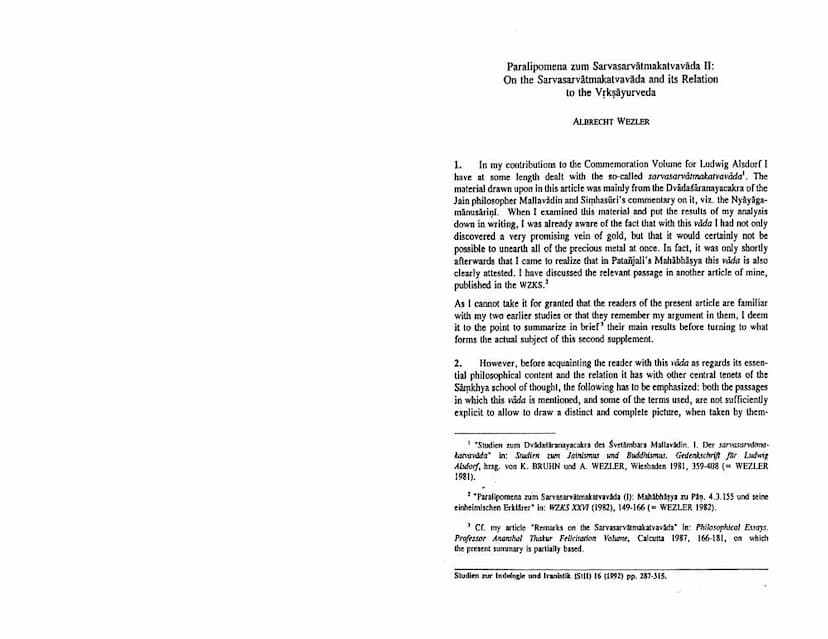
This article, "Paralipomena zum Sarvasarvatmakatvada II: On the Sarvasarvatmakatvada and its Relation to the Vrksayurveda," by Albrecht Wezler, is a continuation of his previous work on the sarvasarvatmakatvavada, a philosophical concept primarily found in the Samkhya school of thought. Wezler aims to further elucidate this doctrine, its origins, and its connections with other philosophical and scientific traditions in ancient India, particularly focusing on its relationship with the Vrksayurveda (the science of horticulture/botany).
Core Concepts of Sarvasarvatmakatvavada:
- Meaning: The central tenet of sarvasarvatmakatvavada is encapsulated in statements like "sarva sarvatmakam" (everything is all-containing) or "sarvam ekam ekam ca sarvam" (everything is one and one is everything), and "sarvar sarvatra (vidyatelasti)" (everything is everywhere).
- Ontological Statement: It posits that every phenomenon, and all phenomena collectively, are material by necessity and contain within themselves at least one representative of every species of individual things.
- Examples: This doctrine is often illustrated using the "alimentary chain," suggesting that an animal contains within itself the matter of plants and other animals it consumes. The core idea is that consumed entities are not destroyed but are incorporated into the consumer.
- Persistence of Being: A key and peculiar aspect is the supposition that all individuals consumed still exist as such, even after being assimilated. This doesn't mean a phenomenon consists only of all others; it can still be an entity in its own right.
- Application: The validity of the vada extends beyond living beings to inanimate evolutes of prakrti (primordial matter).
- Jaryanucchedena: This term is crucial for preventing the misunderstanding that being sarvatmaka negates an individual phenomenon's unique identity. It emphasizes the uninterrupted continuity of being.
- Refutation of Annihilation: The doctrine aligns with the Samkhya view of no annihilation, only disappearance from manifest existence (vyakter apa-gama).
- Connection to Satkaryavada: The sarvasarvatmakatvavada is closely linked to the satkaryavada (the doctrine that the effect pre-exists in the cause). Both are seen as interconnected aspects of a single concept of being: if an effect exists before manifestation (satkaryavada), its existence isn't negated by its disappearance.
- Samkhya Concept of Being: This concept, rooted in the idea that "what exists exists, what does not does not," rejects production and destruction, viewing existence as uninterrupted, with manifestation being a temporary, albeit potentially brief, period.
Origin and Development:
- Empirical Observation: Wezler suggests the doctrine might originate from immediate observation of the natural world, particularly the interdependence of life forms (alimentary chains).
- Upaniṣadic Influence: He posits a possible origin in Upanishadic teachings, specifically citing Ch.Up. 6.2.1.E. where it's stated that "sat" (existence) can only originate from "asat" (non-existence), hinting at a foundational being. This concept of being might have been shared by early Theistic schools.
- Mahābhāṣya Evidence: Wezler finds strong evidence in Patañjali's Mahābhāṣya (on Pāṇini 4.3.155), where an answer to a linguistic question about referring to a dead pigeon with a word for a living one explains it through the philosophical view that the original entity (vikāra) remains existent in its transformation. This points to the sarvasarvatmakatvavada being present by the 2nd century BCE.
- Response to Criticism: The doctrine was likely developed to address criticisms, particularly the "everything is visible everywhere" objection. The Samkhya response involved the concept of abhivyakti (manifestation), conditioned by place, time, shape, etc.
Relation to Vrksayurveda:
- Key Link: The most significant contribution of this article is the detailed analysis of how the sarvasarvatmakatvavada is connected to the Vrksayurveda.
- Examples from Texts: Wezler examines passages from Cakradhara's gloss on Jayantabhaṭa's Nyāyamañjarī and Bhāsarvajña's Nyāyābhiṣaṇa. These texts cite the Vrksayurveda in discussions related to the sarvasarvatmakatvavada.
- The "Alimentary Chain" Extended: Cakradhara's commentary illustrates a chain of transformation: milk -> ghee -> nourishment -> sperm -> children -> death -> decomposed corpse -> worms OR tree -> fruit -> juice -> strength. This demonstrates the idea that "everything is in milk" and that products manifest at different times due to conditioning factors.
- Human Corpse as Manure: Crucially, both Cakradhara and Bhāsarvajña cite the Vrksayurveda in the context of a decomposed human corpse contributing to the growth of trees. This highlights a specific application of the sarvasarvatmakatvavada: the transformation of jangama (moving beings) into sthāvara (stationary beings).
- Samkhya Interpretation of Vrksayurveda: Wezler argues that Samkhya authors likely referred to the Vrksayurveda to support their theory that animals (including humans) after death not only decay into worms but also nourish plants. The inverse (plants into animals) was considered common knowledge.
- Vrksayurveda Texts and Human Remains: Wezler delves into specific verses from Surapala's Vrksayurveda, which explicitly recommend the use of products derived from human corpses (like human oil, fat, flesh) as potent fertilizers for plant growth. This suggests an empirical basis, however unusual, for the Samkhya philosophical claim.
- Practical vs. Theoretical: While Vrksayurveda texts focus on empirical observations and practices, Samkhya philosophy imbues these observations with its theoretical framework of parinama (transformation). The Samkhya philosopher projects their theory of ubiquitous transformation onto the observations made by Vrksayurvedins.
- Interplay of Philosophy and Science: This connection exemplifies a broader relationship between Indian philosophy and natural sciences, where philosophical theories might interpret or utilize findings from specialized sciences like botany.
Additional Points:
- Chronology: The relationship is chronologically sound, with Vrksayurveda being mentioned as early as the Arthasastra.
- Procurement of Human Remains: Wezler also touches upon the challenging question of how such materials were procured, suggesting possible sources like human sacrifice, though acknowledging the secrecy and rarity involved. He analyzes legal and social contexts from the Arthasastra regarding the sale of human flesh.
- Artistic Parallels: In an appendix, Wezler notes a striking parallel in Edvard Munch's painting "Metabolism," which visually depicts the transformation of a human body into a tree, mirroring the Samkhya-Vrksayurveda concept.
In essence, Wezler's article provides a deep dive into the sarvasarvatmakatvavada, demonstrating its sophisticated philosophical underpinnings within Samkhya thought and revealing a fascinating, though often macabre, connection with ancient Indian botanical practices as documented in the Vrksayurveda. The research highlights how philosophical doctrines were sometimes grounded in or illustrated by observations from specialized fields of knowledge.