
Paninis View Of Meaning And Its Western Counterpart
Added to library: September 2, 2025
Summary
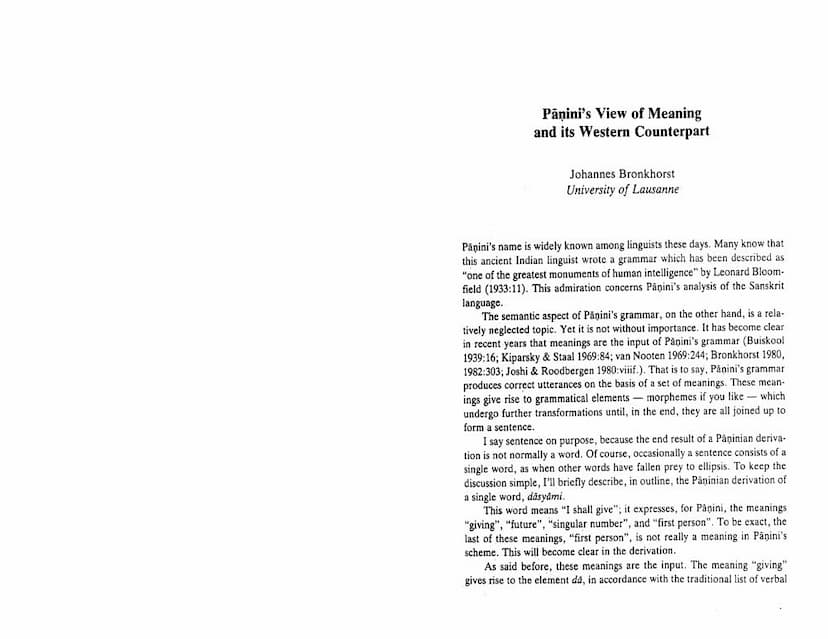
Here's a comprehensive summary of Johannes Bronkhorst's work "Panini's View of Meaning and its Western Counterpart," based on the provided text:
The book explores the often-neglected semantic aspect of the ancient Indian linguist Pāṇini's grammar, highlighting its profound significance. Bronkhorst argues that for Pāṇini, meanings are the fundamental input from which grammatical elements (morphemes) are derived and subsequently transformed to form sentences.
Bronkhorst illustrates this with the example of the Sanskrit word "dāsyāmi" (I shall give). He breaks down its derivation, showing how the meaning "giving" leads to the root "dā," "future" leads to the suffix "lṛṭ" (which is further transformed), "singular number" and the presence of the first-person pronoun contribute to the ending "-mi," and a phonological process accounts for the vowel length. The key takeaway is that each component of the surface form of the word corresponds to a specific meaning element at a deeper, underlying level.
This approach, where parts of words carry distinct meanings, is situated within the cultural and intellectual context of Pāṇini's time. Bronkhorst notes the prevalence of "etymologies" in Brahmanical texts, which, unlike modern etymology, sought to uncover the essence of things through the constituent parts of words. The Nirukta, a contemporary work, exemplifies this by using this method to decipher unknown words. Pāṇini's grammar shares this fundamental presupposition: constituent parts of words are the primary carriers of meaning.
Bronkhorst emphasizes that the ultimate meaning-bearers in Pāṇini's system are not always identical to the surface form of the words, as grammatical elements can be replaced or dropped during derivation. This suggests a deeper underlying level of linguistic representation where meanings are directly expressed.
The text then shifts to explore a Western parallel to Pāṇini's view of meaning, focusing on Franz Bopp (1791-1867), the founder of comparative Indo-European linguistics. Bopp's work, particularly until the 1860s, exhibited striking similarities to Pāṇini's approach. Bopp viewed Indo-European languages as agglutinations of meaningful elements, where primitive semantic concepts were often expressed by separate morphemes. He identified these elements as verbal and pronominal roots, which he believed represented "primary ideas."
Bopp's analysis of "aśrauṣam" (I heard) reveals his view: it's an agglutination of the root "śru" (to hear), a verbum abstractum "to be" (represented by "s"), and a pronominal root (represented by "am") for number and person. Similarly, he analyzed "dāsyāmi" as "dā" (giving), "s" (copula), "a" (to wish), and "mi" (personal pronoun). For Bopp, agglutination was the "spirit" of the Sanskrit language.
Bronkhorst discusses potential influences on Bopp, including Leibniz and Johann Christoph Adelung, but stresses that Pāṇini's influence on Bopp is better established. Bopp was aware of Indian grammarians through European Sanskrit grammars, and his method of analyzing Sanskrit into roots, stems, and suffixes was likely inspired by Pāṇini. While Bopp sometimes disagreed with Indian grammarians, he acknowledged their contributions and even critiqued them for not going far enough in tracing the origins of grammatical forms.
In conclusion, Bronkhorst posits that both Pāṇini and Bopp shared a fundamental approach to language analysis: seeking ultimate meaning-bearers in a deeper, not always surface-identical, layer of language. Bopp identified this layer with an earlier stage of the language, while Pāṇini's framework is understood as operating on an abstract level of meaning. Despite differences in their specific analyses, their shared semantic presuppositions and the influence of Pāṇini on Bopp are clearly demonstrated, making Pāṇini a significant figure in understanding the historical development of linguistic thought, even in the West.