
Paninian Studies
Added to library: September 2, 2025
Summary
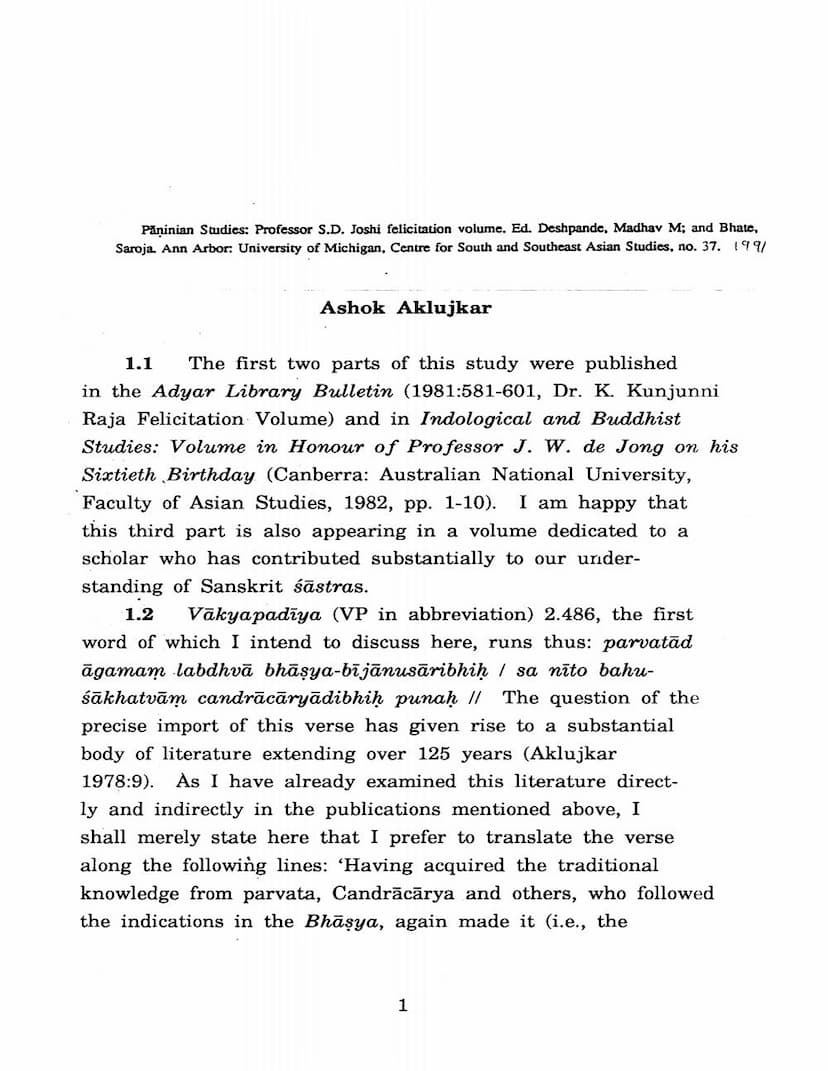
This document is an academic study by Ashok Aklujkar titled "Paninian Studies," specifically focusing on the interpretation of the word "parvata" in verse 2.486 of the Vākyapadīya (VP) by Bhartṛhari. The study is part of a felicitation volume for Professor S.D. Joshi.
Aklujkar begins by stating that his study is the third part of a larger work on this topic, with previous parts appearing in the Adyar Library Bulletin and Indological and Buddhist Studies. He then presents VP 2.486 and offers his preferred translation: "Having acquired the traditional knowledge from parvata, Candrācārya and others, who followed the indications in the Bhāşya, again made it many-branched." He also posits that the verse was likely authored by a student of Bhartṛhari, not Bhartṛhari himself.
The central theme of the study is the ambiguity of the word "parvata" in this verse. While its common meaning is "mountain," many scholars have interpreted it as a proper name of a person, or have struggled to identify a specific mountain. Aklujkar reviews the diverse scholarly interpretations:
-
Parvata as a Proper Name (Person):
- Scholars like Goldstücker, Weber, Kielhorn, and Bhandarkar refrained from translating "parvata," implying it was a proper name.
- More recent scholars like Joshi, Roodbergen, Varma, and Laddu explicitly take "parvata" as a reference to a person. Aklujkar finds Varma's identification with King Abhimanyu of Kashmir "patently absurd" due to geographical and contextual inconsistencies. Laddu's identification with a seer found in the company of Narada is also deemed unlikely and unconnected to grammatical studies.
-
Parvata as a Mountain:
- This interpretation is favored by ancient commentators like Punyarāja/Helā-rāja (the author of the Tīkā) and modern scholars who follow or build upon their explanation.
- Specific Mountain Identifications:
- Chittore: Peterson suggests Chittore in Rajasthan, arguing it was a center of learning for the southern country. Aklujkar finds this reason inadequate, questioning its specialization in grammar and its status as a "southern" center.
- Citra-kūța: Scharfe identifies "parvata" with Citra-kūța. Aklujkar criticizes Scharfe's reasoning as based on unproven assumptions and a flawed interpretation of other verses. He meticulously deconstructs Scharfe's chain of logic, highlighting its speculative nature, particularly concerning the interpretation of a sentence from the Candra Vrtti.
- Tri-kūța: The Tīkā specifies "parvatāt" as tri-kūṭaika-deśa-varti-tilingaika-deśāt. Aklujkar analyzes the possible meanings of "Tri-kūța," listing four instances in literature and inscriptions. He dismisses the Northern mythical mountain and the one associated with Ravana's Lanka (unless Lanka is interpreted differently). He focuses on two potential historical locations: a range of hills in northern Konkan and a mountain in the eastern Deccan (Kotappakonda). While acknowledging the evidence for Tri-kūta in northern Konkan, he finds the identification of Kotappakonda less substantiated.
- Śrī-parvata: Aklujkar proposes Śrī-parvata as a strong candidate for "parvata." He argues that "parvata" could be used as a shorthand for Śrī-parvata due to its prominence and the common practice of dropping honorifics. This identification aligns well with the Tīkā's mention of "Tilinga" (Telangana), as Śrī-parvata is part of that region. This interpretation is also supported by Tibetan traditions and Chinese travelers' accounts of Candra-gomin.
-
Parvata as an Ascetic/Other Entity:
- Aklujkar explores the less common but plausible interpretation of "parvata" as a type of ascetic or a wild ascetic inhabiting mountain areas. He finds support for this in linguistic examples and suggests it could explain the presence of a brahma-rakṣas (a Brahmin ogre) in some accounts of Candra's achievement, as found in the Tīkā and Patañjali-carita. He also notes that the ablative case (parvatāt) might be more fitting for a sentient source than a location. He further investigates the possibility of "parvata" being a corrupt form of "pārvata" (derived from Himavat's daughter, Pārvatī), which could carry a meaning related to supernatural beings.
Synthesizing the Interpretations:
Aklujkar concludes by suggesting that both interpretations—"parvata" as a mountain and "parvata" as an ascetic—can converge. If Candra recovered the agama from a "siddha-like" ascetic on a Southern mountain (likely Śrī-parvata), then the initial interpretation of "parvata" as "mountain ascetic" or "mountain" ultimately points to the same reality.
He ranks his proposed identifications:
- Strongest: "parvata = an ascetic or brahma-rakṣas belonging to Śrī-parvata." This interpretation integrates multiple lines of evidence.
- Next Strongest: "parvata = Śrī-parvata." This assumes scholars at Śrī-parvata possessed the manuscripts.
- Least Acceptable: "parvata = Tri-kūța (mountain or region)." This relies heavily on the Tīkā's statement, and potentially a corrupted reading.
Aklujkar emphasizes the importance of considering the Tīkā's interpretation seriously, criticizing scholars who overlook or dismiss it. He also acknowledges the limitations of historical certainty and the need for further research, particularly regarding the religious affiliations of Bhartṛhari and Candra-gomin. The study highlights the complex and nuanced nature of interpreting ancient Sanskrit texts, where a single word can invite multiple scholarly debates and interpretations.