
Paninian Studies
Added to library: September 2, 2025
Summary
Here's a comprehensive summary of the provided text, "Paninian Studies" by G. Cardona, focusing on the key themes and arguments presented:
Overall Purpose: The article, "Paninian Studies," by George Cardona, provides an overview of recent developments and ongoing trends in the study of Pāṇini's grammar, the Aṣṭādhyāyī, and its associated traditions, primarily focusing on works from the late 1970s and 1980s. Cardona aims to assess the validity of certain critical interpretations of Pāṇini's work and the Paninian tradition, particularly those that challenge the traditional understanding of Pāṇini's systematic approach and the interpretative insights of later grammarians like Kātyāyana and Patañjali.
Key Areas of Discussion and Cardona's Arguments:
-
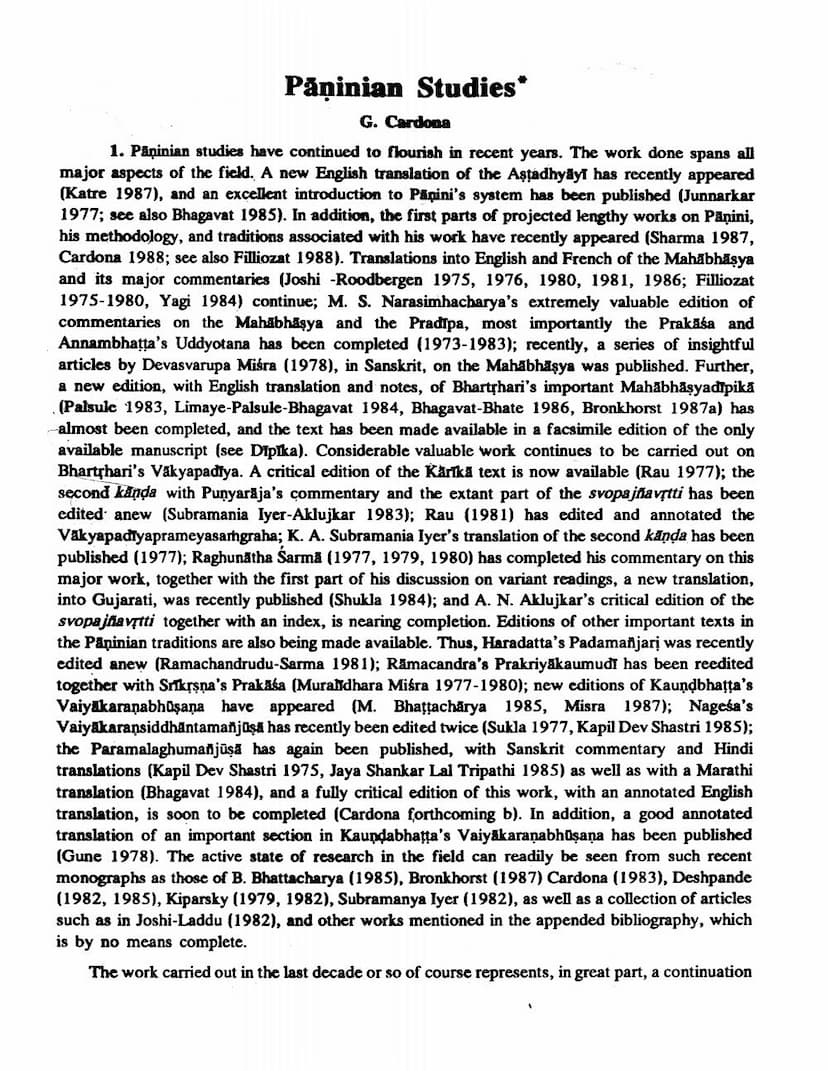
Flourishing of Paninian Studies: Cardona begins by noting the vibrant state of research in Paninian studies, citing new translations of the Aṣṭādhyāyī and the Mahābhāṣya, as well as significant scholarly works on Pāṇini's methodology and traditions.
-
Debunking Claims of Massive Interpolations in the Aṣṭādhyāyī:
- Cardona addresses a tendency among some scholars to find "massive interpolations" in the received text of the Aṣṭādhyāyī.
- He specifically refutes the claims by Joshi and Roodbergen (and others) that the sections on compounds (samāsa) and taddhita affixes are later additions.
- Cardona argues that perceived "inconsistencies" in terminology (e.g., referring to case endings vs. kārakas) are not evidence of interpolation but rather a reflection of Pāṇini's well-organized and systematic derivational approach. Pāṇini's rules are contextually appropriate, using the correct level of linguistic abstraction (e.g., referring to the form of a pada rather than the underlying kāraka when formulating rules for compounds).
- Similarly, the separation of rules for assigning kārakas from rules for introducing case endings is presented not as an inconsistency but as a deliberate organizational principle within Pāṇini's system.
- Cardona criticizes scholars who focus on finding interpolations, urging them instead to understand Pāṇini's underlying organizational principles.
-
Analysis of Asiddha (Suspension) and Sthānivat (Substitution as Original):
- Cardona delves into complex discussions regarding how Pāṇini's rules relate to each other, particularly the concept of asiddha (suspension).
- He explains the distinction between operation suspension (the result of an operation is suspended) and rule suspension (the rule itself is suspended).
- He argues that Kātyāyana and Patañjali understood and applied these concepts of suspension to ensure the correct derivation of Sanskrit words.
- Cardona meticulously analyzes examples like the derivation of adhitya and amuṣmai to demonstrate how these principles of suspension function to prevent undesired outcomes and ensure the correct application of rules in sequence.
- He clarifies that asiddha means a rule is treated as non-existent with respect to another rule, not that the rule itself is absent from the text.
- Cardona also discusses the closely related concept of sthānivat, where a substitute is treated as the original element, and how it interacts with suspension.
-
Critique of Kiparsky's Theory on Terms for Optionality:
- Cardona addresses Christopher Kiparsky's thesis that Pāṇini assigned distinct semantic values to terms like vā, vibhāṣā, and anyatarasyām (all related to options). Kiparsky argued that Pāṇini's definition of vibhāṣā in Aṣṭādhyāyī 1.1.44 was necessary only if these terms had distinct meanings.
- Cardona argues against this, suggesting that the traditional interpretation of these terms as largely equivalent is correct.
- He points out inconsistencies in Kiparsky's claims, including the fact that Kiparsky himself admits limitations and exceptions to his proposed system.
- Cardona criticizes Kiparsky's approach to Aṣṭādhyāyī 1.1.44, arguing that it's not a mere definition but rather establishes a convention for handling optionality, with vibhāṣā being a general term that encompasses vā.
- He concludes that Kiparsky's thesis is not cogently maintained and that the traditional understanding is likely accurate.
-
Paninian Syntax and Derivational Methods:
- Cardona highlights recent interest in Pāṇini's syntactic theory and sentence derivation.
- He commends Deshpande's work for its rigorous scholarship and challenging ideas, particularly regarding the relationship between formal grammatical factors and sociolinguistic/historical developments.
- Deshpande's idea that Kātyāyana's alternative derivations might reflect "Middle Indo-Aryan impulses" is discussed, with Cardona acknowledging the possibility but stressing the difficulty of proving such influences definitively.
- Cardona refutes a claim by Bronkhorst that Kātyāyana's suggested derivations for desideratives solved an "unsolved problem" in Pāṇini's grammar, pointing out that Bronkhorst overlooked a relevant Pāṇinian rule.
-
The Antaranga-Bahiranga Principle (Internal vs. External Conditioning):
- Cardona addresses claims that the antaranga-paribhāṣā (principle of internal conditioning taking precedence) has been misapplied by Paninians to internal word operations, arguing it was only intended for cross-word boundaries.
- He defends the Paninian tradition, arguing that this principle is valid both internally and externally, and that attempts to deny its internal application are based on misinterpretations or selective use of evidence.
- He discusses the complexity of Pāṇini's metarules and how they interact to ensure correct derivations, particularly in the context of vowel substitutions.
-
Scholarly Trends and Cardona's Perspective:
- Cardona reiterates his belief that while recent scholarship has merit, the major premises and methods of some critical scholars are not entirely cogent or acceptable.
- He advocates for a thorough, non-prejudiced study of the entire Paninian corpus, including the arguments of later grammarians, rather than focusing solely on finding interpolations or dismissing traditional interpretations.
- He emphasizes the importance of reliable editions of Paninian texts as a foundation for future research.
In essence, Cardona's article is a scholarly defense of the integrity, systematicity, and coherence of Pāṇini's grammar and the subsequent interpretations by the Paninian tradition. He critiques modern scholarship that questions these aspects, arguing that perceived flaws are often due to a lack of deep understanding of Pāṇini's sophisticated organizational principles and analytical methods.