
Paninian And Veda Reconsidered
Added to library: September 2, 2025
Summary
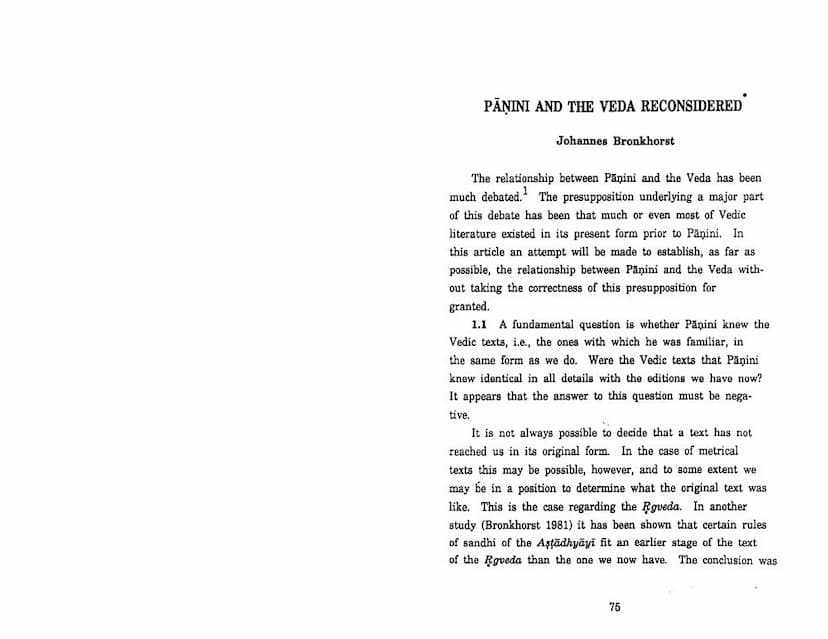
Here's a comprehensive summary of the provided text, "Paninian And Veda Reconsidered" by Johannes Bronkhorst, focusing on the relationship between the grammarian Pāṇini and Vedic literature:
The article challenges the common assumption that most Vedic literature existed in its current form before Pāṇini. Bronkhorst aims to re-evaluate the relationship between Pāṇini and the Veda by examining the evidence without this presupposition.
Key Arguments and Findings:
-
Discrepancies in Vedic Texts:
- Sandhi and Accentuation: Bronkhorst highlights that Pāṇini's rules for sandhi (sound combination) and accentuation do not always perfectly align with the current Vedic texts, even the meticulously preserved Ṛgveda. This suggests that Vedic texts may have undergone changes in these areas after Pāṇini.
- Pāṇini's Rules as Prescriptive: He argues that Pāṇini's rules for Vedic sandhi and accentuation might not just be descriptive of the Vedic texts he encountered but also prescriptive, guiding how these elements ought to be. This is supported by Pāṇini's explicit indication of optionality in some rules, implying a standard he expected to be followed otherwise.
- The Role of Ūha (Modification): The concept of ūha, the adjustment of Vedic mantras for different ritual contexts (e.g., changing deity names, numbers, or genders), is introduced. Bronkhorst suggests that some of Pāṇini's Vedic rules might have been formulated to accommodate or even guide these modifications, meaning some forms prescribed by Pāṇini might not have existed in static Vedic texts but were intended for such adapted mantras.
-
The Scope of "Chandas":
- Pāṇini uses the term chandas to refer to Vedic literature. Bronkhorst, building on Thieme, notes that chandas wasn't limited to metrical texts but also included prose passages like Brahmanas and Yajus, essentially meaning "Sacred Literature."
- However, Bronkhorst points out that Pāṇini's rules labeled chandasi also apply to Sūtra texts (ritual manuals). This implies that Pāṇini's concept of chandas extended to a fringe area where Vedic usage was considered appropriate, including ritual Sūtras. This finding complicates direct attribution of Pāṇini's knowledge to specific Vedic texts if a form appears in both a Vedic text and a Sūtra.
-
Determining Pāṇini's Knowledge of Vedic Texts:
- Bronkhorst proposes a method to ascertain which Vedic texts Pāṇini knew. This involves two approaches:
- Identifying Text-Specific Forms: Collecting forms that Pāṇini prescribes for Vedic usage and that are found exclusively in one particular Vedic text. If a significant number of such forms are found for a text, it suggests Pāṇini knew that text.
- Identifying Excluded Forms: Looking for Vedic texts that contain features explicitly excluded by Pāṇini's rules. A large number of such deviations might indicate that Pāṇini was unaware of these texts.
- The study then proceeds to analyze various Vedic collections based on this methodology:
- Ṛgveda: Pāṇini's rules and references to the Padapāṭha strongly indicate his familiarity with the collected Ṛgveda. No forms explicitly rejected by Pāṇini are found in the Ṛgveda.
- Taittiriya Samhitā: Three forms prescribed by Pāṇini are found exclusively in the Taittiriya Samhitā's mantras. However, the Brahmana portions of this text exhibit features (like the ending -ai instead of -as) that contradict Pāṇini and suggest these parts might have been collected later, possibly after Pāṇini.
- Taittiriya Brāhmaṇa and Aranyaka: These texts contain numerous forms explicitly rejected by Pāṇini, leading to the conclusion that Pāṇini likely did not know or accept them. The interdependence of these texts with the Taittiriya Samhitā suggests they might have existed as an undivided whole initially, and their later redaction could have occurred after Pāṇini.
- Maitrāyaṇī Samhitā and Kathaka Samhitā: While Pāṇini's knowledge of parts of these texts is suggested by some shared exclusive forms, the presence of deviations from Pāṇini in the Maitrāyaṇī Samhitā is surprising and reinforces the idea that texts may have changed form over time.
- Atharvaveda: Pāṇini knows a few forms exclusively found in the Atharvaveda (in its Saunakiya and Paippalāda versions). However, this is heavily outweighed by numerous forms forbidden by Pāṇini that are present in the Atharvaveda. The author also argues against the idea that certain Atharvan specific forms were implicitly covered by Pāṇini's rules. Furthermore, a passage in the Chandogya Upaniṣad (3.4) that equates atharvāṇgirasaḥ with itihāsa purāṇa rather than the Atharvaveda itself suggests the latter might not have existed as a unified collection when this passage was composed.
- Brahmanas (Aitareya, Kausitaki, Pañcavimsa, Jaiminiya, Satapatha): These early Brahmanas consistently show deviations from Pāṇini's rules, with many containing forms explicitly rejected by him. This leads to the conclusion that Pāṇini was likely unacquainted with these texts in their current forms.
- Bronkhorst proposes a method to ascertain which Vedic texts Pāṇini knew. This involves two approaches:
-
Caveats and Nuances:
- Textual Evolution: Bronkhorst emphasizes that Vedic texts were likely in flux during Pāṇini's time, and our current versions may not reflect what he encountered. The process of orthoepic diaskeuasis (refinement of pronunciation and form) also complicates direct comparisons.
- Authorship: Since Vedic texts are often composite works, the presence of a few deviations doesn't necessarily mean Pāṇini was completely ignorant of the entire text.
- Regional Differences: Pāṇini's presumed northwest Indian origin might explain his lack of acquaintance with texts primarily associated with other regions, unless they gained wider acceptance.
Conclusion:
The article significantly challenges the traditional view by suggesting that Pāṇini did not know the majority of Vedic literature in its present collected form. While he was clearly familiar with the Ṛgveda and possibly parts of some other Samhitās, many Samhitās, Brahmanas, and Aranyakas deviate considerably from his grammar, indicating his likely ignorance of them. The study underscores the dynamic nature of Vedic texts during Pāṇini's era and highlights the importance of treating his grammatical rules not just as descriptive but also potentially prescriptive, especially concerning sandhi, accentuation, and the use of ūha in ritual contexts.