
Panini And Nominal Sentence
Added to library: September 2, 2025
Summary
Here's a comprehensive summary of the provided pages of Johannes Bronkhorst's "Pāṇini and the Nominal Sentence":
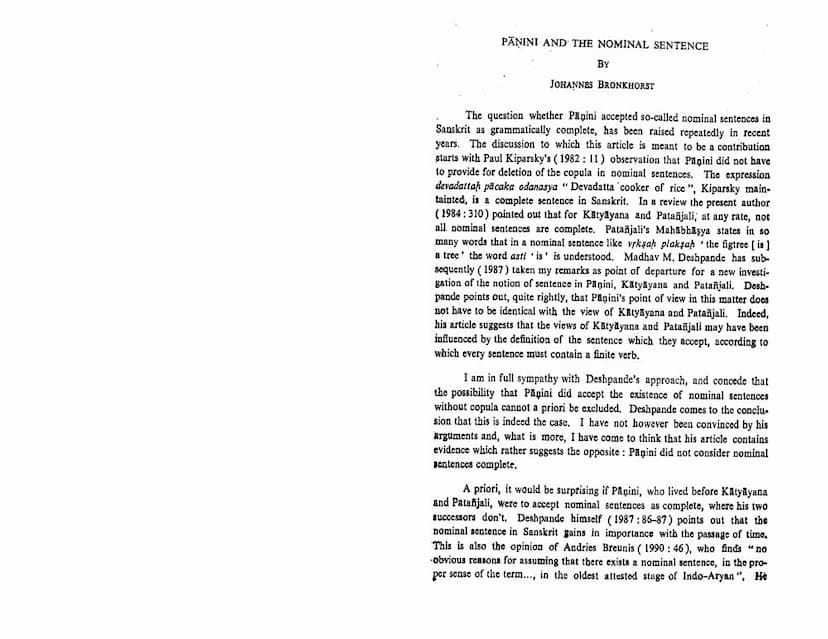
The article engages with the ongoing debate about whether the ancient Indian grammarian Pāṇini considered "nominal sentences" (sentences without an explicit verb like "is") to be grammatically complete in Sanskrit.
The Core of the Debate:
- Paul Kiparsky's Position: Kiparsky (1982) suggested that Pāṇini didn't need to account for the deletion of a copula (linking verb) in nominal sentences, implying they were considered complete as they are. An example is devadattaḥ pacaka odanasya ("Devadatta, cooker of rice").
- Bronkhorst's Initial Counterpoint: Bronkhorst (1984) previously argued that for Pāṇini's successors, Kātyāyana and Patañjali, not all nominal sentences were complete. Patañjali, for instance, stated that in sentences like vrkṣaḥ plakṣaḥ ("the fig tree [is] a tree"), the word asti ("is") is understood.
- Madhav M. Deshpande's Contribution: Deshpande (1987) took Bronkhorst's remarks as a starting point and argued that Pāṇini's view might have differed from his successors. Deshpande suggests that Pāṇini might have accepted nominal sentences as complete, possibly because Kātyāyana and Patañjali's definition of a sentence required a finite verb, which may have been a later development.
Bronkhorst's Argument Against Deshpande:
Bronkhorst expresses sympathy with Deshpande's approach but is not convinced by his arguments. Instead, Bronkhorst believes Deshpande's own article provides evidence suggesting the opposite: that Pāṇini did not consider nominal sentences complete.
Bronkhorst's Reasoning:
-
Historical Progression: Bronkhorst finds it unlikely that Pāṇini, being earlier than Kātyāyana and Patañjali, would hold a more "liberal" view on nominal sentences than his successors. He notes that the importance of the nominal sentence in Sanskrit increased over time, and early Indo-Aryan stages might not have had them in the "proper sense." The increasing prevalence of nominal sentences in later Indo-Aryan languages (like Hindi, where participles have become finite verbs) suggests that earlier stages would likely be more conservative.
-
Critique of Deshpande's Evidence:
- Derivability vs. Completeness: Deshpande's primary argument is that Pāṇini's grammar can derive nominal sentences without assuming an underlying finite verb (e.g., rāmaḥ sundaraḥ - "Rama handsome"). Bronkhorst counters that this derivation might simply be the surface form without necessarily implying grammatical completeness in Pāṇini's eyes. The combination of two nominatives might not inherently convey the meaning of "is."
- Understood Copula: Bronkhorst argues that such nominal sentences could be explained by Pāṇini by postulating an auxiliary finite verb that is then elided. This aligns with Patañjali's view.
- Gerund Constructions as a Parallel: Bronkhorst uses the example of gerunds (participles) to draw a parallel. He cites sentences where gerunds appear with an auxiliary verb (e.g., ... prati-m-a-m sthāp-ya - "having put on the garment") and others where they appear independently (e.g., ... mūlīnir jagdhvā - "having eaten the rooted plants").
- Pāṇini's rule P. 3.4.21 (samanakartṛkayoḥ pūrvakāle) requires two verbs with the same agent for a gerund ending to be added to one of them.
- The existence of independent gerund clauses, which seem to violate this rule, suggests to Bronkhorst that Pāṇini understood an auxiliary finite verb to be implied in such cases, even if not explicitly stated.
- Bronkhorst argues that nominal sentences like rāmaḥ gataḥ ("Rama gone") are analogous to these independent gerunds. If Pāṇini implied an auxiliary verb for independent gerunds to make them grammatically sound according to his own rules, it's plausible he would similarly imply a copula for nominal sentences to consider them complete.
- Lack of Definitional Necessity: Bronkhorst notes that while Pāṇini's rule for gerunds forces us to consider the implied meaning of an auxiliary verb, there's no similar explicit rule for nominal sentences that compels this consideration. However, he suggests the absence of such a rule doesn't preclude the implied presence of a copula for completeness.
Conclusion (Implied):
Based on the historical context and the analysis of Pāṇini's rules regarding gerunds, Bronkhorst leans towards the interpretation that Pāṇini, like his successors, likely did not consider nominal sentences to be grammatically complete without the implied presence of a finite verb. The debate hinges on whether the grammatical derivation implies semantic completeness in Pāṇini's system, and Bronkhorst argues for the latter requiring the implied copula.