
Orthoepic Diaskeuasis Of Rgveda And Date Of Panini
Added to library: September 2, 2025
Summary
Here's a comprehensive summary of Johannes Bronkhorst's article "The Orthoepic Diaskeuasis of the Rgveda and the Date of Panini," focusing on its main arguments and findings:
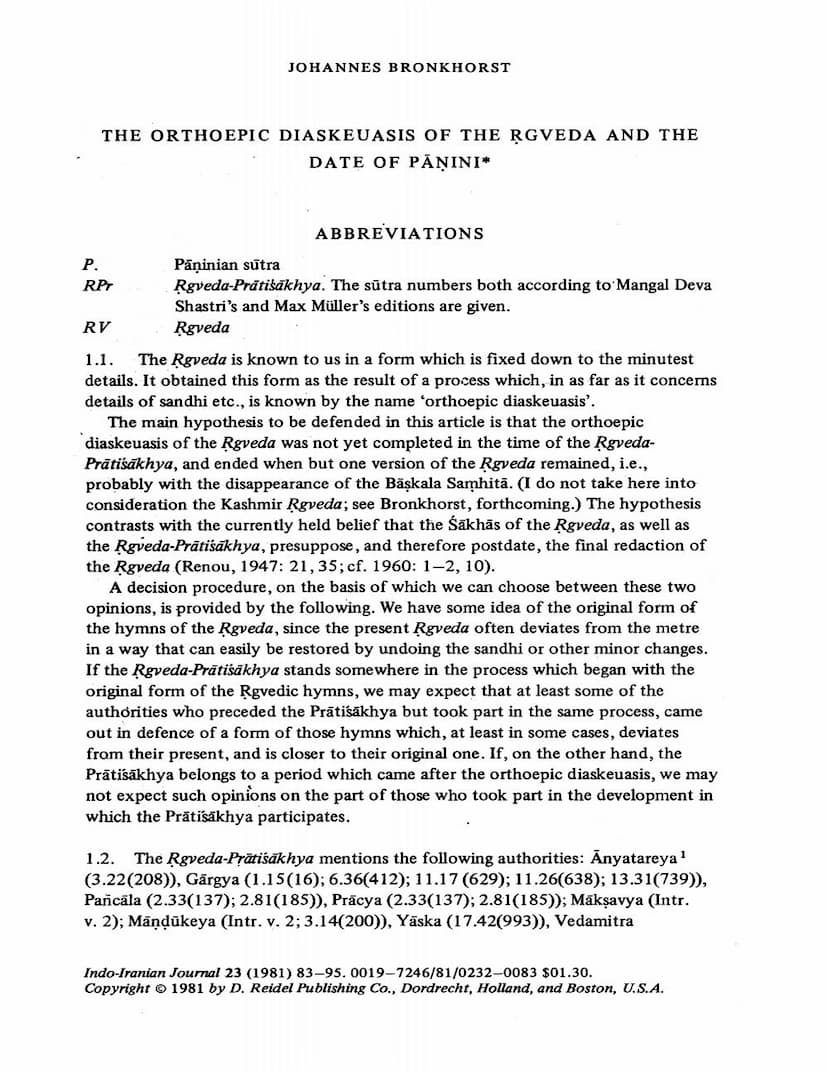
The central argument of Bronkhorst's article is that the orthoepic diaskeuasis of the Rgveda (the process of fixing its phonetic and sandhi details) was not yet complete during the time of the Rgveda-Prātisakhya. Instead, it likely concluded with the eventual disappearance of the Bāṣkala Samhitā, the standard text of the Rgveda that has survived. This directly challenges the prevailing view that the Rgveda-Prātisakhya and its associated schools (śākhās) presuppose and therefore postdate the final redaction of the Rgveda.
Bronkhorst proposes a method to test this hypothesis: if the Rgveda-Prātisakhya belongs to a period after the orthoepic diaskeuasis, then authorities mentioned within it (and preceding it) should not offer opinions that deviate from the current Rgveda and move closer to its original form. Conversely, if the Prātisakhya is within the process, such authorities might indeed propose changes that align better with earlier versions.
The article then examines specific linguistic and grammatical evidence to support its thesis:
1. Śākalya and Panini's Rule P. 6.1.127 (Sandhi of short vowels before dissimilar vowels):
- Panini's rule, when interpreted with "chandasi" (in Vedic literature), suggests that short i, u and their long counterparts should be shortened or elided when followed by a dissimilar vowel.
- The current Rgveda often deviates from this rule, but its earlier form, as reconstructed by scholars like E. Vernon Arnold, aligns with Śākalya's rule.
- Bronkhorst argues that the Rgveda-Prātisakhya does not reflect this specific sandhi rule as interpreted by Panini and Arnold, suggesting that the text was already somewhat fixed before the Prātisakhya's finalization.
- Furthermore, Panini's mention of Śākalya four times and his apparent connection to the Padapatha (the text that lists words individually) strengthens the link between Panini and the Rgveda.
2. Vyādi and Gālava's Rule (Insertion of y, v, r, l):
- Vyādi and Gālava are cited as proponents of inserting y, v, r, l between certain vowel sequences (e.g., dadhi atra becoming dadhi-y-atra).
- This type of sandhi is not found in the current Rgveda but would improve its meter in many instances.
- The Rgveda-Prātisakhya does not mention this specific rule.
3. Panini's Rules P. 8.3.17-19 (Sandhi of r, v, y):
- Panini's rules (P. 8.3.17, 8.3.18, 8.3.19) discuss the sandhi of r, v, y before vowels or voiced consonants, mentioning Śākaṭāyana and Śākalya.
- These rules allow for forms like ay+a-, aỹta-, ata- for the sequence -as ta- (when followed by a-).
- The current Rgveda invariably shows o-. Bronkhorst argues that the forms permitted by Panini and his authorities (Śākaṭāyana, Śākalya) are closer to the original Rgveda's meter, implying Panini is working with an earlier, less fixed version.
- He critiques the orthodox interpretation of Panini's grammar that leads to o- for -as ta-, arguing that the ordering of Panini's rules makes the derivation of o- problematic, while the derivation of ay+a- etc., fits better. This suggests Panini's grammar predates the full standardization that led to the current Rgveda form.
4. Panini's Rules P. 6.1.134 and P. 6.1.115-116 (Sandhi involving sa, e, o):
- P. 6.1.134 deals with the elision of the nom. sing. case ending su of sa. Panini's rule seems to defend an older reading of sā- which survived in some cases, while the Prātisakhya applies stricter rules. This indicates Panini might be working with a less finalized text.
- P. 6.1.115-116 describe when e and o retain their original form before a. Bronkhorst argues that these rules are an earlier, less refined version of rules found in the Rgveda-Prātisakhya (specifically RPr 2.35). The Prātisakhya's more complex rules, while aiming for accuracy, show a later stage of development and refinement.
5. Absence of the retroflex consonant ḷ in Panini:
- Panini's grammar does not mention the retroflex ḷ. While the current Rgveda has it, Bronkhorst notes that not all versions did. He suggests that Panini lived before this sound became widespread in the Veda and thus before the Rgveda-Prātisakhya, which accommodates it (though perhaps through a "śākalization" process).
6. Description of the svarita accent:
- Panini's description of the svarita accent is considered less sophisticated than that found in the Rgveda-Prātisakhya. This difference in detail and sophistication points to the Prātisakhya being a later development.
Chronological Implications:
Based on this evidence, Bronkhorst concludes that Panini's Aṣṭādhyāyi is older than the Rgveda-Prātisakhya. He also traces a development in the perception of Śākalya, from a composer of the Padapatha (in Yaska's Nirukta) to the redactor of the Samhitā (in Patanjali's Mahābhāṣya), suggesting a chronological order of Nirukta > Mahābhāṣya > Anuvākānukramaṇī.
Broader Significance:
The article suggests that the orthoepic diaskeuasis was a long and complex process involving many individuals with differing views. It implies that scholars should re-evaluate the perceived "lacunae" in Panini's grammar, recognizing that he might be describing an earlier stage of the Rgveda's textual transmission. Finally, it touches on the relationship between schools focused on the Rgveda Samhitā and those focused on ritual, noting a tendency towards unification in both.