
Origin Of Mimamsa As A School Of Thought A Hypothesis
Added to library: September 2, 2025
Summary
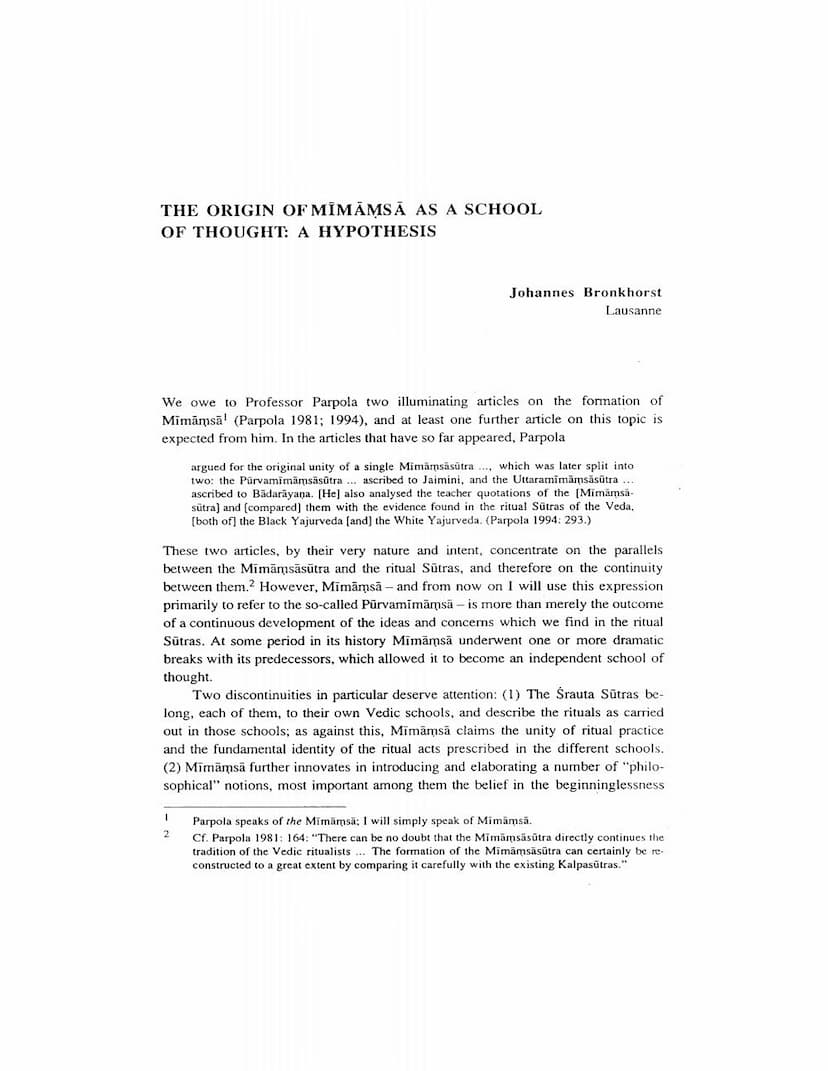
This article by Johannes Bronkhorst proposes a hypothesis regarding the origin of Mimāṃsā as an independent school of thought. Bronkhorst acknowledges Professor Parpola's work on the formation of Mimāṃsā, which suggests an original unity of a single Mimāṃsāsūtra later split into Pūrvamīmāṃsā and Uttaramīmāṃsā. However, Bronkhorst argues that Mimāṃsā, particularly Pūrvamīmāṃsā, represents more than a mere continuation of Vedic ritual traditions; it involved significant breaks with its predecessors, leading to its independent status.
Bronkhorst identifies two key discontinuities:
- Unity of Ritual Practice: While earlier ritual Sūtras were tied to specific Vedic schools and their practices, Mimāṃsā asserted the unity and fundamental identity of rituals prescribed across different schools.
- Introduction of Philosophical Notions: Mimāṃsā introduced and elaborated novel "philosophical" concepts, most notably the beginninglessness (anāditva), authorlessness (apauruṣeyatva), and self-sufficient validity (svatahpramanya) of the Veda.
Bronkhorst suggests that the first discontinuity likely arose from increased interaction among representatives of different Vedic schools. He posits that the second discontinuity, the adoption of these philosophical doctrines, was a response to "critical outsiders," specifically in the context of the rise of rational debate in India.
The article focuses on the second discontinuity, examining the three core doctrines of Mimāṃsā. Bronkhorst notes the peculiarity of this set of doctrines, finding no direct parallels in contemporary schools or in the preceding Vedic tradition. He highlights that Vedic Brahmins, even as late as Megasthenes, believed the world (and by implication, the Veda) had a beginning, unlike Mimāṃsā's assertion of the Veda's beginninglessness. Similarly, other philosophical schools believed in the beginninglessness of the universe but differed from Mimāṃsā in their acceptance of periodic world destruction and recreation.
Bronkhorst argues that these doctrines, particularly beginninglessness, had a crucial consequence: since the Veda has no beginning, events recorded in it cannot be considered to have happened historically. This allowed Mimāṃsakas to reinterpret implausible Vedic stories and statements, classifying them as arthavāda (praise or censure) or mantra (to be recited), neither of which required literal acceptance. This applied even to Vedic myths and the concept of deities, which Śabara, a prominent Mimāṃsā commentator, reduced to mere names or even words, devoid of independent power or physical form.
Bronkhorst proposes two possible explanations for this rejection of the Veda's contents:
- Shifting Religious Convictions: The religious beliefs of Vedic Brahmins may have evolved, leading to a disconnect between the Veda's contents and their actual beliefs. Mimāṃsā offered a way to maintain Vedic ritualism while discarding its literal narrative aspects.
- Response to External Criticism: The emergence of rational debate meant that Brahmins had to defend their traditions against critical outsiders, primarily Buddhists. These critics likely challenged the contents of the Veda, particularly its improbable myths. The doctrines of beginninglessness and authorlessness provided a defense by allowing Mimāṃsakas to argue that the Veda, being eternal and unauthored, should not be interpreted literally, thus deflecting criticism and preserving the Vedic way of life.
The article illustrates this point by examining the myth of the Puruṣasūkta, which explains the origin of the caste system. Bronkhorst notes that some Brahmanical intellectuals, like Praśastapāda, took this myth literally, while Buddhist critics challenged its logical coherence. Mimāṃsā, by positing the Veda's beginninglessness, could dismiss such myths as non-literal praise, thus avoiding direct confrontation and criticism.
Bronkhorst suggests that the development of Mimāṃsā into a distinct "school of thought" occurred in stages, likely linked to the author of specific sūtras (1.1.27-32) and the Vṛttikāra cited by Śabara, both of whom were engaged with Buddhist arguments. The three core doctrines, therefore, provided Mimāṃsā with a coherent and defensible system, unique in its radical departure from both its Vedic predecessors and contemporary philosophical schools.
Finally, Bronkhorst briefly touches upon the decline of Buddhism, the primary source of criticism, suggesting that this may have led later Mimāṃsā authors, like Kumārila Bhaṭṭa, to no longer feel the same pressure to provide elaborate philosophical explanations for the Veda's content. He also notes how Mimāṃsā methods were later applied to interpret other texts like the Dharmaśāstras, further solidifying its influence. In essence, Mimāṃsā's philosophical innovations were a strategic response to the intellectual challenges of its time, transforming it from a ritualistic tradition into a self-aware philosophical school.