
Opening Speech 4th International Dharmakirti Conference Vienna 20050823
Added to library: September 2, 2025
Summary
Here is a comprehensive summary of Ernst Steinkellner's opening speech at the 4th International Dharmakirti Conference in Vienna, 2005, focusing on the Jain context where applicable (though the text primarily discusses Buddhist scholarship):
Summary of Ernst Steinkellner's Opening Speech at the 4th International Dharmakirti Conference (Vienna, 2005)
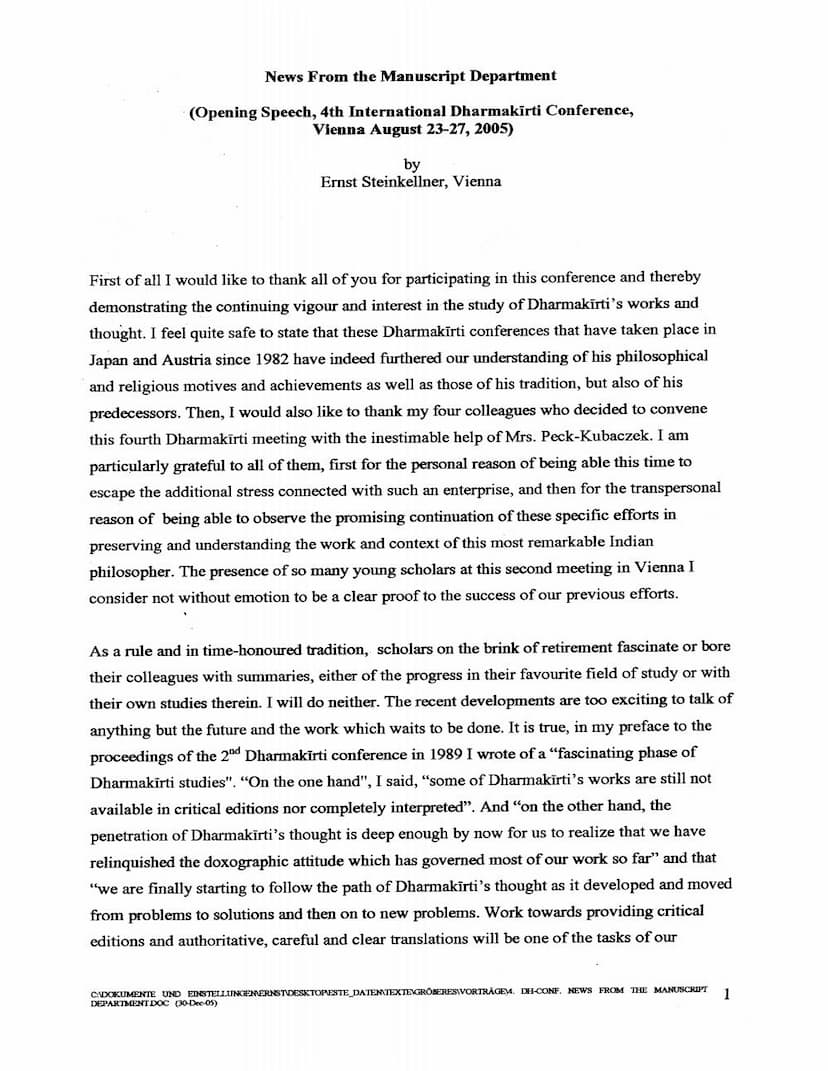
Ernst Steinkellner, in his opening speech for the 4th International Dharmakirti Conference, expressed gratitude to the attendees, highlighting the sustained interest in the works and thought of Dharmakirti. He acknowledged the significant progress made in understanding Dharmakirti and his intellectual tradition through previous conferences held in Japan and Austria since 1982. He also thanked his colleagues and Mrs. Peck-Kubaczek for organizing the current event, noting with satisfaction the presence of many young scholars as a sign of the field's vitality.
Steinkellner opted not to summarize past achievements but instead focused on future research directions. He reiterated his previous sentiment from 1989 about a "fascinating phase of Dharmakirti studies," emphasizing that while some works still lacked critical editions and full interpretations, the depth of understanding had moved beyond mere doxography to a more nuanced engagement with Dharmakirti's thought process, tracing his development from problems to solutions and new challenges. He underscored the importance of future work on critical editions, translations, and detailed tracing of his rigorous thought development.
The core of his speech then shifted to the "News From the Manuscript Department," detailing a significant breakthrough in accessing original Sanskrit texts of the Buddhist epistemological tradition, the "pramāṇa school." This, he described, had transformed from a "long pipe dream" into a tangible reality.
Steinkellner elaborated on a crucial agreement signed on January 9th, 2004, between the China Tibetology Research Center (CTRC) and the Austrian Academy of Sciences. This agreement, facilitated by the understanding and action of Prof. Lhagpa Phuntshogs of the CTRC (whom Steinkellner lauded as a "kşanajña" – one who knows the moment), allows for:
- Access to photocopies of Sanskrit manuscripts held by the CTRC.
- Joint editorial work and research on selected texts.
- Joint publication in a new series, "Sanskrit Texts From the Tibetan Autonomous Region," with affordable pricing.
- Inclusion of scholars from the Vienna institute in this cooperative effort.
He proudly announced that the first volume of this new series had already arrived in time for the conference. Steinkellner expressed confidence in the positive reception of these efforts from both the scholarly world and the wider international community, especially within the PRC, recognizing their value in reclaiming Buddhist heritage and Tibetan cultural heritage. He cautioned that progress would be "step-by-step" and clarified that access was granted to photocopies, not the original manuscripts in Tibet.
Steinkellner also acknowledged the foundational work of Prof. Luo Zhao, whose descriptive lists of manuscripts in Tibetan repositories served as the basis for a forthcoming "Vienna Catalogue of Tibetan Sanskrit Manuscripts."
He then presented a survey of newly available or potentially available Sanskrit texts relevant to the pramāṇa tradition, categorizing them:
-
Texts named in a first subagreement as subjects of cooperation:
- Jinendrabuddhi's Pramāṇasamuccayaṭikā (unique manuscript)
- Dharmakīrti's Hetubindu (unique manuscript)
- Dharmakīrti's Pramāņaviniscaya (multiple manuscripts, including complete ones)
- An anonymous commentary on Santānāntarasiddhi
- Works by Sankaranandana (fragmentary materials)
-
Texts known to exist in the CTRC collection and potentially available with extended cooperation:
- Dharmottara's Pramāņaviniscayaţikā (chapters 2 and 3)
- Yamāri's Pramāņavārttikālankāranibandha (chapter 1)
- A previously unknown commentary on Arcața's Hetubinduţikā by Jayabhadra (attributed with a potentially royal Nepalese epithet)
- Approximately ten unidentified, mostly fragmentary manuscripts potentially belonging to the pramāņa tradition.
-
Texts at the upper limits of current access possibilities:
- A bundle of paper manuscripts in the Potala, containing fifteen identified texts and one stray leaf, written on Bhutanese paper and partially burnt. These include works by Dignāga, Sankarasvāmin, Dharmakīrti, Vinītadeva, and Acarya Manoratha. Steinkellner noted efforts to motivate partners in Beijing to photograph this valuable bundle.
In conclusion, Steinkellner outlined their current policies:
- Convincing the CTRC to create a detailed and updated description of their photocopy collection.
- Gaining access to as many texts as possible.
- Publishing texts as quickly as feasible.
He emphasized the limited capacity of their Vienna group (eight scholars, soon to be nine) and their agreement with CTRC, which allows for the incorporation of associate researchers. He extended an invitation for cooperation to scholars attending the conference, encouraging them to choose texts based on their expertise and interest, and to form editorial teams for larger works. He reiterated the importance of swift results despite the challenges of balancing this work with university life.
Steinkellner concluded by inviting interested colleagues to contact him or Dr. Krasser to express their willingness to cooperate, assuring them of access to the desired items and a shared responsibility in this significant endeavor.