
Once Again Vaisesika Sutra 3 1 13
Added to library: September 2, 2025
Summary
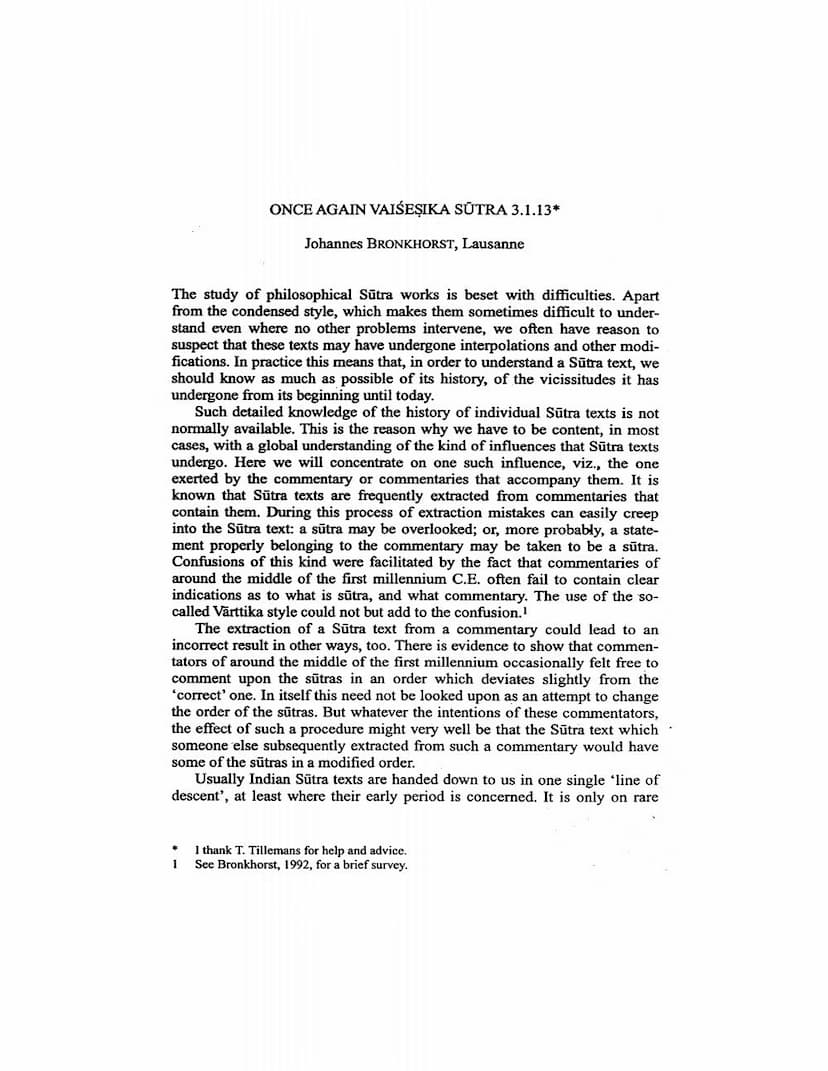
This academic article, "Once Again Vaiśeṣika Sūtra 3.1.13" by Johannes Bronkhorst, delves into the complexities of interpreting ancient Indian philosophical texts, specifically focusing on the Vaiśeṣika Sūtra. The central argument is that the order and interpretation of these texts can be significantly altered by later commentators, leading to potential misinterpretations of their original meaning.
Bronkhorst begins by outlining the inherent difficulties in studying philosophical Sūtra works, including their condensed style and the possibility of interpolations or modifications over time. He highlights the significant influence of commentaries on the Sūtra texts themselves, explaining how the extraction of Sūtras from commentaries can lead to errors, such as mistaking commentary for Sūtra or altering the original sequence of Sūtras.
To illustrate his point, Bronkhorst uses the Sāṅkhya Kārikā as a primary example. He details how the Yuktidīpikā, a commentary on the Sāṅkhya Kārikā, treats the kārikās (verses) as if they were Sūtras, dividing them into smaller parts and even changing their order. This manipulation of the text, as evidenced by the disruption of the meter and the comparison with other commentaries, demonstrates that commentators could consciously alter the arrangement of the texts they were analyzing. He also briefly mentions the Brahma Sūtras as another example where different orders are found in commentaries.
The core of the article then shifts to Vaiśeṣika Sūtra (VS) 3.1.13. Bronkhorst notes that a significant number of early authorities, including Dignāga, interpret this Sūtra as a definition of perception: "That which arises from the contact of soul, sense organ, mind, and object is something else." This interpretation is supported by various ancient commentators and texts.
However, Bronkhorst presents a dissenting view, held by some Sanskrit authors and modern scholars, who reject this interpretation based on the context of the Sūtra. They argue that the entire section (Āhnika 3.1) is meant to prove the existence of the soul, and a definition of perception would be out of place within such an argument.
Bronkhorst critically examines this contextual argument, questioning the confidence placed in the surviving Sūtra text's order without sufficient historical evidence. He points out several anomalies in the current arrangement of Āhnika 3.1 that cast doubt on its original sequence:
- Repetitive Proofs of the Soul: The proof of the soul's existence appears to be presented twice, with a section on the mind's existence inexplicably placed between them.
- Absence of "Ātman" in Early Sections: The initial Sūtras (3.1.1-12) allegedly proving the soul's existence do not mention the word "ātman" or any synonym, unlike the later section (3.2.4) which clearly lists "ātman-marks."
- Superfluity of Sūtra 3.1.1: Sūtra 3.1.1, stating that senses and objects are well-known, seems redundant if it's intended as an introduction to Sūtra 3.1.2, which infers the soul's existence from the established senses and objects.
Bronkhorst proposes a reordering of the Sūtras to resolve these issues. He suggests that Sūtra 3.1.1 might have been moved from its original context to serve as an introduction to the soul's proof. He hypothesizes a reconstructed order where Sūtra 3.1.13 (defining perception) is followed by Sūtra 3.1.1 (on sense objects), which then leads into discussions on the mind (3.2.1-3) and finally the soul (3.2.4-5). This reconstructed sequence, he argues, is more coherent and explains the necessity of the definition of perception in relation to the proof of the mind.
He further suggests that VS 3.1.13 originally followed Sūtras discussing inferential knowledge, indicated by the word "anyat" (something else) in 3.1.13, implying a distinction from a previously discussed type of knowledge. He also considers the possibility that Sūtra 3.1.8, which discusses inferential marks, might have originally been part of a discussion introducing inferential knowledge.
Bronkhorst then explores the timing of these changes, suggesting that the commentator who reordered the Sūtras likely lived before Praśastapāda (roughly 5th century CE), though not necessarily long before him. He notes that later commentators like Śrīdhara and Udayana seem to have inherited the altered context. He also examines evidence from other texts like the Caraka-saṃhitā and commentaries from Chinese sources (Vimalākṣa, Vasu) to assess when the new interpretation might have gained traction. While these sources use VS 3.1.13 in ways that can be interpreted through either the old or new framework, they don't definitively prove the earlier existence of the reordered context.
In conclusion, Bronkhorst argues that the interpretation of VS 3.1.13 as a definition of perception, supported by early witnesses, remains a valid possibility. He contends that the contextual arguments against it are not conclusive and that the possibility of a deviation from the original order of Sūtras in the surviving Vaiśeṣika Sūtra texts should be seriously considered, mirroring instances of such modifications in other classical Indian philosophical traditions. The hypothesis of the Sūtras reaching us in their original order is presented as no less speculative than the opposite assumption.