
On Vinaptimatra Passage In Samadhinirmocanasutra VIII
Added to library: September 2, 2025
Summary
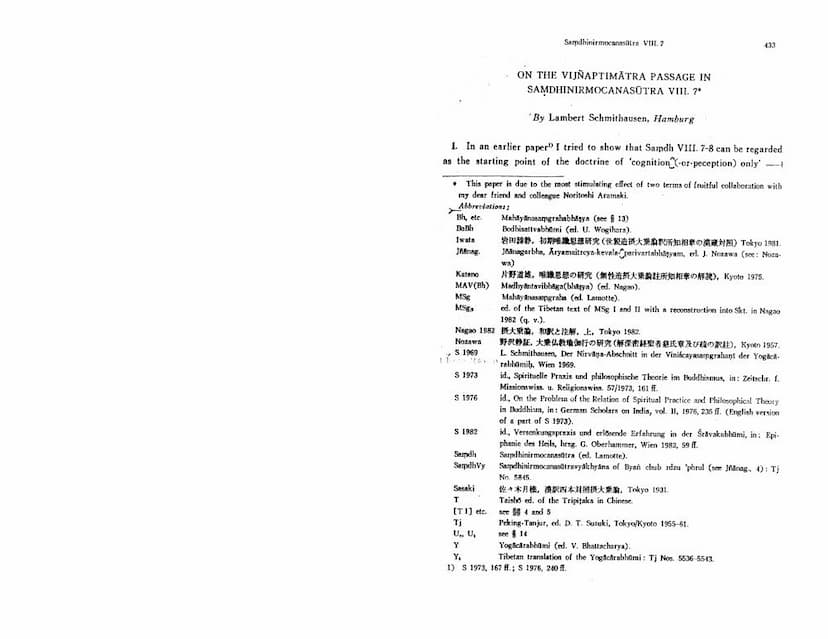
Here's a comprehensive summary of the provided text by Lambert Schmithausen, focusing on the vinaptimatra passage in the Samdhinirmocanasutra VIII. 7:
The paper by Lambert Schmithausen examines a crucial passage in the Samdhinirmocanasutra (Samdh) VIII. 7, which he argues is the origin of the vinaptimatra (cognition-only) doctrine. This doctrine posits that all phenomena are merely mental constructions, essentially "cognition only."
Key Arguments and Findings:
- Origin of the Doctrine: Schmithausen posits that Samdh VIII. 7-8 is the foundational text for the vinaptimatra doctrine. This doctrine emerged from yogic practices involving the visualization and subsequent effacement of mental images. The aim was either to refine these images or, in Mahayana contexts, to transcend phenomenal experience to realize tathata (suchness).
- The Crucial Passage and its Ambiguity: The core of the discussion revolves around the interpretation of a specific sentence in Samdh VIII. 7: "These images... are nothing but cognition." The ambiguity lies in the precise Sanskrit reconstruction of this sentence, particularly regarding the presence or absence of an anusvara (a nasalization) in the word alambana. This leads to two main proposed reconstructions:
- [A]: "alambanam vijñaptimatraprabhavitam vijñānam" (The object is constituted by mere cognition).
- [S]: "alambanavijñaptimatraprabhavitam vijñānam" (Mind is constituted by merely cognizing its object).
- Schmithausen's Preference for [S]: The bulk of the paper is dedicated to demonstrating that reconstruction [S] is the more likely original form. His arguments for [S] are based on:
- Tibetan and Chinese Translations: A meticulous analysis of Tibetan and various Chinese translations (Bodhiruci, Paramartha, Dharmagupta, Hsuan-tsang) and their commentaries. While some early translations can be interpreted to support [A], Schmithausen argues that a deeper look, especially at commentaries like the Mahāyānasamgrahabhāṣya and the Mahāyānasamgrahopanibandhana, strongly favors [S].
- Internal Consistency and Style: The syntax and style of [S] are deemed more coherent and consistent with the unfolding of the doctrine than [A]. The unwieldy nature of the predicate in [S] makes it less likely to be a secondary alteration of [A].
- Double Entendre and Terminological Choice: The wording in [S] allows for a deliberate double meaning that evokes traditional Abhidharmic terminology (alambana, vijñapti, vijñāna), suggesting a conscious effort to frame the new idealist doctrine within a familiar linguistic context.
- Comparison with Asanga: Schmithausen notes that Asanga, in his Mahāyānasamgraha, quotes this sentence but omits a preceding sentence that qualifies pratibimba (images) as vijñaptimatra. He argues that Asanga's preference for vijñapti (rather than vijñāna or citta) in his own work suggests that the original phrasing of the Samdhinirmocana passage, as reconstructed in [S] where vijñāna is the subject, aligns better with his own system's nuances.
- Implications of [S] vs. [A]:
- [A] and the Problem of Prior Statements: If [A] were the original, the phrase "I have declared" within the sentence would imply that the vinaptimatra doctrine was expounded even earlier, potentially undermining the claim that Samdh VIII. 7-9 is the first literary expression.
- [S] and the First Expression: If [S] is correct, the sentence can be interpreted as a skillful utilization of an existing Abhidharmic definition of vijñāna, and thus does not necessarily imply a prior, distinct enunciation of the vinaptimatra doctrine. It could be the first literary formulation of the generalization of image ideality to all phenomena.
- Historical Context and Development: The paper traces the conceptual lineage from yogic practices of visualization to the development of the vinaptimatra doctrine. It also considers how interpretations of this passage in later commentaries might have influenced the textual readings.
In essence, Schmithausen's detailed philological and comparative analysis strongly advocates for the reconstruction of the Samdhinirmocanasutra VIII. 7 passage as "alambanavijñaptimatraprabhavitam vijñānam" ([S]), arguing that this reading is crucial for understanding the passage as the seminal and earliest literary articulation of the core Yogacara doctrine of vinaptimatra. He suggests that the alternative reading [A] likely arose from misinterpretations and modifications of commentaries.