
On Two Medical Verses In Yuktidipika
Added to library: September 2, 2025
Summary
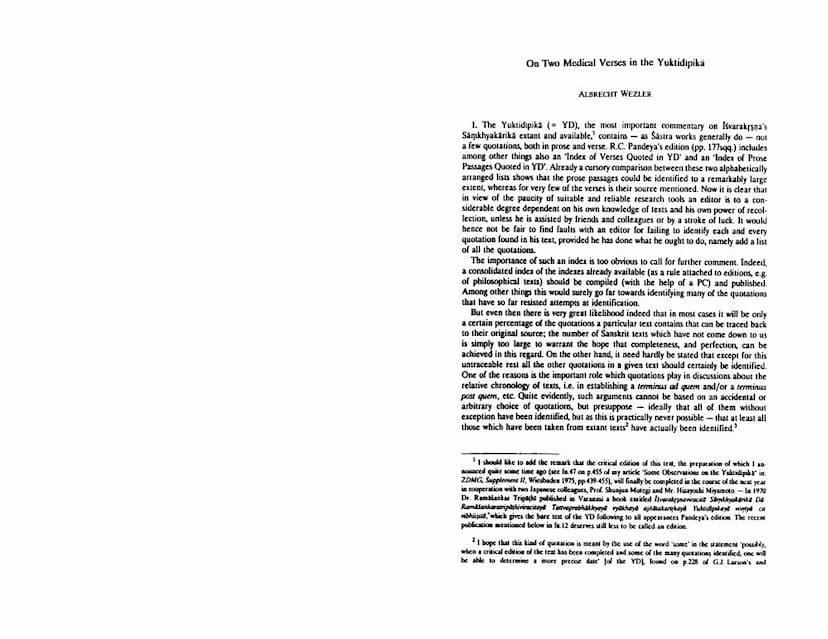
This academic article, "On Two Medical Verses in the Yuktidipika" by Albrecht Wezler, delves into the identification and interpretation of specific verses quoted within the Yuktidipika (YD), a significant commentary on the Samkhyakarika. The author's primary aim is to correct and expand upon the work of previous editors, particularly R.C. Pandeya, in identifying these quotations and understanding their significance.
Key points and arguments from the article include:
- The Importance of Identifying Quotations: Wezler emphasizes the critical role of identifying all quotations within a text for understanding its context, intellectual influences, and for determining relative chronologies of different works. He notes that while prose passages in the YD are often identified, verses are frequently not, highlighting the need for better research tools.
- Critique of Pandeya's Edition: The article points out several instances where Pandeya's identification of verses or his inclusion of certain phrases as quotations in his "Index of Verses Quoted in YD" is either incorrect or questionable. This includes:
- Gautama Dharmasastra (DhS) 1.4.1: A hemistich identified by Pandeya as from another shastra is identified by Wezler as a misquotation from Gautama DhS.
- Paramarthasara of Ādisesa: A verse quoted in the YD is correctly identified as belonging to the Paramarthasara, but the author criticizes the method of using such identifications to determine the chronology of other texts without careful examination of the evidence.
- Sambandhisabdah sapekso: Wezler argues that this phrase, listed as a verse quotation by Pandeya, is likely not a quotation but a part of the YD's own argumentation, possibly influenced by the Vakyapadiya. He provides detailed philological reasoning based on manuscript variations and the YD's argumentative structure, suggesting it might be a marginal note that crept into the text.
- Focus on Two Medical Verses: The core of the article is the detailed analysis of two medical verses quoted in the YD (12.12-15) in the context of a discussion about the causes of disease and the effectiveness of medicine. These verses state that all diseases have a threefold cause: what is taken into the body (ahara), bodily activity/mode of life (vihara), and deeds done previously (karma). Diseases from ahara and vihara are curable by drugs, while those from karma are ultimately fatal.
- In-depth Semantic Analysis of "Āhara" and "Vihāra":
- Āhara (Food/Intake): Wezler meticulously examines the etymology and usage of ahara, tracing its meaning from "taking food" to a broader concept of "what is taken into the body through the mouth," including liquids. He discusses how grammarians and commentators understood the term and notes its connection to Ayurvedic theories.
- Vihāra (Activity/Mode of Life): This is the more extensively analyzed term. Wezler explores its various meanings in different texts:
- Primary meaning: Movement, walking, bodily activity, particularly of the feet.
- Extended meanings: Wandering, roaming, sport, pleasure, amusement, pastime.
- Specific Ayurvedic context: In the context of health and disease, vihara is presented as "bodily activity/mode of life," distinct from diet (ahara). It encompasses actions of the body, speech, and mind. Wezler highlights its significance in the context of maintaining health and preventing disease, often in conjunction with ahara. He differentiates this meaning from the more common understanding of "pleasure" or "amusement."
- Buddhist context: The article touches upon the meaning of vihara as a monastery in Buddhist literature but emphasizes that this is a specific development and not the primary or Ayurvedic meaning.
- Purpose of the Quotation: Wezler argues that the YD quotes these medical verses not to highlight individual cases but to underscore a crucial point within the philosophical discussion: that medicine itself acknowledges the limitations of its remedies and recognizes certain diseases as inherently incurable, stemming from past actions (karma).
- Challenges in Identification and Interpretation: The article consistently emphasizes the difficulty of precisely identifying the source of all quotations and the nuances involved in interpreting words like vihara, which have a wide range of meanings across different disciplines.
- Contribution to Ayurvedic Research: Wezler concludes by stating that his analysis demonstrates the value of close examination of even unidentified quotations, the critical need for semantic studies in Ayurvedic research, and the importance of cataloging and analyzing ideas from various texts to build a comprehensive understanding of Indian intellectual traditions.
In essence, Wezler's article is a meticulous philological and semantic study that seeks to clarify and correct previous scholarship on quotations found in the Yuktidipika, particularly focusing on the medical insights conveyed by two specific verses and the complex meanings of the term vihara within the context of Indian medicine and philosophy.