
On Some Vedic Quotations In Bhrtrharis Works
Added to library: September 2, 2025
Summary
Here's a comprehensive summary of the provided text from "On Some Vedic Quotations in Bhartrhari's Works" by Johannes Bronkhorst, based on the supplied pages:
This academic article by Johannes Bronkhorst serves as a critique and refinement of an earlier study by Wilhelm Rau on Vedic quotations found in the works of Bhartrhari, specifically the Vākya padiya and his commentary on the Vyakarana-Mahabhāsya. Bronkhorst aims to correct and improve upon Rau's findings.
The core of Bronkhorst's argument revolves around two main points concerning the identification and tracing of Vedic quotations:
1. The Concept of "Ūha" (Modification) and its Impact on Quotations:
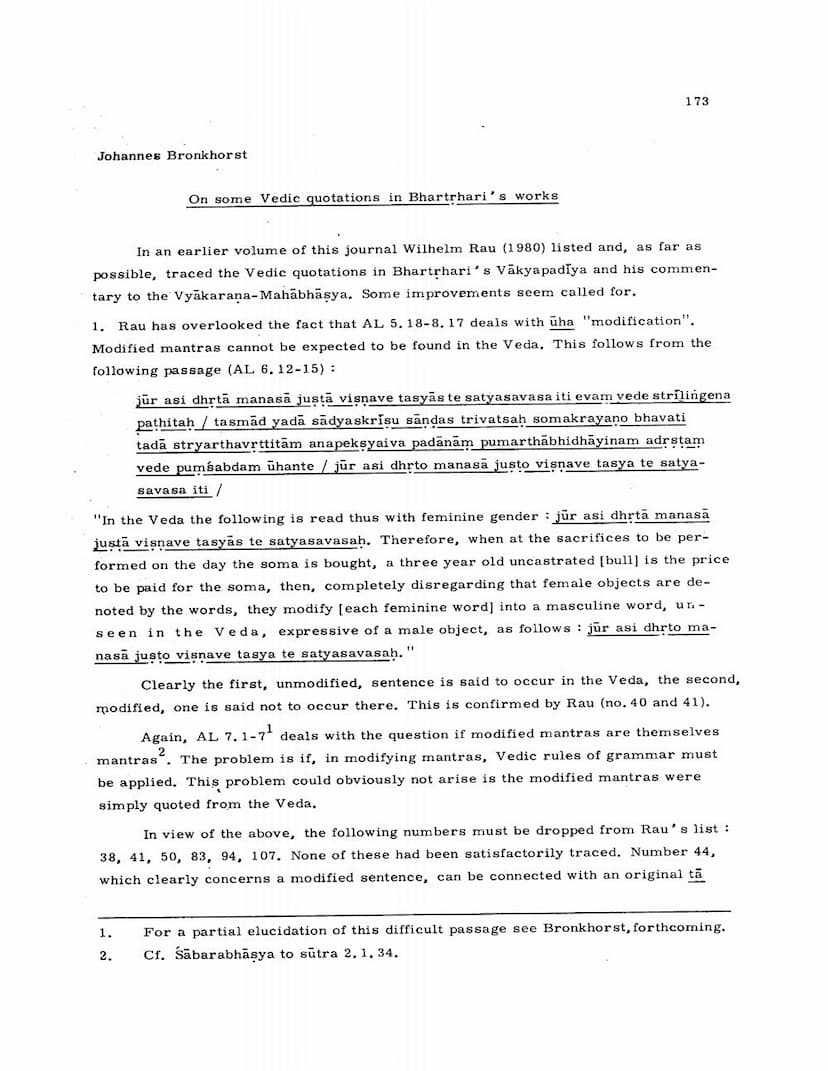
- Bronkhorst argues that Rau overlooked the significance of the concept of "ūha" (modification of mantras) as discussed in certain sections of the Aitareya Āraṇyaka (AL).
- He provides a specific passage from AL 6.12-15 to illustrate that modified mantras are not found in the original Veda. The example shows a Vedic mantra originally in the feminine gender, which is then modified into the masculine gender for specific ritual purposes. The text explicitly states that this modified version is "unseen in the Veda."
- This distinction is crucial because it implies that any quotation presented as a modified mantra should not be expected to be found verbatim in the Veda. If a quotation is indeed a modified mantra, it should be traced back to its original, unmodified Vedic source.
- Based on this understanding of "ūha," Bronkhorst concludes that several numbers from Rau's list (38, 41, 50, 83, 94, 107) must be dropped because they refer to modified sentences or were not satisfactorily traced.
- He identifies a correct trace for number 44, which clearly discusses a modified sentence, connecting it to the original mantra tasmā asmai prativedaya found in the Maitrayaniya Shakha (Manss 1, 8, 3, 1).
2. Clarification of a Specific Quotation (Number 97):
- Bronkhorst addresses number 97 in Rau's list, which pertains to AL 13.5 ff. He suggests that this passage might be corrupt.
- He proposes a partial reconstruction of the passage based on the Ratnaprakasa by Sivaramendra Sarasvati. This reconstruction involves a series of mantra-like phrases.
- Bronkhorst notes that the segment "samidhah ... vetu" appears verbatim in the Aitareya Śrautasūtra (AsvSs 2, 8, 6). The only significant difference is Bhartrhari's use of "narasamso" where the Aitareya Śrautasūtra has "tanunapad."
- He explains that both Sivaramendra Sarasvati and the commentator Gargya Narayana account for this variation, suggesting it's a recognized substitution. This explanation is supported by a possible reference in AL 13.3-4.
- Therefore, Bronkhorst concludes that number 97 can be satisfactorily traced to AsvSs 2,8,6.
Overall Conclusion:
By making these adjustments and clarifications, Bronkhorst strengthens Rau's original conclusion. He reiterates that these findings support the idea that Bhartrhari was more familiar with the Vedic texts of the Maitrayaniya school than with those of any other Vedic tradition.
The article also includes a brief, somewhat puzzling discussion about a claim by Vaidyanatha Payagunda regarding a passage in Bhartrhari's commentary attributed to the Chandogya Brahmana. Bronkhorst finds this claim mysterious, as no such passage is found in the Chandogya Brahmana or any other Samaveda Brahmana, raising questions about the state of Bhartrhari's commentary in the 18th century or potential misquotations by Vaidyanatha.