
On Relationship Between Dharmottara Santaraksita And Kamalasila
Added to library: September 2, 2025
Summary
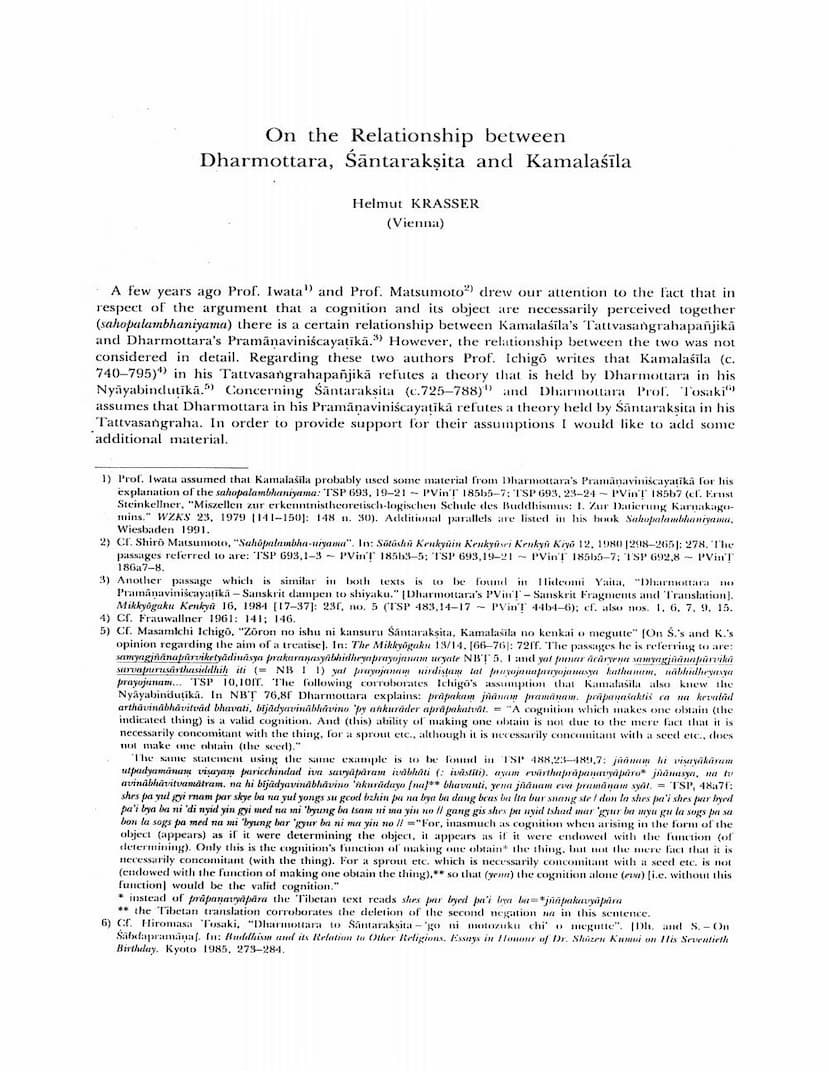
This paper by Helmut Krasser explores the intricate intellectual relationship between three prominent Buddhist philosophers: Dharmottara, Śāntarakṣita, and Kamalaśīla. Krasser argues that Kamalaśīla's Tattvasangrahapanjikā (commentary on Śāntarakṣita's Tattvasangraha) draws heavily on Dharmottara's works, particularly his Pramāṇaviniścayaṭīkā, in its discussion of valid cognition (pramāṇa).
Here's a breakdown of the key arguments and findings:
1. Kamalaśīla's Debt to Dharmottara:
- Shared Arguments: Krasser highlights similarities between Kamalaśīla's explanation of the sahopalambhaniyama (the principle that cognition and its object are perceived together) in his Tattvasangrahapanjikā and Dharmottara's Pramāṇaviniścayaṭīkā. He points to specific textual parallels, suggesting Kamalaśīla likely utilized material from Dharmottara's work for this argument.
- Refutation of Dharmottara's Views: Professor Ichigo's observation that Kamalaśīla refutes a theory held by Dharmottara in his Nyāyabinduṭīkā is also mentioned. Krasser provides evidence for this by showing that Kamalaśīla knew and engaged with Dharmottara's Nyāyabinduṭīkā, citing a passage where Kamalaśīla uses the same example and similar wording to Dharmottara.
- Definition of Valid Cognition: The paper meticulously compares Kamalaśīla's definition of valid cognition in the Tattvasangrahapanjikā with Dharmottara's definition in the Pramāṇaviniścayaṭīkā. Krasser demonstrates that Kamalaśīla's formulations are remarkably close to Dharmottara's, suggesting a direct influence. He specifically notes that Kamalaśīla's explanation of perception making an object "obtainable" or "motivating" the person towards it echoes Dharmottara's detailed explanations of these concepts.
- Borrowing of Elaborate Explanations: Krasser points out that Kamalaśīla incorporates a detailed explanation from Dharmottara's Pramāṇyaparīkṣā (a longer work) concerning how cognition motivates action, even when the person is unable to act on their own. This particular passage appears to be the only instance where Kamalaśīla uses a parallel from a Dharmottara text other than the Pramāṇaviniścayaṭīkā.
- Paraphrasing Dharmakirti: Krasser also notes that Kamalaśīla paraphrases a statement from Dharmakīrti, which Dharmottara also cites in his Pramāṇaviniścayaṭīkā. The striking verbatim correspondence, even though not marked as a quotation by Kamalaśīla, further underscores the close textual relationship.
- Dharmottara as the Source: Krasser concludes that Kamalaśīla's exposition of the theory of valid cognition in the Tattvasangrahapanjikā is not an original development but rather a collection of "fruits" harvested from Dharmottara's "field" of work, primarily his Pramāṇaviniścayaṭīkā. He considers Dharmottara's Pramāṇaviniścayaṭīkā the most likely source due to its conciseness and direct relevance to the topic.
2. Dharmottara's Engagement with Śāntarakṣita:
- Refutation of Śāntarakṣita's Theory: Krasser supports Professor Tosaki's assumption that Dharmottara, in his Pramāṇaviniścayaṭīkā, refutes a theory held by Śāntarakṣita in his Tattvasangraha. Specifically, he identifies a passage in Dharmottara's shorter Pramāṇyaparīkṣā where Dharmottara refutes Śāntarakṣita's definition of validity as "agreement with the real thing" (vastusamvāda) characterized by the "cognition in which the fulfillment of the purpose appears" (arthakriyābhasajñāna).
- Dharmottara's Counter-argument: Dharmottara argues that such a cognition of the fulfillment of a purpose is not itself valid because it doesn't actively cause that fulfillment. Instead, validity lies in the non-disagreement (avisamvāda) with the thing capable of fulfilling a purpose. This is a direct critique of Śāntarakṣita's formulation.
- Kamalaśīla's Awareness: Krasser notes that Kamalaśīla, in his commentary on Śāntarakṣita's view, is aware that Dharmottara criticized this very theory. This indicates an awareness of the intellectual debate between Dharmottara and Śāntarakṣita.
3. Chronological Implications:
- Dating Dharmottara: Based on the analysis of textual influences, Krasser suggests that Dharmottara's main period of activity falls between approximately 760 and 790 AD. This places Dharmottara slightly earlier than some previous scholarly estimations. He critiques Professor Frauwallner's dating arguments, particularly those based on the Ihan kar-catalogue and references in Kalhaṇa's Rājatarangini.
- Terminus Post and Ante Quam: Śāntarakṣita's Tattvasangraha serves as a terminus post quem (a point in time after which something must have been written) for Dharmottara's works, as Dharmottara engages with Śāntarakṣita's theories. Conversely, Kamalaśīla's Tattvasangrahapanjikā acts as a terminus ante quem for several of Dharmottara's works, including the Pramāṇaviniścayaṭīkā, indicating that Dharmottara's influential writings predate Kamalaśīla's commentary.
In summary, Helmut Krasser's paper establishes a clear intellectual lineage and significant textual borrowing from Dharmottara to Kamalaśīla, particularly in the philosophical domain of epistemology and the definition of valid cognition. It also sheds light on the critical engagement Dharmottara had with Śāntarakṣita's theories, with Kamalaśīla indirectly acknowledging this debate within his commentary. The paper contributes to our understanding of how Buddhist philosophical ideas were transmitted and developed within this important intellectual tradition.