
On Reading Texts
Added to library: September 2, 2025
Summary
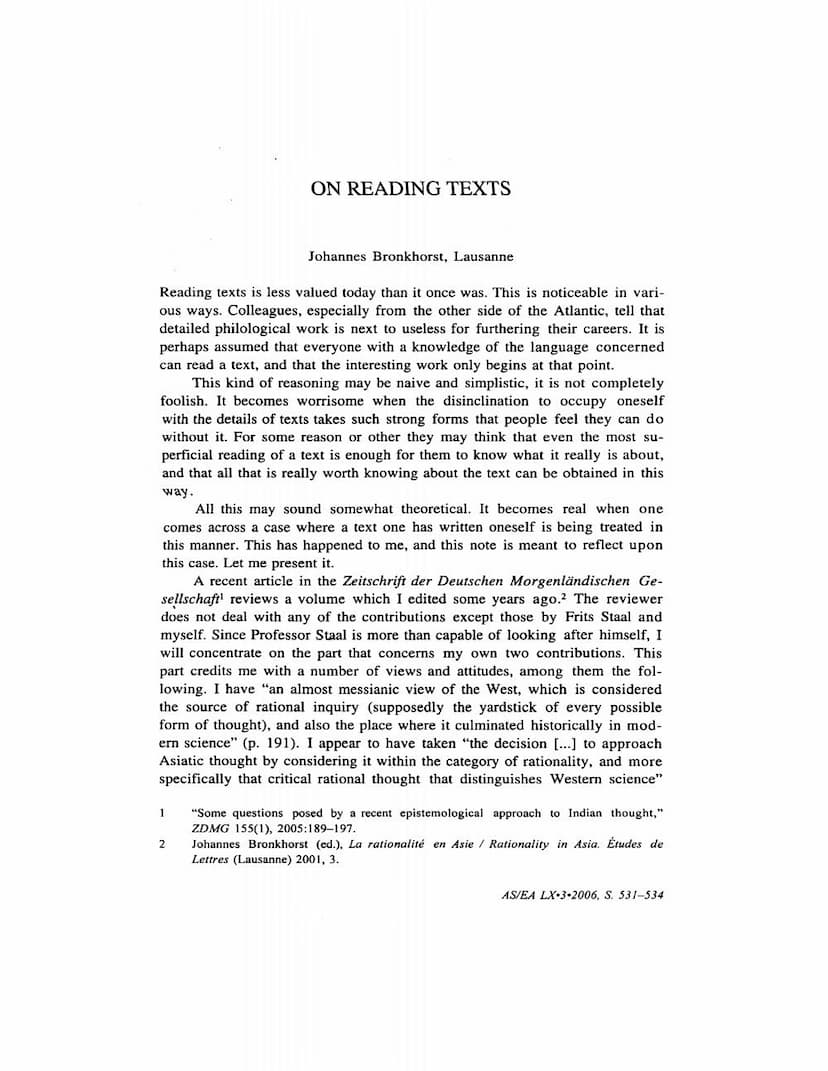
Here is a comprehensive summary of Johannes Bronkhorst's "On Reading Texts":
Johannes Bronkhorst begins by lamenting a perceived decline in the appreciation for detailed textual scholarship, particularly in academic circles where philological work is seen as less beneficial for career advancement. He suggests this attitude stems from a naive belief that anyone with a basic grasp of a language can read a text, and that the real intellectual work begins thereafter. While acknowledging this isn't entirely foolish, Bronkhorst expresses concern when this disinclination leads to the belief that superficial readings suffice for understanding a text's essence.
He illustrates this point with a personal experience: a review of a volume he edited. The reviewer focused only on his contributions and misattributed several views to him, painting him as having an "almost messianic view of the West" and seeing Western rationality as the ultimate standard for all thought. Bronkhorst vehemently denies these accusations, stating they are entirely contrary to his actual positions. He believes the reviewer is "fighting windmills," attacking views ("neopositivist") that no one actually holds, and has unfairly chosen him as a target. Bronkhorst argues that the reviewer, by mischaracterizing his work, bypasses his genuine intellectual concerns and contributions to the study of Indian thought.
Bronkhorst suggests that a proper defense against such misinterpretations is difficult, and he can only hope that readers will consult the original texts rather than relying on the faulty review. He then turns to the reviewer's interpretation of the Indian philosopher Nāgārjuna, noting that the review's high level of abstraction, influenced by Western philosophers like Gadamer and Heidegger, leads to general remarks rather than specific textual analysis.
However, the reviewer does offer some specific interpretations, particularly regarding Nāgārjuna's aim to lead thought into an impasse. The reviewer links this to Western philosophical problems, particularly in phenomenology, describing it as a process of abstracting from original experience. Bronkhorst argues that this is a European interpretation driven by reading Western philosophers, not necessarily a close reading of Nāgārjuna himself.
Bronkhorst posits that Nāgārjuna's reasoning, which leads to an impasse, is based on certain presuppositions. He proposes one such presupposition: "the words of a statement correspond, one by one, to the things that constitute the situation described by that statement." He acknowledges that other scholars might offer different formulations. The reviewer, however, dismisses this proposal as stemming from Bronkhorst's "epistemological neopositivist approach."
This leads Bronkhorst to question whether the reviewer has ever seriously engaged with Nāgārjuna's works at a fundamental level. He uses verse 7.17 of Nāgārjuna's Mulasamadhyamakakārikā as a concrete example. He contrasts his more measured approach of trying to understand the logical coherence of such verses by considering presuppositions with the reviewer's seemingly melodramatic interpretation that these verses force thought into an impasse and require "thinking the unthinkable."
Bronkhorst argues that dismissing the verse's implied conclusion without considering possible presuppositions is less generous to Nāgārjuna than attempting to understand his reasoning within its own context. He reiterates that the reviewer offers no evidence of attempting to make sense of individual passages in Nāgārjuna's work, relying instead on broad, unhelpful comparisons with Western philosophers.
In conclusion, Bronkhorst expresses his distress at being misrepresented and fears that Nāgārjuna and other Indian thinkers would be similarly bewildered by such interpretations. He hopes that other researchers will dedicate more time to in-depth textual study, as the reviewed article serves as a cautionary example of how not to engage with academic texts.