
On Quadruple Division Of Yogasastra
Added to library: September 2, 2025
Summary
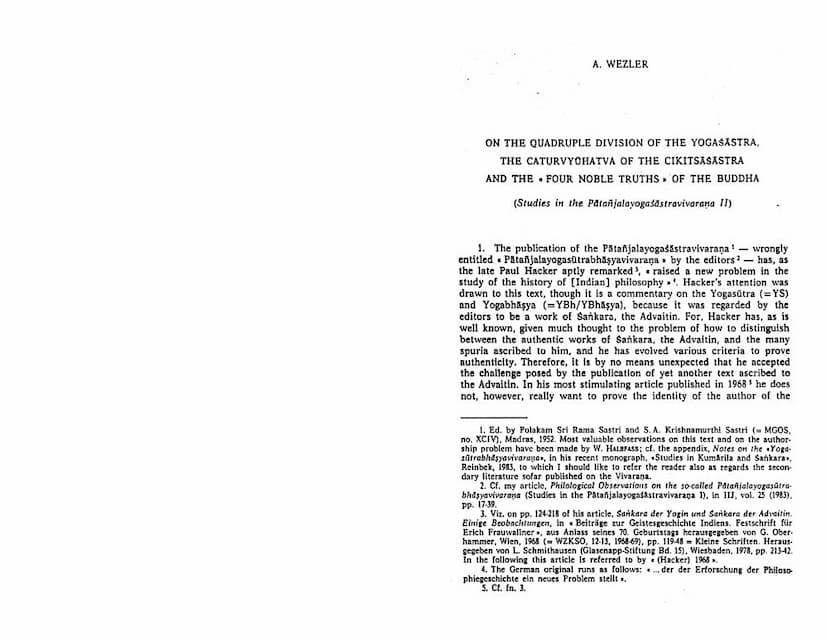
This document, "On the Quadruple Division of the Yogasastra" by A. Wezler, is a scholarly article that delves into the concept of a "quadruple division" (caturvyuhatva) and its presence in various Indian philosophical and religious traditions. It primarily engages with the work of Paul Hacker and attempts to clarify the origins and significance of this divisional scheme.
Here's a comprehensive summary of the key points:
1. The Problem of the Vivarana and Sankara's Authorship:
- The article begins by discussing the Patañjalayogasastravivarana, a commentary on Patanjali's Yoga Sutras. This text was controversially attributed to the Advaitin philosopher Sankara by its editors.
- Paul Hacker's research is central here, as he explored the authenticity of works attributed to Sankara and found the Vivarana to be a significant challenge. Hacker proposed that if the Vivarana were indeed by Sankara, it would likely be his earliest work and could help explain Yoga influences in his later Vedanta writings.
2. The Quadruple Division of the Yogasastra:
- Core Concept: The Vivarana, at its outset, presents the Yogasastra as being divided into four parts (vyuha), drawing an analogy to Cikitsasastra (the science of therapeutics).
- The Four Parts:
- Samsara, full of Suffering, is to be avoided (analogous to Illness - roga in therapeutics).
- The cause of samsara is the connection of the subject with the object based on nescience (analogous to the Cause of Illness - roga-hetu).
- The means by which samsara is avoided is the unswerving lucidity of discriminating knowledge (analogous to the Remedy - bhaiṣajya).
- When this has been attained, nescience is eliminated, and the connection of subject and object ceases entirely; that is avoidance, absolute independence (analogous to Health - arogya).
- Vivarana's Assertion: The author of the Vivarana claims this division is present in Patanjali's Yoga Sutras, specifically starting from Sutra 2.15.
3. Critiquing Hacker's Interpretation:
- Wezler argues that Hacker overlooked or downplayed the fact that the quadruple division is already present in the Yoga Bhasya (YBh) and even in the Yoga Sutras themselves.
- He contends that Hacker's assertion that the Yoga Sutras themselves are not divided in this manner is demonstrably wrong.
- Wezler points out a key difference in the Vivarana compared to the YS and YBh: the reversal of the order of the last two members (remedy and health/avoidance). He argues this transposition in the Vivarana is likely due to its introductory purpose of highlighting the ultimate goal (prayojana).
4. Comparison with Other Traditions:
- Four Noble Truths of Buddhism: Wezler acknowledges a structural similarity between the Yoga quadruple division and the Buddhist Four Noble Truths. However, he carefully analyzes the Buddhist terms (like dukkhasamudaya and dukkhanirodha) and suggests that while there's a conceptual correspondence, the precise nuances and historical origins are complex. He disputes Hacker's assertion that a "chapter on the final goal" is a uniquely Brahmanical addition, arguing that the Buddha also presented a path to liberation.
- The Science of Medicine (Cikitsasastra):
- The YBh is credited with first introducing the comparison of Yoga to medicine.
- Wezler investigates the presence of this quadruple division in Indian medical texts, notably the Carakasamhita. He finds a similar fourfold division (disease, cause of disease, cure, and recovery/prevention of recurrence).
- He notes that while medical texts refer to this scheme, it's not always the basis for the internal organization of the texts themselves.
- He also examines the possibility of Buddhist influence on medical texts and vice versa, concluding that the evidence for direct influence in either direction regarding the quadruple division is not definitive, but the division itself was likely common knowledge.
- Nyaya Tradition: Wezler explores the Nyaya school, particularly the commentary by Vatsyayana on the Nyaya Sutras (NS 1.1.1). He argues that the Nyaya tradition also presents a fourfold division of "objects of valid cognition" (arthapada) leading to liberation: "that which is to be avoided," "that which brings it forth," "absolute avoidance," and "the means leading to it."
- Historical Chronology and Hypothesis: Wezler considers the relative chronology of these traditions. He proposes a hypothesis that the Buddha might have been the discoverer of this quadruple division, which was then adopted by the author of the Yoga Sutras (noting other Buddhist influences in YS), and subsequently found its way into medical texts like the Carakasamhita. This medical framework then influenced the YBh and the Buddhist Vyadhisutra. This hypothesis challenges the common assumption that medicine, as a worldly concern, must have originated the concept.
5. Key Arguments and Methodological Points:
- Emphasis on Method: Wezler stresses the importance of rigorous philological and historical analysis, urging against accepting attributions or interpretations without critical examination. He advocates for treating the authorship of the Vivarana as an unsolved problem and for analyzing influences without preconceived notions.
- Discrepancies and Similarities: The article meticulously compares the terminology, order, and conceptual nuances of the quadruple division across the different texts. It highlights both striking similarities and subtle but significant differences.
- Critique of "Commonplace" Assumptions: Wezler challenges widely held scholarly views, particularly the notion that the Buddha's Four Noble Truths were directly "borrowed" from medical practice without sufficient evidence. He suggests that superficial similarities can lead to unwarranted historical claims.
- The Purpose of the Analogy: The comparison with medicine serves not just as an illustration but also to elevate Yoga to a superior form of therapy, curing the fundamental "illness" of existence, which medicine cannot address.
In essence, the article is a detailed comparative analysis of the "quadruple division" concept across Yoga, Buddhism, medicine, and Nyaya. It critically examines scholarly interpretations, particularly those of Paul Hacker, and proposes a nuanced hypothesis about the historical development and transmission of this concept, suggesting a possible Buddhist origin and subsequent adoption by other Indian traditions.