
On Asrayasiddha
Added to library: September 2, 2025
Summary
Here's a comprehensive summary of Toru Funayama's paper "On Aśrayasiddha," based on the provided text:
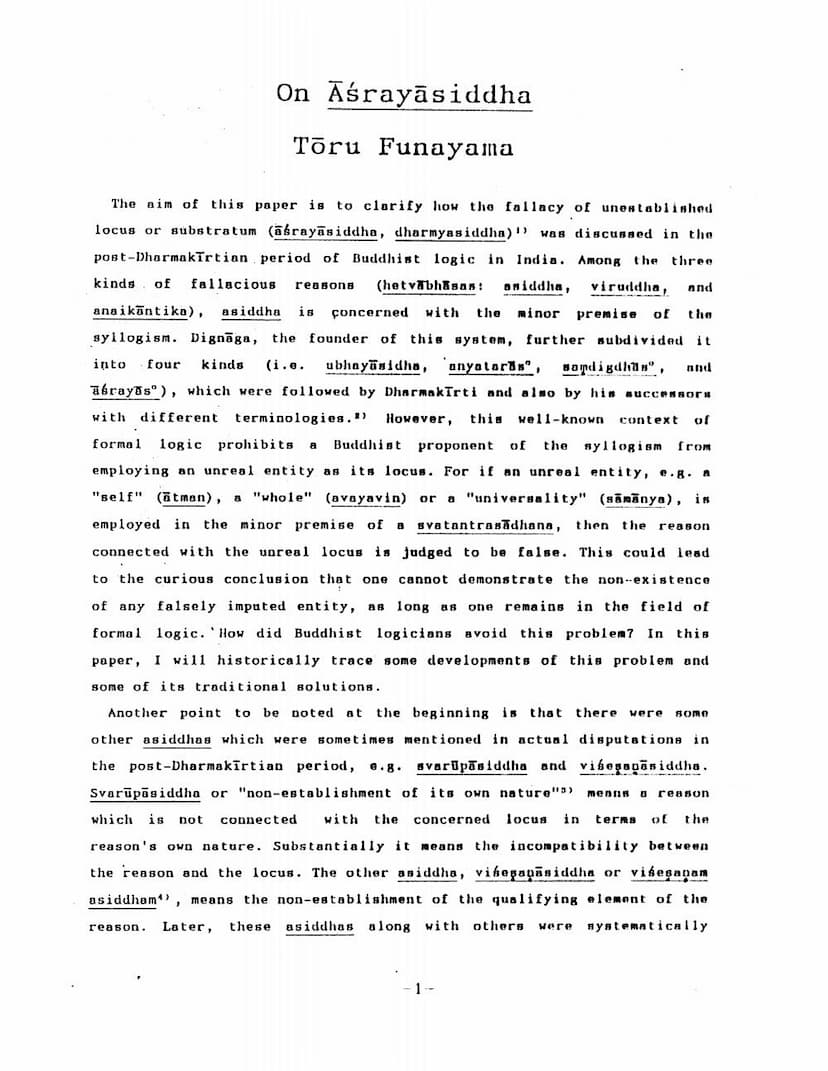
This paper by Toru Funayama delves into the historical development and traditional solutions concerning the fallacy of "unestablished locus or substratum" (āśrayāsiddha or dharmyāsiddha) within Indian Buddhist logic, specifically in the post-Dharmakīrti period.
The Core Problem: The Fallacy of Aśrayāsiddha
- Definition: Aśrayāsiddha is one of the three main types of fallacious reasons (hetvābhāsa), concerned with the minor premise of a syllogism. It signifies that the subject (the locus or substratum) upon which the reason is applied is not established or is unreal.
- Dignāga and Dharmakīrti's Classification: Dignāga, the founder of Buddhist logic, identified four subtypes of asiddha, including ubhayāsiddha, anyatorāsiddha, sopadhika, and āśrayāsiddha. Dharmakīrti and his successors largely followed this, though with differing terminology.
- The Dilemma for Buddhists: A fundamental tenet of Buddhist philosophy is the rejection of inherently existing entities like "self" (ātman), "whole" (avayavin), or "universality" (sāmānya). If Buddhist logicians were prohibited from employing such unreal entities as the locus in their syllogisms (especially in svatantrasādhana – independent proofs), they would face a curious paradox: they couldn't logically demonstrate the non-existence of these imputed entities.
Key Aspects and Developments Discussed:
-
Types of Syllogisms: The paper highlights two main types of syllogisms relevant to āśrayāsiddha:
- Anupalabdhi-type: Used to refute an entity that the opponent claims is real (e.g., a "whole").
- Vyatireka-type: Utilizes the contraposition of the major premise to exclude the possibility of an eternal entity (e.g., demonstrating non-momentariness).
- Dharmakīrti's Stance: Dharmakīrti argued that for vyatireka statements, especially in cases of svabhāvahetu (reason of own nature) and kāryahetu (reason of causal relation), the subject (locus) does not necessarily need to be existent. However, for anupalabdhi (non-perception) arguments, the locus must be real. This distinction is crucial.
- Exception to the Rule: The fallacy of āśrayāsiddha does not occur in anupalabdhi inferences of the form "Here there is no X, because of Y," where "here" (a place) is the locus, not "X."
-
Historical Solutions and Debates: The paper traces the evolution of addressing this problem through the views of various Buddhist logicians:
-
Devendrabuddhi: A disciple of Dharmakīrti, Devendrabuddhi commented on refuting the "oneness of a whole" using syllogisms where the whole is the locus. While his arguments were considered prasangasādhana (reductio ad absurdum arguments), the minor premise itself was often not admitted by opponents, raising questions about its strict formal validity in this context.
-
Śāntarakṣita and Kamalaśīla:
- Kamalaśīla, in his Tattvasaṅgrahapañjikā (TSP), clearly stated that an unreal entity can be a locus if the syllogism is a prasanga. This was a significant, albeit not final, solution.
- He later elaborated in his Madhyamakāloka that an unreal entity could serve as a locus even in svatantrasādhana because all terms are merely products of differentiation (vyavacchedamātra). This radical idea, however, had limited influence due to its composition in Tibetan.
- Another solution discussed by Śāntarakṣita and Kamalaśīla involved using a "gross object" (sthūla) as the locus, which both proponent and opponent could admit, indirectly referring to the "whole." This avoided the āśrayāsiddha problem because the locus was perceived as real.
-
Dharmottara: Also employed similar syllogisms using a gross object as the locus, offering a transitional solution.
-
Later Buddhist Logicians (Jñānakīrti and Ratnakīrti): These logicians, in the final period of Buddhist logic, ultimately declared that an unreal locus like a "sky-flower" could be validly used if the major premise was negative and contrapositional.
-
Criticisms from Naiyāyikas (Bhāsarvajña, Vācaspati, Vyomasiva): Critics from the Nyaya and Vaiseṣika schools strongly condemned Buddhist syllogisms that used unreal loci in svatantrasādhana, labeling them as āśrayāsiddha. They distinguished between prasanga and svatantrasādhana.
-
Āśoka: Āśoka's Avayavinirākaraṇa provides a refined version of the "gross object" solution. He explicitly stated that the locus was a perceptible gross object, not the abstract "whole." He argued that refuting the oneness of the whole could be achieved by demonstrating that the gross object (which is identical to the whole) is connected with contradictory properties. This solution, rooted in Śāntarakṣita and Dharmottara, was highly sensitive to the āśrayāsiddha and maintained the traditional view that the locus should be real, thus presenting a svatantrasādhana. This approach was effective for entities that had a real counterpart (like the whole being the gross object) but not for purely fictitious entities like "sky-flower."
-
Concluding Remarks:
The paper concludes by noting that while Āśoka's solution was significant, it was limited to cases where an unreal entity had a perceptible counterpart. The problem of using purely fictitious entities as loci (like "sky-flower" in demonstrating momentariness) remained until Jñānakīrti and Ratnakīrti provided the solution of using negative and contrapositional major premises. Further research is needed to fully explore these later developments.
In essence, Funayama's paper meticulously traces the intellectual journey of Buddhist logicians in grappling with the philosophical and logical challenges posed by the fallacy of āśrayāsiddha, showcasing various innovative strategies and debates over centuries to reconcile their ontological commitments with rigorous argumentation.