
Number Of Pramanas According To Bhartrhari
Added to library: September 2, 2025
Summary
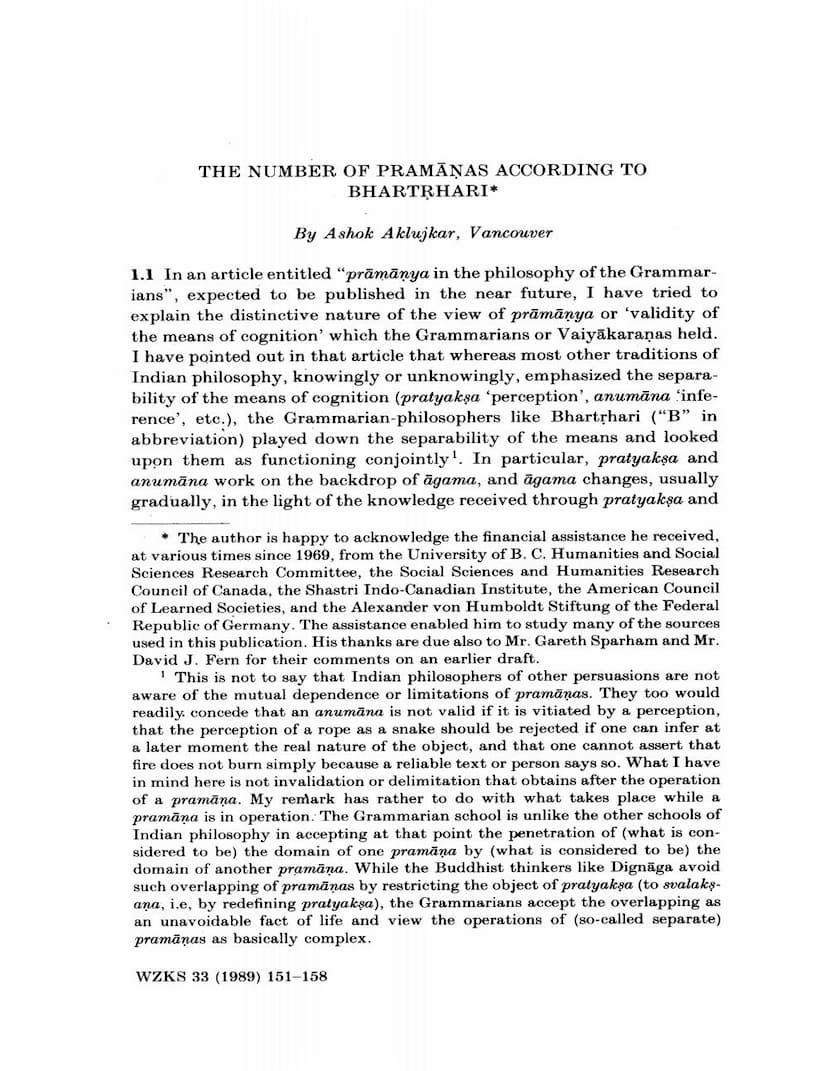
Here's a comprehensive summary of Ashok Aklujkar's article "The Number of Pramāņas According to Bhartṛhari," focusing on the core arguments and conclusions:
The article explores the number of valid means of cognition (pramāņas) as understood by the Grammarian philosopher Bhartṛhari. Aklujkar's central thesis is that Bhartṛhari, in his philosophical framework, primarily accepts three pramāņas: perception (pratyakṣa), inference (anumāna), and authoritative testimony or scripture (āgama).
Key Arguments and Differentiations:
- Interconnectedness of Pramāņas: Aklujkar highlights a significant departure from other Indian philosophical traditions. While many schools emphasize the separability of pramāņas, Bhartṛhari, according to Aklujkar, stresses their interdependence and conjoint functioning. Pramāņas don't operate in isolation but influence and inform each other. For instance, perception and inference operate against the backdrop of āgama, which itself can be revised in light of new perceptual and inferential knowledge. This view stems from Bhartṛhari's understanding of language's centrality and its multi-layered nature.
- Addressing the "Number" Question: Aklujkar acknowledges that Bhartṛhari doesn't explicitly state a definitive number of pramāņas. This leads to differing interpretations among scholars. The article aims to clarify this by examining Bhartṛhari's key terminology in his works like the Vākyapadīya (Trikāṇḍī) and Mahābhāṣyatīkā (Tripādī).
- The Core Trio: Pratyakṣa, Anumāna, Āgama: The article argues that the recurring use of terms like pratyakṣa, anumāna, and āgama in Bhartṛhari's discussions on validity strongly suggests these are the fundamental pramāņas he accepts. This is further supported by the fact that Bhartṛhari doesn't reject pratyakṣa or anumāna, and he explicitly argues for the validity of āgama.
- The Influence of Yoga and Patañjali: The author notes that the Yogasūtra (attributed to Patañjali) also acknowledges these same three pramāņas, suggesting a shared philosophical lineage or influence. Patañjali, Bhartṛhari's "guiding light" in grammar, also seems to primarily recognize these three.
- Rejection of Additional Pramāņas (like Pratibha and Arthāpatti):
- Pratibha (Intuitive Insight/Flash of Understanding): While pratibhā plays a crucial role in Bhartṛhari's philosophy, Aklujkar argues that it is not a separate pramāṇa in the same way as the others. Pratibhā is viewed as knowledge itself from a particular perspective, and it can arise from all types of linguistic expressions. Crucially, Bhartṛhari identifies āgama as the principal cause of pratibhā, making it unlikely for pratibhā to be an independent means of knowledge. Extraordinary perceptions attributed to intensified sensory capacities are ultimately dependent on āgama.
- Arthāpatti (Implication/Presumption): Aklujkar finds no strong evidence that Bhartṛhari accepts arthāpatti as a distinct pramāṇa. He suggests that statements in Bhartṛhari's work might even rule out its acceptance, except perhaps as a hermeneutical device. He also critiques interpretations that attribute arthāpatti to Bhartṛhari's predecessors based on weak evidence of awareness of implied meaning.
- Critique of Other Interpretations:
- Vrşabha's Commentary: The article addresses Vrşabha's commentary, which some scholars interpret as suggesting Bhartṛhari accepted means of knowledge beyond the traditional three. Aklujkar argues that Vrşabha's interpretation is not supported by the textual context and that Bhartṛhari's phrases in those passages likely refer to cases of extraordinary perception rather than new pramāņas.
- Mokṣākaragupta's View: The article considers Mokṣākaragupta's statement that Grammarians accept only two pramāņas (pratyakṣa and śabda). While acknowledging that this can be defended in a sense (emphasizing the interplay of pratyakṣa and āgama as oars navigating life), Aklujkar finds it less defensible than the acceptance of three, especially given the evidence for anumāna. He also clarifies that Bhartṛhari's āgama is broader than the narrow sense of 'testimony' used by other thinkers.
Conclusion:
Ashok Aklujkar concludes that the most consistent interpretation of Bhartṛhari's philosophy, based on textual evidence, is that he primarily recognizes three pramāņas: pratyakṣa, anumāna, and āgama. While these pramāņas are understood to function in a highly integrated manner, and concepts like pratibhā are significant, they do not constitute independent means of knowledge in the way the core three do. The article aims to correct interpretations that attribute additional pramāņas or a significantly different number to Bhartṛhari.